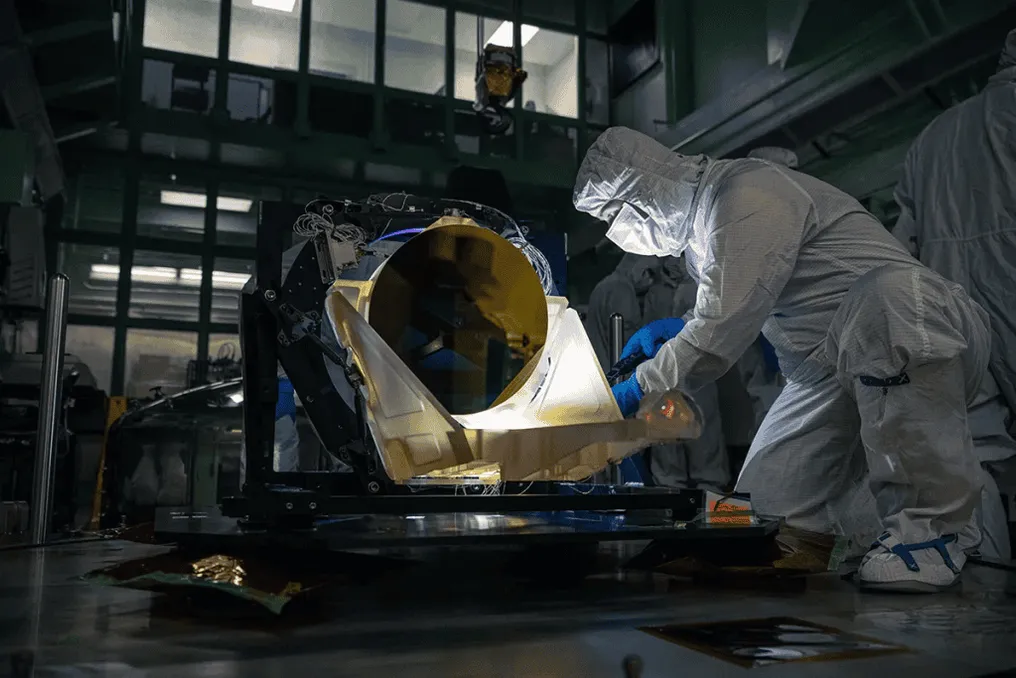
NASA has progressed in the development of a telescope intended for the LISA (Laser Interferometer Space Antenna) mission, a space observatory designed to identify gravitational waves, which are small distortions in the fabric of spacetime. On October 8, 2026, the agency announced a new phase of this project, which involves the construction of a test unit by L3Harris Technologies.
This equipment, called the Engineering Test Unit, will be fully designed, assembled, and integrated by the company. This unit represents one of the final phases before the production of instruments that will be sent into space. The LISA mission, led by the European Space Agency (ESA), is scheduled for launch in the mid-2030s, with NASA's collaboration in providing telescopes, other components, and scientific and engineering support.
The project envisions the use of three spacecraft orbiting the Earth, forming a triangular structure with 2.5 million kilometers on each side. Each vehicle will be equipped with two telescopes, whose function is to simultaneously transmit and receive infrared laser beams between the spacecraft themselves.
Through this system, the mission will be able to measure minuscule variations in the distances between the vehicles. Such changes can signal the passage of gravitational waves, enabling the study of phenomena that currently cannot be detected by terrestrial facilities under the same conditions.
According to Ira Thorpe, the scientist responsible for the project at NASA, the measured variations will be less than the width of a helium atom. Even so, the instruments will have the capacity to identify low-frequency gravitational waves, expanding observation opportunities of the Universe. Targets include detecting collisions of black holes located billions of light-years from Earth. The mission will also allow mapping of compact pairs of white dwarfs, neutron stars, and stellar-mass black holes in the cosmic neighborhood of Earth, in addition to assisting in gravity research.
The telescopes will be manufactured entirely using Zerodur, an amber-toned glass and ceramic composite used in applications requiring high precision. This material is chosen due to its resistance to shape changes across a wide range of temperatures, which is crucial for maintaining instrument stability.
L3Harris had already supplied a prototype to NASA in 2024, which was used in the engineering development of this new unit. Ritva Keski-Kuha, head of the LISA telescope program at the Goddard Space Flight Center, reported that tests conducted with the prototype generated valuable data that will be incorporated into the next version of the equipment.
This new unit will constitute the final testing stage before launch and will represent the first delivery of an optical telescope to ESA. In June 2026, the team also delivered a structural model of the apparatus, built in metal and not glass.
Gravitational waves were predicted by Albert Einstein's theory of general relativity, published in 1916, and were first detected by terrestrial observatories in 2015. They are generated when massive bodies experience acceleration, such as when two stars orbit each other. These perturbations travel through spacetime at the speed of light and are unaffected by objects crossing their path, characteristics that make them a powerful tool for investigating cosmic events.
Each LISA spacecraft will also contain a test mass, a cube of gold and platinum that will remain in free floatation. The vehicles will control the surrounding environment of these components to ensure they move only under the influence of gravity. In 2016, the ESA's LISA Pathfinder mission proved the feasibility of reducing non-gravitational forces affecting these masses to the level necessary for gravitational wave detection. In addition to telescopes, NASA's contribution to LISA includes the laser system, devices to manage electrical charge accumulation on the test masses, and data analysis tools designed to identify and characterize the origins of the signals.