In many college campuses, students face the same problem: they urgently need to print a document, but the nearest Xerox shop has a long queue. Some people print 50 pages, others get their project bound, and you only need two pages, but you have to wait a long time.
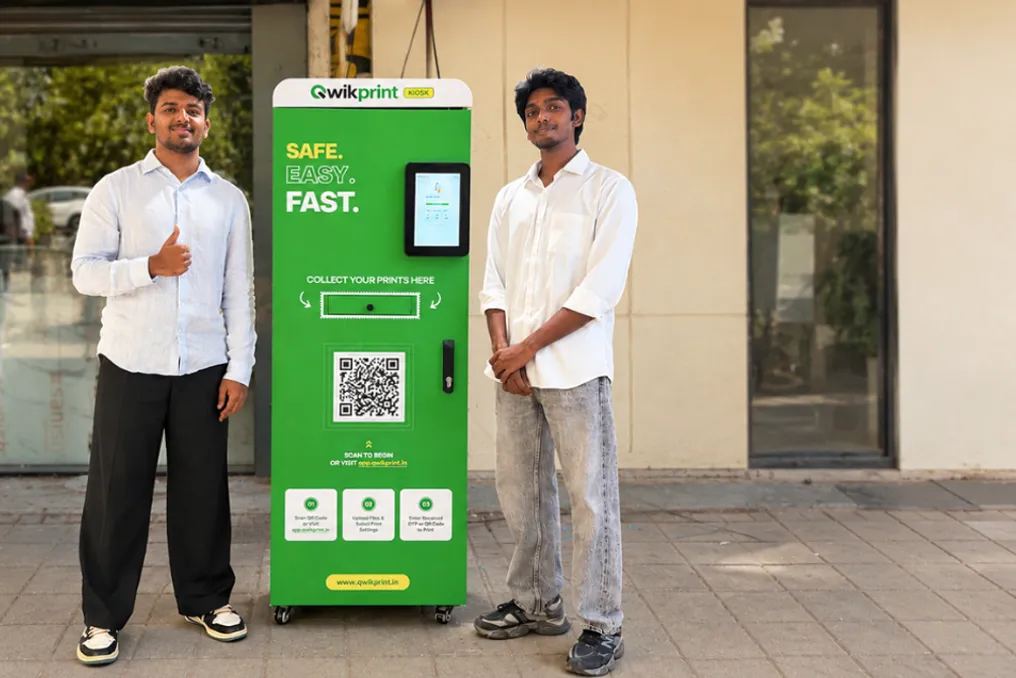
Even if there are several such shops around the campus, the problem often remains the same: more points mean more queues. For entrepreneurs Pranav Senthil and Subeshwar P from Chennai, this daily frustration became the starting point for the startup QwikPrint, which creates self-service printing kiosks that function like ATMs.
Instead of handing the file to a seller and waiting, users can upload the document, select printing settings, pay digitally, and pick up the printed sheets themselves.
A familiar problem viewed differently
The idea arose from the founders' personal experience. Pranav recalls that while studying on campus, there were about 18 Xerox shops, but waiting for printing took approximately 45 minutes, regardless of whether one page or a hundred was needed. Subeshwar experienced a similar situation when he urgently needed to print a health insurance bill and spent almost an hour finding a suitable shop and waiting.
This led them to a seemingly simple question: if there are so many Xerox shops, why do people still have to wait so long? They realized that the issue might not be a lack of printers, but the method of accessing the service. Every transaction depended on the presence of a person at the counter, the shop being open, and the flow of the queue.
QwikPrint was developed to eliminate some of these bottlenecks.
Printing without a cashier
The process is designed to be quite simple. The user scans a QR code, uploads the document from a phone or laptop, selects parameters such as the number of copies and printing settings, makes a digital payment, and then receives the printout through a system based on a One-Time Password (OTP).
The company claims that the entire process takes about 60 seconds. The kiosks are also designed to operate without staff and 24/7, solving another common campus problem—the need to print a document after the nearest shop closes.
There is also a less obvious concern. Students and professionals often print forms, identification documents, and other files that they do not want another person to handle. QwikPrint states that its system uses encryption and privacy-focused measures so that uploaded documents are accessible only to the user.
From university frustration to startup
QwikPrint was launched in June 2025. Since then, its kiosks have been installed in educational institutions such as Rajalakshmi Engineering College, Dhaanish Ahmed College of Engineering, and PSG iTech. According to the company, as of May 2026, nearly 45 kiosks have been installed in cities including Chennai, Bangalore, Hyderabad, Pune, and Delhi.
However, achieving this goal was not as simple as just putting a printer in a box. The founders had software development experience, but the hardware presented a completely different set of challenges. Manufacturers were often willing to produce hundreds of machines, but finding suppliers willing to build just a few prototypes for testing was harder. Another obstacle was convincing universities, suppliers, and potential partners to trust two young founders.
Can printing become an on-demand service?
For something as mundane as printing, the broader idea might not be replacing Xerox shops, but changing where and how the service is provided. QwikPrint sees potential for these kiosks in places where people regularly need documents in a hurry, including universities, hospitals, and government offices.
It remains unclear whether self-service printing will become as common as ATMs. But the problem that sparked the idea is surprisingly familiar.
Sometimes a startup doesn't begin with futuristic technology or grand predictions about the future. Sometimes it begins with waiting in a 45-minute queue when all you needed was a single sheet of paper.