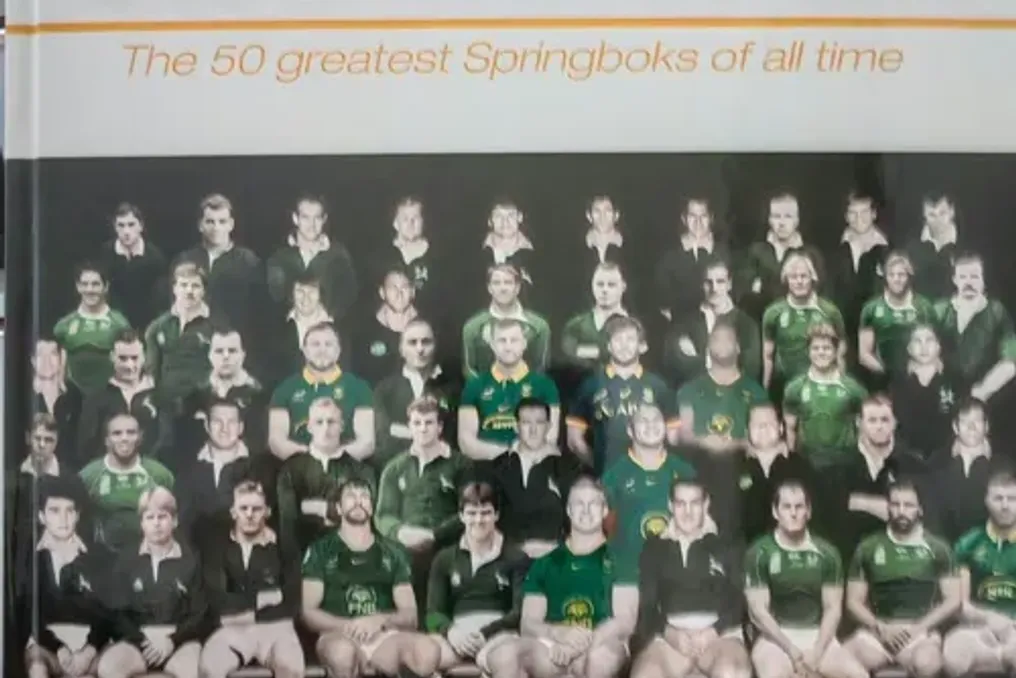
Compiling a list of the 'greatest of all time' in sports is one of the most controversial tasks. Nevertheless, the authors of the book The Chosen undertook this attempt, ranking the 50 greatest Springboks players since the South African national team's first match in 1891.
Among the authors of this work are journalist Andy Colkhuhn, who became an administrator for SA Rugby, and the late Paul Dobson, father of Stormers coach John. From the beginning, they acknowledge that this task involves numerous difficulties.
Choosing the best Springbok team to face the All Blacks on Saturday would spark heated discussions, and compiling a ranking of the country's best players from one to fifty presents an even more complex challenge. This is the third edition of The Chosen, first published in 2003, and the latest rankings differ significantly from previous editions. This is not surprising, as new stars emerge, old legends are re-evaluated, and the outstanding success of the era of Rassie Erasmus has added fresh names to this debate.
The second edition in 2011 highlighted outstanding players from the era of John Smith, including the former captain, as well as Victor Matfield, Schalk Burger, Frikkie du Preez, Bryan Habana, Jacques Fourie, Duane Vermeulen, Juan Smith, and Percy Montgomery. However, to make room for these players, names such as Gary Tahmann, Mark Andrews, Ruben Kruger, and Francois Pienaar had to be excluded.
The new 2026 edition updates the ranking, including the achievements of the current generation, such as Malcolm Marx, Cheslin Kolbe, Eben Etzebeth, Siya Kolisi, Handré Pollard, and Pieter-Steph du Toit. A question arises: how does one compare players from different eras, especially those whose careers began before the advent of television and whose performances cannot be assessed by modern video footage?
The authors explain in the introduction that they adopted the view that 'a great player from any era, transplanted to another, would be just as great in their new era if subjected to the same advantages and disadvantages of that time.' Furthermore, they relied on extensive study of personal accounts of performances to assess the greatness of players whose careers developed long before modern rugby.
There is another, deeper problem when compiling such a list: how to rank the greatest South African players when much of the country's rugby history was closed off to the general public regarding selection for the Springboks? The authors do not shy away from this uncomfortable reality. They write: 'What this book cannot do is correct past imbalances,' before speculating on who among Mayolas, Mbikos, Mkatas, Dayers, and Jabaars might represent South Africa if the racial restrictions of the time had not dictated that teams consist of 15 white players.
The book also dedicates a chapter to outstanding Black players before the unification period, acknowledging the history that any honest account of Springbok rugby must confront.
Interestingly, the answer to who occupies the top of this fiercely debated ranking remained unchanged across all three editions. The authors consistently consider Danie Gerber the greatest Springbok player of all time—a remarkable endorsement of this spectacular centre who scored 24 touchdowns in 19 matches in the 1980s.
Readers will undoubtedly have their own opinions, and the rankings will certainly cause controversy. But for the author, the true pleasure of The Chosen lies not so much in the debates over positions, but in the stories behind the names. The book, dedicated to 50 outstanding players, contains many fascinating anecdotes and details about the personalities who shaped Springbok rugby.
One of the favorite moments is the story of Barry 'Fairy' Hitchen, a formidable forward who led South Africa in its first victory over Britain in 1896. Hitchen wore the green jersey of his Cape Town rugby club, Old Diocesans, and this color subsequently became synonymous with the Springboks. It is such details that bring rugby history to life, reminding us that the legacy of the game is built not only on victories, records, and rankings, but also on the personalities and stories that remain after the final whistle.