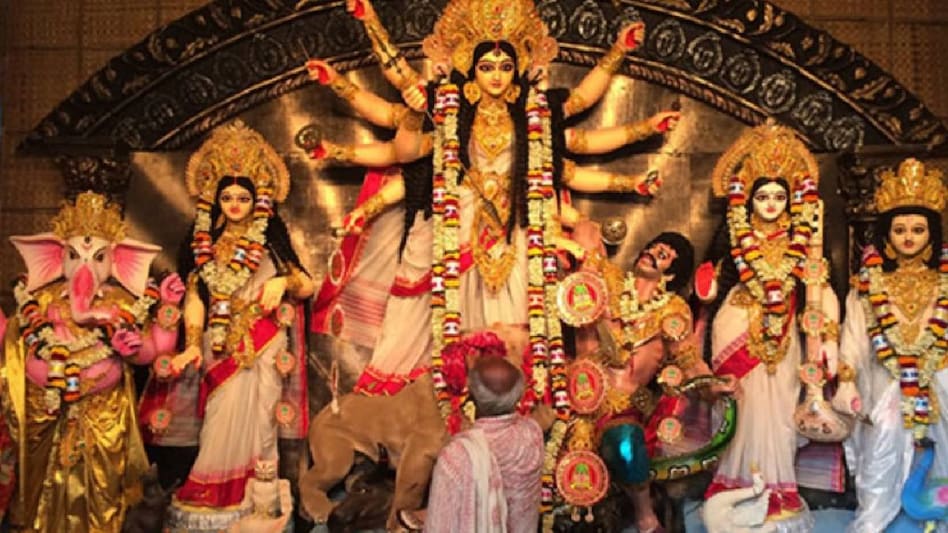
The beginning of Sharadiya Navaratri marked the start of the celebration. The first day is dedicated to worshipping Goddess Shailaputri. Navaratri begins on the first day of the Ashwin lunar month according to Hindu tradition. This period holds special significance in Hindu culture.
During the nine days, rituals are performed to worship various aspects of Mother Durga. Devotees observe fasts, recite the Durga Saptashati, and perform morning and evening aartis, striving to appease the Goddess.
According to religious beliefs, performing the aarti of Mother Durga brings prosperity into the home and removes life's difficulties. There is a special, widely recited aarti that praises many of her forms.
Significance of Mother Durga's Aarti
During Navaratri, worshiping Mother Durga is considered incomplete without performing the aarti. In religious traditions, the aarti is viewed as the concluding and most important stage of worship. It is believed that through the aarti, devotees express their devotion and reverence to the Goddess.
This well-known aarti describes the Mother in her Kali form as a goddess of mercy. She is portrayed not only as a fierce figure but also as a source of tenderness for her followers. Titles mentioned include Ambe, Kali, Sinhvahini, Ma, Ashtabhuja, Lakshmi, Sati, and Khapparavali. Furthermore, the text mentions Shivaji, Vishnuji, and Bhairav.
Therefore, there is a belief that performing this aarti brings fruits equivalent to five aartis.
Below is the aarti itself, which can be included in your rituals:
Ambe tu haiyagadambe Kali, jai Durge khapparavali
Tere hi gun gave bharthi, o maiya ham sab utore teri aarti
Tere bhakt jono pe mata bhid padi haiya bhid padi haiya
Danav dal par tut pado maa karke sing savari karke sing savari
Sau-sau sihon se bhi balshali, haiya ashtabhujaon vali
Dushto ko tu hi lalkarati
O maiya ham sab utore teri aarti
Ambe tu haiyagadambe Kali, jai Durge khapparavali
Tere hi gun gave bharthi, o maiya ham sab utore teri aarti
This prayer emphasizes the pure bond between mother and child. Even if children behave improperly, the mother always shows compassion. She is a source of grace, pouring out nectar, and relieves the suffering from sorrow.
The plea is repeated: 'O Maiya, we all offer your aarti...'
The prayer also contains a request not for wealth, gold, or silver, but merely for a small corner at her feet. It is described as one that corrects what is flawed and protects honor, as well as adorning the virtues of holy women.
In the final parts of the aarti, help is sought to overcome difficulties, asking her to place a hand of blessing on the head. They ask for the cup to be filled with spiritual joy, as well as for her to assist in the affairs of her followers.
At the end of the aarti, scenes are mentioned where Shiva-Shankar rides a chariot, Garuda rides an elephant, and the Mother herself rides a lion, arriving to fulfill wishes. She continues to be a source of mercy and deliverance from grief.