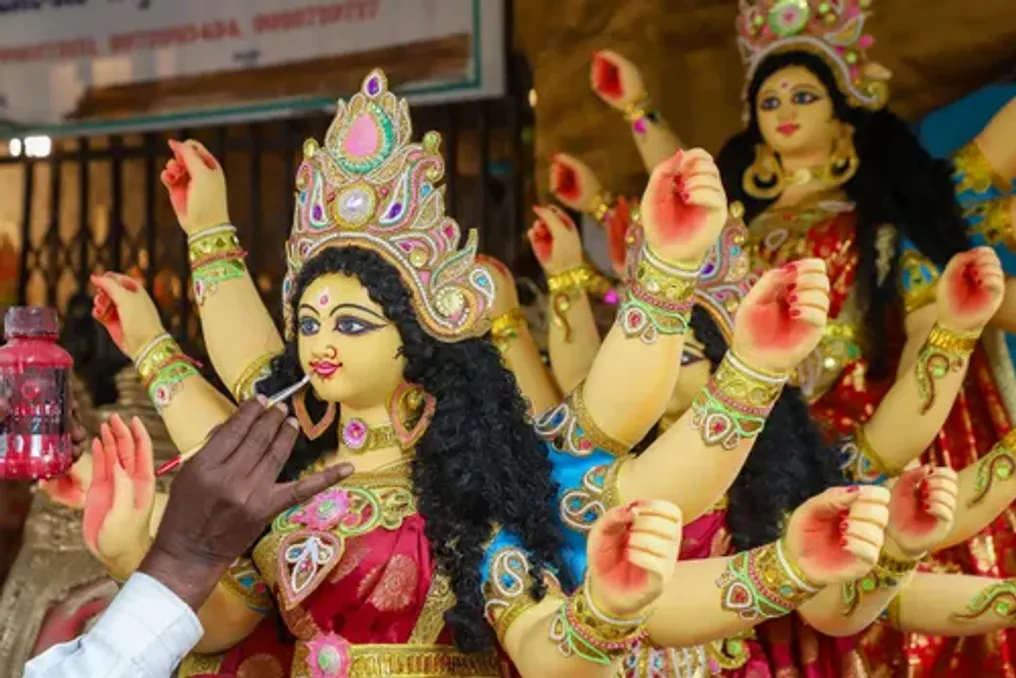
The festival of Navaratri poses a fundamental question to people: what must change within us on the tenth day after nine nights of fasting and devotion? It is easy to observe the festival, but much harder to achieve inner transformation. Performing the ritual, offering prayers, and participating in traditions passed down through generations are simple. The true test of devotion manifests later: in our interactions, the decisions we make, our patience, our ability to overcome mistakes, and the compassion we show others.
For this reason, Navaratri goes far beyond the nine nights of religious rites; its core is a call for inner transformation. From October 11th to 19th, millions of Hindus will worship various manifestations of the Divine Mother. During this time, homes will be purified, altars decorated, temples filled, and communities gathered for celebration. However, beneath all the colors, music, dances, and rituals lies a deeper purpose—to awaken the qualities embodied by this festival within ourselves.
The nine nights can be seen as a journey from weakness to strength, from ignorance to wisdom, from fear to courage, and from selfishness to compassion. The divine forms we worship embody qualities that expect not just admiration from us, but active cultivation. Their battle against evil prompts us to confront our own internal enemies—anger, arrogance, envy, greed, especially selfishness, impatience, and indifference. This is where the meaning of Navaratri becomes personal.
One can perform all the rituals while remaining unchanged. One can pray for hours while continuing to speak rudely to loved ones. One can fast for purification while harboring resentment. One can revere Shakti, the divine feminine power, yet fail to show respect and dignity to women in one's own life. If devotion does not affect behavior, something important has been lost.
Thus, Navaratri calls for taking spirituality beyond the temple. Fasting can teach self-control. Prayer can foster humility. Stories can inspire courage. Worship reminds us that power carries responsibility. And the presence of family and community reminds us that our spiritual life ultimately reflects how we treat other people. Above all, Navaratri must deepen compassion.
What good is worshipping the Divine in a certain form if we cannot recognize dignity in the person standing before us? What does devotion mean if it does not make us more patient with children, more caring towards the elderly, more generous to the vulnerable, and more respectful to those who think or worship differently?
Our traditions have provided us with powerful stories and enduring symbols. But their purpose is not merely to preserve the past; they are intended to shape the present. Otherwise, religion risks becoming a ritual without reflection, and celebration—a transformation without change.
Perhaps this Navaratri we should ask ourselves some simple yet uncomfortable questions: Am I becoming more truthful? More disciplined? Less angry? More compassionate? Less judgmental? Bolder in defending what is right? More willing to serve? And ultimately, am I becoming a better person?
These questions are important because our children watch us. They learn about Hinduism far more from our lifestyle than from the number of rituals we perform. They absorb dharma from our choices when no one is watching. They understand compassion when they see it practiced. This is the legacy worth passing on—not just the ability to perform a ritual, but the ability to live its meaning.
When the ninth night ends, the lamps will be extinguished, decorations removed, and ordinary life will resume. But the festival's purpose should not end with it. Discipline must remain. Courage must remain. Compassion must remain. The resolve to overcome our lower selves must persist.
The greatest tribute we can pay to the Divine Mother is not simply bowing before her, but becoming worthy of what she represents. May Navaratri become not just nine nights of worship, but nine nights that change our way of life for the remaining 356 days. Because the highest victory celebrated during Navaratri is not only the triumph of the Divine over evil in ancient history, but also the triumph of good within us over our inner weaknesses. And this victory must be renewed every day.