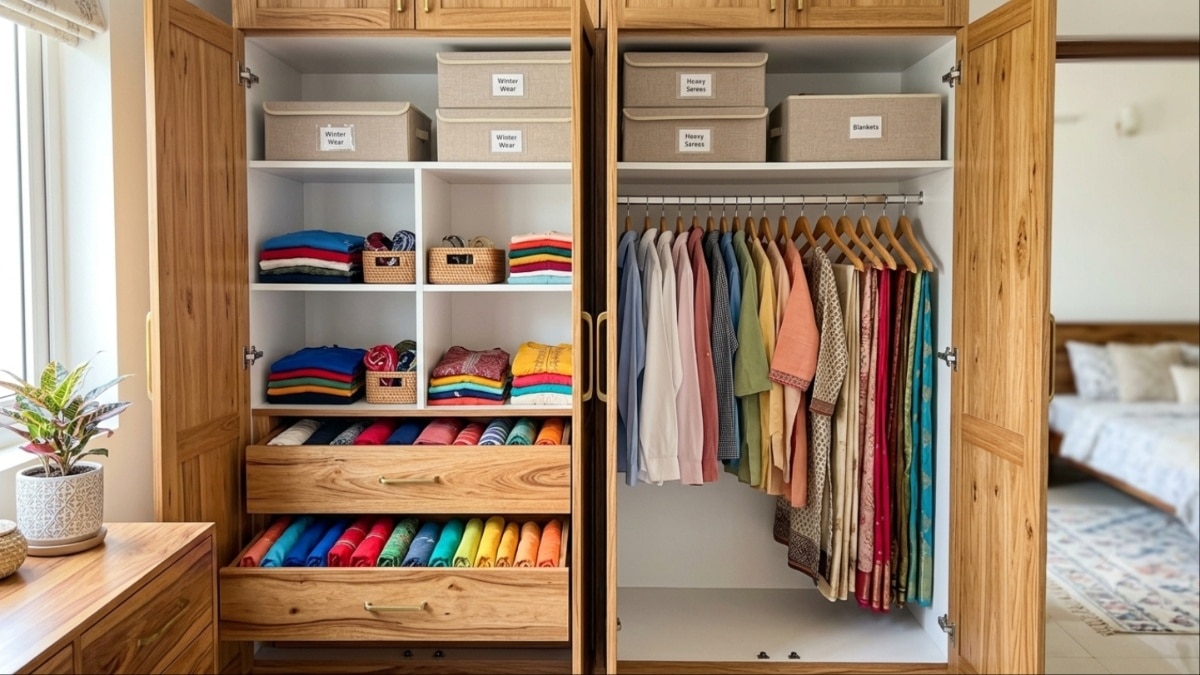
In rented apartments or small houses, the problem of clothing storage often arises because it is impossible to fit a large wardrobe in every room. If you simply leave things on the bed, chair, or in the corner, the room starts to look cluttered. However, the absence of a wardrobe does not mean that clothes cannot be organized. Many people face a lack of space and do not know how or where to store their belongings correctly.
If you also have little space in your room and don't know how to organize your wardrobe, the solution may lie in using every corner of your home. You can utilize walls, under-bed space, old furniture, and the area behind the door for clothing storage. This not only prevents clutter but also makes the room visually cleaner and tidier. Below are simple and compact methods.
If you have an old bookshelf that is currently unused, you can turn it into a place to store clothes. T-shirts, jeans, sweaters, and bags can be folded on the shelves. Small baskets can be used for small items like socks. If necessary, a railing can be installed between the shelves to hang some items. This approach looks aesthetic, and clothes are easily kept in order.
The space under the bed is often left unused, although it can hold many things. In this space, you can store seasonal clothing. Summer and winter clothes should be packed in boxes or plastic containers and placed under the bed. If you have an old wheeled drawer, you can use it to store clothes under the bed.
In limited space conditions, a small wooden ladder can be useful for storing accessories and clothes. Scarves, bags, belts, and daily-use items can be hung on the steps of this ladder. Additionally, hooks can be hung on the wall to place shirts, trousers, hats, handbags, and scarves.
If you have an old chest of drawers, you can adapt it for clothing storage. Its drawers are convenient for storing t-shirts, pajamas, trousers, and underwear, as these items take up little space. The top of the chest of drawers can be used to place mirrors, perfumes, or small accessories. An old chest of drawers can be painted to give it a new look, making the room more attractive.
If you cannot install a wardrobe, you can install an open clothing rack, which is currently a popular trend. It can be purchased online at an affordable price and placed near an empty wall. This rack is ideal for hanging everyday shirts, jackets, trousers, and dresses. If the rack has a lower shelf, it can be used to store shoes, bags, or folded items, eliminating the need to constantly search for clothes. Such structures are often equipped with hooks for hanging daily jewelry.
Do not consider a bare wall useless; it can be used for clothing storage. By attaching sturdy shelves to the wall, you can place jeans, t-shirts, sweaters, and bags. A railing can be installed under the shelf to hang shirts and other clothes. Baskets are suitable for small items and accessories. This reduces the amount of things on the floor and gives the room a more open look.
If you need to both hang and fold clothes simultaneously, a floor stand that combines shelves and hangers is best. Shirts, jackets, blazers, and dresses can be hung on the top bar, while jeans, t-shirts, shoes, or boxes can be placed on the bottom shelf. This is an effective way to organize different types of clothing in one place, simplifying the process in a small space.
It is customary in homes to hang clothes on hooks, and if there is no wardrobe, you can additionally install hooks behind the door. Everyday clothes, scarves, belts, bags, and hats can be hung on the door surface. This method is especially useful in small rental rooms as it does not take up extra floor space.
Clothes that are not used daily can be stored in chests or wooden storage boxes. Winter wear, evening dresses, and extra sheets fit perfectly in such containers. They can be placed next to the bed or at its foot. If you have a storage bench, it serves a dual function: it allows you to store things and provides a place to sit.