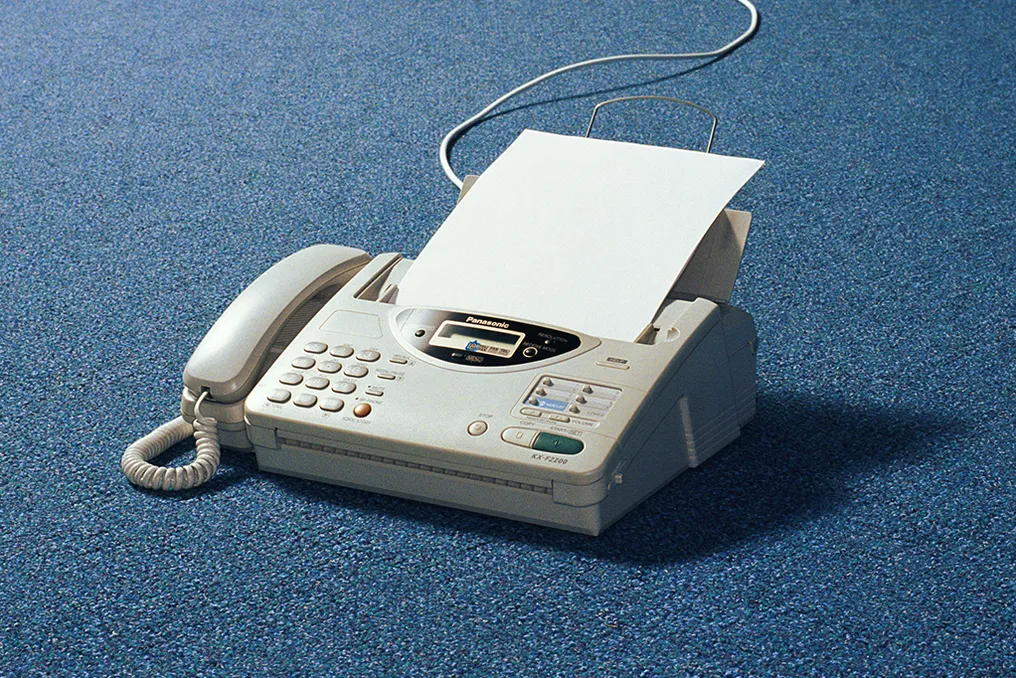
Despite the existence of technologies such as WhatsApp, email, and digital signatures in 2026, the use of paper messages over telephone lines seems outdated. Nevertheless, fax maintains its existence, and its operating principle offers a small lesson in engineering ingenuity.
The process begins with a scanner. Paper is fed by rollers and illuminated by light, which is most often LED today. A sensor measures the amount of reflected light from each point. Light does not pass through the paper, as many assume; light areas reflect a lot of light, while dark areas reflect almost none. As a result, a grid of points is formed, usually with a resolution of about 200 dots per inch horizontally and 100 vertically. Each point becomes either black or white, meaning 1 or 0, without half-tones.
Sending this raw grid would be slow, so the fax compresses the data. Instead of recording 'white, white, white' hundreds of times, the system records something like '300 consecutive white dots.' Since letters often have a lot of empty space, the data saving is significant.
Next, the modem comes into play, converting bits into modulated sounds. Before this happens, both devices emit a characteristic loud greeting signal. They exchange tones to agree on the speed the line can handle, which ranges from 2400 to 33600 bits per second, depending on the model and line quality. Transmitting one page takes from a few seconds to a minute. On the receiving end, the device performs the reverse process: it converts the sounds back into bits, decompresses the data, and reconstructs the image point by point.
Printing can be done in different ways. Classic thermal paper, sold in rolls, is coated with a dye that darkens under heat. The print head contains tiny heating elements that 'draw' the page without using ink or toner. This makes the paper inexpensive, but this is also why old faxes fade over time and stain the user's fingers. More modern models use inkjet or laser printing, similar to a regular printer.
The idea of fax is much older than the telephone itself. In 1843, Scottish watchmaker Alexander Bain patented a system that scanned an image and reproduced it remotely using synchronized pendulums. In 1865, Italian Giovanni Caselli opened the first commercial service of this kind in France, connecting Paris and Lyon. However, the fax only became a real hit in the 1980s after the appearance of the international digital standard known as Group 3, which significantly accelerated transmission.
Today, the internet has pushed fax out of the spotlight, but has not eliminated it entirely. It is still used in hospitals, notary offices, law firms, and government institutions in various countries where old protocols and legislative requirements maintain this habit. A large part of these 'faxes' does not use paper at all: these are services that receive the document over the network using the T.38 protocol and deliver it via email. The wire has changed, but Bain's principle remains relevant.