
Ancestral remembrance ceremonies held in Haridwar on Pitru Visharjani Amavasya day
Read more
Aaj Tak
www.aajtak.in

Ancestral remembrance ceremonies held in Haridwar on Pitru Visharjani Amavasya day

Haridwar, known as the 'Gateway to Har', is a pilgrimage site where people come to take holy dips in the Ganges for merit. They also come here to ensure the liberation of their ancestors. While Haridwar is considered a sacred place for earning merit and achieving liberation, it also serves as a place for ancestral release.

People bid farewell to their ancestors with deep reverence on this day. It is believed that if a person does not know the date of their ancestors' death, they can take a dip in the Ganges or perform a worship ritual at the Shri Narayan Shila temple on the last day of Pitr Paksha, which is Pitru Visharjani Amavasya. This brings liberation and moksha to the ancestors.

The period from the full moon of Bhadrapada to the new moon of Ashvina is called the 'Two Weeks of Ancestors'. Performing pindadana and Sharaddha Tarpana for ancestors during these days brings them liberation. When ancestors are pleased, happiness, peace, and prosperity reign in the home. Scriptures state that anyone who could not perform Sharaddha for any reason during the Sharaddha period can perform pindadana and Sharaddha on the last day of this period—Pitru Visharjani Amavasya, which brings supreme well-being to the ancestors.

A large number of devotees gathered at the Shri Narayan Shila temple in Haridwar on Pitru Visharjani Amavasya. People started arriving early in the morning, and in the temple, they stood in long queues to bid farewell to their ancestors. Given the large gathering of pilgrims, the police organized extensive measures, allocating a significant number of police personnel.

Jyotishacharya Pandit Manoj Tripathi notes that Pitru Visharjani Amavasya is a time of farewell to ancestors who have been in homes for 16 days. He says that if there was a mistake, an oversight, or if a person forgot about Sharaddha or could not perform it for any reason, they can seek forgiveness and perform the 16-day Sharaddha on this day. Those who do not know the date can also perform Tarpana.

This place, which is located from the throat to the navel of Lord Narayana, where performing Sharaddha brings moksha to the ancestor. If a person performs Sharaddha here with devotion, or simply visits this place today, or just offers water, the ancestor is granted eternal sustenance. Pleased ancestors bestow blessings.

On Pitru Visharjani Amavasya, one should perform Sharaddha and feed a cow. The ancestors should be bid farewell in the evening. The farewell can be performed by offering 16 types of sweets, 16 portions of sweets with offerings, and lighting 16 lamps made of pure ghee from dough. Many make a round lamp from dough, which is also somewhat acceptable.

Sio City Haridwar Shishupal Singh Negi stated that today is Pitru Amavasya. All people are coming for worship and viewing. As seen since the morning, there are long queues. A sufficient number of police forces are present. Crowd pressure is very high, but the police are smoothly managing the movement of people. Adequate organization has been provided for crowd control. Entry of any four-wheeled vehicles is prohibited from Tulsi Chowk to Devapura, and enough duty staff has been assigned to this purpose.

Similar stories

Deity in a Cradle Revered at Maa Alop Shankari Temple in Prayagraj, Pilgrims Gather During Navaratri
Read more
www.aajtak.in

Deity in a Cradle Revered at Maa Alop Shankari Temple in Prayagraj, Pilgrims Gather During Navaratri

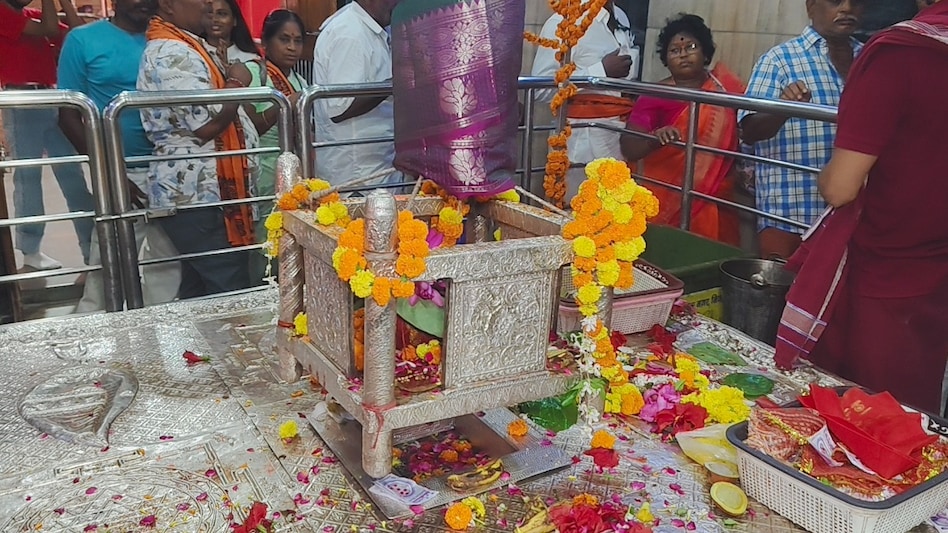
Prayagraj is known as a city of pilgrims, as well as a center of faith and piety. The Maa Alop Shankari Temple, located here, is recognized as one of the 51 Siddhipetas. The main feature of this shrine is the absence of a traditional statue or image of the Mother; instead, worship is performed to a deity residing in a sacred cradle.

There is a belief that all wishes sincerely offered to the Mother's temple are fulfilled. This is why pilgrims arrive from different parts of the country to make a pilgrimage and see the deity.

The religious significance of this temple, located in Alopibagh, Prayagraj, is considered centuries old. According to mythological history, Mata Sati, upset by Lord Shiva's insult to her father Daksha Prajapati at his fair, sacrificed her life in the fire of yoga. After this, Lord Shiva began to wander the universe, carrying her earthly body. To save the cosmos from this situation, Lord Vishnu separated parts of Mata Sati's body using his Sudarshana Chakra.

It is believed that where parts of Mata Sati's body fell, the Siddhipetas were established. According to legend, it was in this place that Mata Sati's palm fell in Prayagraj, becoming invisible, hence 'Alop'. Due to this tradition, the shrine received the name Maa Alop Shankari. Pilgrims revere this place as a Siddhipeta and seek the Mother's blessings by visiting it.

The most unique tradition of the Maa Alop Shankari temple is related to the divine cradle installed in the shrine. There is no traditional statue of the Mother in the main hall of the temple. Pilgrims circumambulate and worship the deity in the cradle, presenting their desires before the Mother. They believe that prayers offered with true devotion will surely reach the Mother.

In addition to nine forms of Goddess Durga, Kala Bhairava, Maa Shitlu, and Lord Hanuman can also be seen in the temple premises. Because of this, pilgrims visiting this place receive blessings not only from Maa Alop Shankari, who resides in the cradle, but also from other deities.

During Navaratri, the number of visitors to the temple increases significantly, and people come from afar to make a pilgrimage.

There is a sacred pond on the temple grounds. According to belief, pilgrims whose wishes have been granted fill this pond with milk, yogurt, and nuts as a sign of gratitude to the Mother. This tradition is closely linked to the faith and devotion of the pilgrims. People also perform special rituals here when their requests are fulfilled.

Newlyweds come to the temple after marriage with wishes for happiness and prosperity in family life. There is also a tradition of performing the Mundan ritual (head shaving) for an infant after the birth of the first child in the family. During Navaratri, pilgrims look at the Mother's cradle, bringing her shawls, coconuts, flowers, and fruits to ask for blessings.

The Maa Alop Shankari Temple is a primary center of faith, trust, and religious beliefs. Pilgrims believe that anyone who comes here with a prayer of unwavering faith receives fulfillment of their wishes from the Mother. It is because of this faith that pilgrims visit the temple even on ordinary days, and during the nine days of Navaratri, a special atmosphere prevails in the temple.

During Navaratri, thousands of pilgrims arrive to worship the Mother. They worship the cradle, bring shawls and coconuts, and pray for the well-being of their families. A distinctive feature of this unique Maa Alop Shankari shrine is that the divine form of the Mother is revered in the form of a cradle, and this tradition gives the temple its special identity.

Smriti Irani performed Chhath Puja; Bihari festival shown in the series 'Kyunki Saas Bhi Kabhi Bahu Thi'
Read more
www.aajtak.in

Smriti Irani performed Chhath Puja; Bihari festival shown in the series 'Kyunki Saas Bhi Kabhi Bahu Thi'

The film 'The One', created under the aegis of Unnata Kapoor, received mixed reviews from the public. The plot of the film is based on folk tales from the Van Devi temple in Bihar, and it also depicts Chhath Puja. Unnata Kapoor included elements of worshiping Chhath Mai in her popular series 'Kyunki Saas Bhi Kabhi Bahu Thi'.

In the series 'Kyunki Saas Bhi Kabhi Bahu Thi', the women of the Tulsi family performed Chhath Puja. One video published by Unnata demonstrates how all the women of the Tulsi family celebrate this festival. Viewers highly appreciated Unnata Kapoor's work, noting that she linked the Bihari folk festival with her series, evoking strong emotions in fans while watching the video and listening to Chhath songs.

Gauri Pradhan was also captured in the video performing Chhath Puja, dressed in a traditional red sari. She was accompanied by co-stars Ravi Gupta and Prachi Singh. All three appeared immersed in the worship of Chhath Mai, dressed in red saris and traditional ornaments, with headscarves and sindoor.

Ravi plays the role of Damini, and Prachi Singh portrays Munni Virani, who is a police officer and Tulsi-Mihir's daughter-in-law. Fans admire Gauri and Nandani Virani for their roles, noting that she is Karan Virani's wife. Gauri shared a photo of her Chhath Puja celebration on Instagram with the caption: 'My first Chhath Puja.'

The second season of the series 'Kyunki Saas Bhi Kabhi Bahu Thi' is extremely popular. This season was released after 25 years, marking Smriti Irani's return to television after a long break. The series combines both new stars and the former cast.

Popular