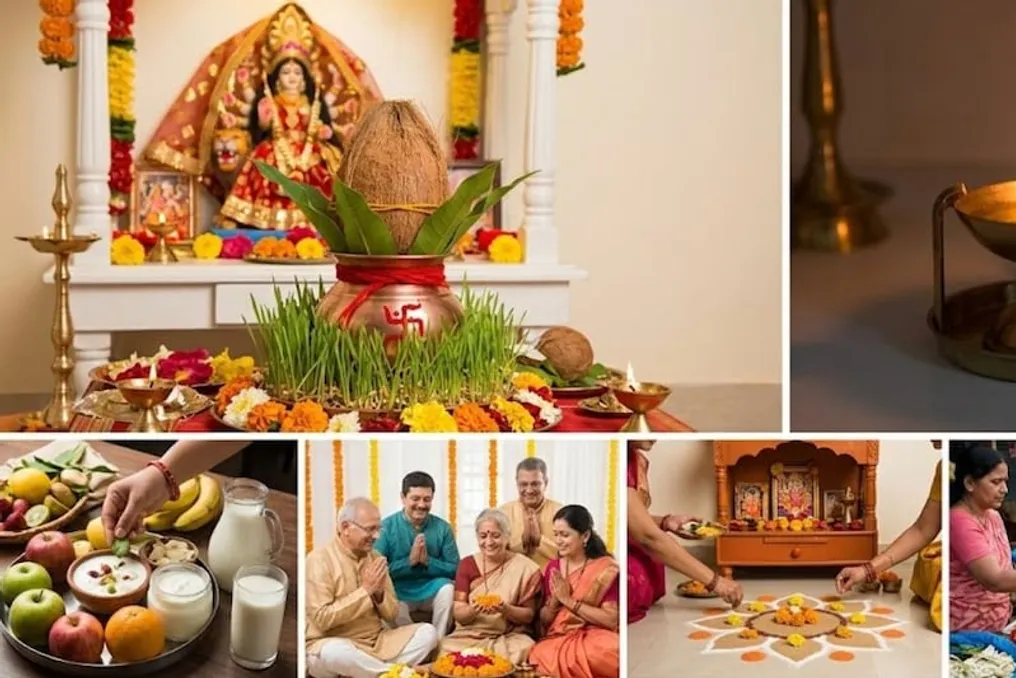
Sharadiya Navratri 2026 begins with the performance of Ghatasthapana, during which worship of Goddess Durga commences. This year, the celebration will start on October 11th. On the first day, a kalash installation will be performed in homes and temples. According to religious beliefs, attention must be paid to the cleanliness and righteousness of the home during worship throughout these nine days. There are several aspects that require special attention after Ghatasthapana, and we will discuss the mistakes that are recommended to avoid.
Firstly, one should not leave the house unattended after installing the kalash. It is considered necessary to regularly care for the place of worship during Navratri. If a continuous sacrificial lamp (Akhand Jyot) has been lit, its safety and constant supervision must be ensured. It is also important to maintain cleanliness around the kalash and prevent disorder, while monitoring fire safety when the fire is burning.
Secondly, it is extremely important to abstain from Tamasic food. Sattvic food holds great significance during Navratri. According to religious views, it is advised to avoid meat, alcohol, garlic, and onions during these nine days. People observing the fast exercise particular caution in their diet, but even those who do not fast prefer to consume Sattvic food. It is believed that a moderate diet promotes peace of mind and helps focus on prayers.
Thirdly, quarrels and conflicts in the home should be avoided. Navratri is considered a festival of worship to Goddess Durga, and during this period, maintaining a peaceful and positive atmosphere at home is recommended. Unnecessary arguments, anger, and insults towards others must be avoided. Family members should strive to maintain mutual love and harmony. Religious beliefs state that it is easier to concentrate on spiritual practices in a calm environment, so patience is better than engaging in disagreements over trifles.
Furthermore, the cleanliness of the place of worship must be maintained after Ghatasthapana. No unnecessary items should be placed around the kalash, and materials used in rituals must be neatly organized. Daily cleaning of the place of worship should be conducted. When choosing a location for the kalash installation, a clean area should be selected, and all necessary materials should be prepared in advance to avoid problems during worship. It should be noted that worship traditions may vary across different regions and families, so it is appropriate to follow one's family traditions.
Ghatasthapana is also known as Kalash Sthapana and is performed on the first day of Sharadiya Navratri. According to religious beliefs, through this ritual, Goddess Durga is invoked, after which the nine-day worship begins. Items used for Kalash Sthapana include a kalash, water, Amu or Ashoka leaves, a coconut, akshat, vermilion, and flowers. In many homes, there is a tradition of planting barley next to the kalash; the sprouts of the barley are considered a symbol of prosperity and well-being.
In Sharadiya Navratri, Ghatasthapana is performed on the day of Prabhadai. This year, Navratri begins on October 11, 2026. The auspicious time for worship should be determined according to the city and local Panchang. Therefore, before installing the kalash, one must check the Panchang of their region or consult an knowledgeable priest regarding the suitable time. According to religious beliefs, besides observing rituals, devotion and purity in worship are important. During the nine days of Navratri, one should try to maintain regular worship, a moderate daily routine, and a peaceful atmosphere.