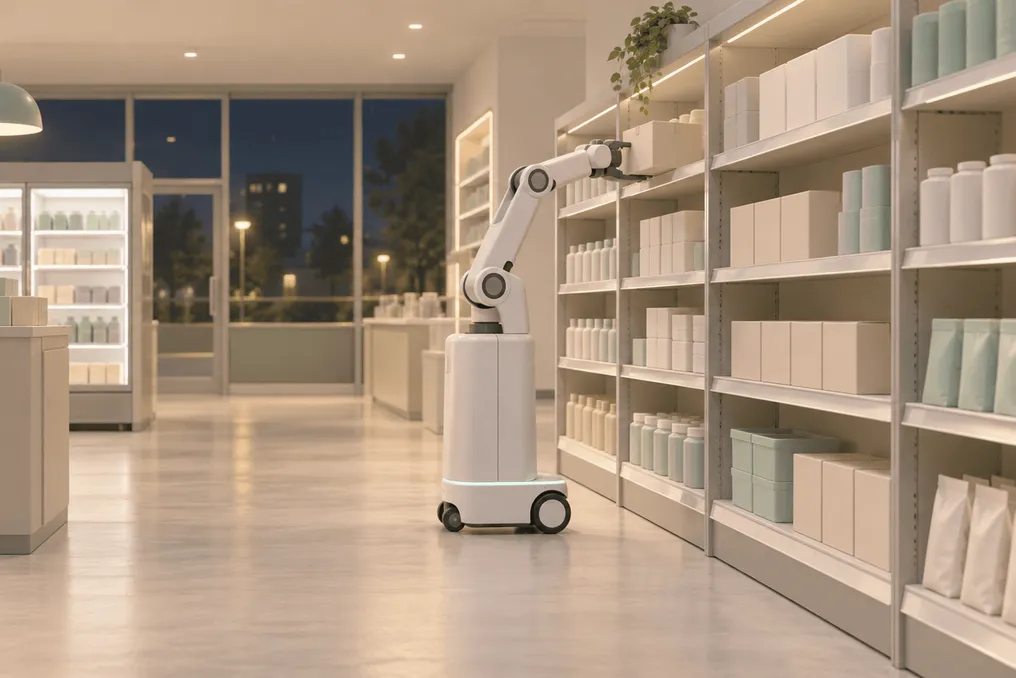
Striding AI, a physical artificial intelligence startup from Beijing, has introduced a robot system designed for 24-hour retail stores. The presentation took place on October 8th at the 22nd Asia-Pacific Retail Conference (APRCE 2026), according to a company announcement distributed via QbitAI.
The system consists of three main components. The H1 robot is a bipedal humanoid designed for areas where customers move. It can speak over 20 languages, display 45 different facial expressions and 36 gestures, and provides an open API for custom development.
The C1 robot is a wheeled apparatus with manipulators, suitable for narrow aisles. It operates on a slim omnidirectional base, has a height ranging from approximately 100 mm to over 1750 mm, and performs tasks such as moving goods, restocking shelves, and loading. Striding AI claims that C1 uses combined sensors to detect nearby customers, stops within 10 cm of an obstacle in emergencies, and is equipped with front and rear depth cameras, as well as 360-degree vision.
The M1 control platform is responsible for task distribution, status tracking, and personnel intervention capabilities. The company emphasizes that this setup requires no modifications to the store's shelf or aisle structure, which it calls zero retrofit. The goal of deploying these robots is to delegate routine and nighttime tasks, such as inventory checks, inspections, and patrolling, allowing staff to focus more on customers. The company states that the robots autonomously complete 99% of tasks, although details of this figure are not disclosed.
The foundation for the robots' operation is Striding AI's so-called 'embodied brain.' The lightweight SLM-0.5 world action model demonstrated an average task success rate of 98.6% in the LIBERO benchmark and, according to the company, performs calculations 24 times faster than standard approaches. The STEAM system, based on the open-source RLinf framework and functioning as a post-training reinforcement learning system, achieved 95% success in the shelf restocking task. The Rpent agent layer, developed in collaboration with Tsinghua University and Infinigence AI, breaks down a request, such as filling a row of shelves, into sequential steps, calls navigation and grasping modules, and replans actions when failures occur.
Striding AI was co-founded by serial entrepreneur Song Yao, Yan Yuxin, Tsinghua researcher Yu Chao, and the Charoen Pokphand group. The company plans to test the system in a major global retail chain and commence commercial operation in 2027. Sales may be conducted as a one-time purchase or through a Robotics-as-a-Service subscription, which includes hardware, software, and maintenance. More powerful versions and an A1 robot for checkout and packaging are also planned, though their release timelines have not been specified.