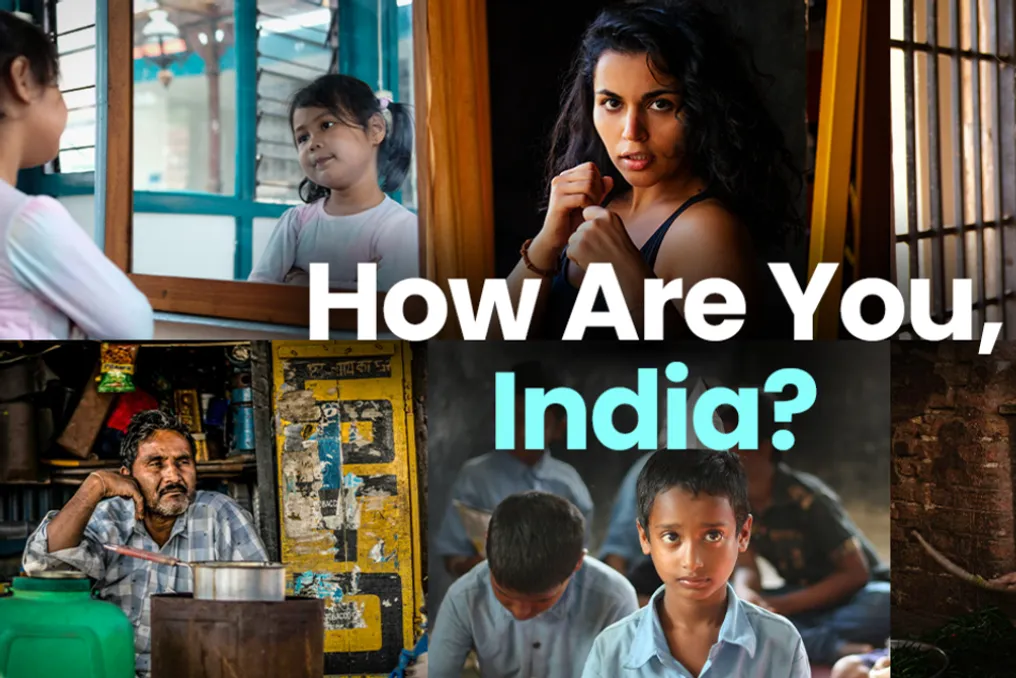
Behind every 'I'm fine' answer lies a unique story. The 'How Are You, India?' series aims to tell these stories. It is important to note that the presented narratives are personal testimonies of real people and cannot replace medical advice, clinical guidance, or therapeutic prescriptions. Those experiencing difficulties are encouraged to seek help from a qualified mental health professional or contact Tele MANAS at 1-800 891 4416.
We often utter variations of the phrase 'How are you?' dozens of times a day—to colleagues, relatives, neighbors in the elevator, and sometimes to ourselves. It is quick, polite, and allows one to conclude a conversation before it even begins. However, this rarely reflects the whole truth.
The actual situation is usually much more complex. It might be a morning where getting out of bed requires more effort than the entire day ahead; it could be a message you read three times but never replied to; it might be a mother who hasn't slept properly for months; a colleague smiling in a meeting with a heaviness in their chest; or a woman in a village who has never been asked how she is doing.
That is why The Better India presents the 'How Are You, India?' series, dedicated to the daily, imperfect labor of caring for our emotional state and for the people we love. This series is not an expert guide and does not focus on triumphant comebacks. There are no perfect 'before and after' storylines here. Instead, viewers will meet ordinary people making small, sustainable actions: making a phone call, setting boundaries, or finally having a conversation. Although some of these actions may seem insignificant externally, they can be profoundly meaningful.
Why This Series Is For You
Perhaps you are reading this because something feels heavy lately, and you can't find the right words. Or maybe someone you love has become withdrawn, and you don't know where to start. Or perhaps you are simply tired of 'fine' being the only acceptable answer.
If so, this series is for you. Discussions about mental health in the media often feel distant from everyday Indian life. They tend to be clinical, urban, English-language, or dramatic. But for most of us, emotional strain doesn't look dramatic. It manifests as financial anxiety, caregiving burden, loneliness, burnout, grief, or the constant need to 'keep moving forward.'
Here, you will find stories that sound like your own life, told honestly and in simple language. You will gain confidence that you are not alone, and perhaps receive one small, practical idea that you can apply, whether you are caring for yourself or someone else. To belong here, you need no label, diagnosis, or perfect words.
Who Cares About You?
For every person going through tough times, there is someone looking out for them. It might be a mother learning to read the silence in her child's room; a partner completely changing their life; a friend who never stops picking up the phone; or a caregiver returning home after a very long shift.
This care is quiet and demanding. It is rarely thanked, and those providing it are seldom asked how they cope themselves. In this section, the focus shifts to them. We will hear from families who have found a way out of confusion and silence, friends who have learned what to say (and what not to), and caregivers who have discovered that caring for another starts with not depleting oneself.
Their stories speak to what sustains them and what they wish someone had told them sooner.
How Did You Cope Today?
Most acts of courage never make it into the news. They live on crowded markets, in endless to-do lists, on commutes to work, in bills, and in the weight we carry through it all—unseen, yet constantly present.
This section is dedicated to how ordinary Indians continue to live through difficult days. For many, the hardest part is not a dramatic moment, but the simple act of structuring an ordinary day. We will meet people who have created their own routines, rituals, and small systems through years of trial and error, based not on books, but on understanding what their own mind and body need.
For some, resilience is a morning walk or a to-do list broken into small parts. For others, it is therapy, medication, creativity, rest, a trusted friend, or simply getting through another day. Each story carries at least one practical observation, not a prescription.
What Does Work Really Look Like?
Some of the toughest days happen between nine and five: a presentation that keeps you awake at night, a 'no' that hurts more than it should, the Sunday evening dread, the exhaustion that no vacation can fix.
Work takes up a huge portion of our waking hours, and yet it is often where we practice phrases like 'everything is fine.' Here, we talk to people about how they support themselves at work—from a colleague who quietly established a lunch break ritual to a manager who learned to ask a team member a different question. We also highlight workplaces that are learning to better support their employees, doing so not through slogans or posters, but through daily choices.
What About Rural Areas?
Some people have never been asked how they are doing, neither by the outside world nor by systems designed to care for them. In this section, we venture beyond the metropolises, into places where this conversation has not yet reached. LGBTQ+ individuals, women, tribal communities, and migrant workers share their stories of how they endure, heal, and support each other.
These are stories of community, as well as rituals and methods of mutual aid that existed long before the lexicon of wellbeing. We will tell these stories gently, using the words and mannerisms chosen by our narrators.
How Will We Tell These Stories?
Expect long articles, short personal essays, photo stories, and quick, easily shareable content. Where it is helpful, experts will explain what works using accessible language, but they will never be the center of the story. This space belongs to the person living it.
We have made several promises to ourselves. We will not tell you what to do; we will tell you what someone else did, and you can take what is useful to you. We will not use others' suffering as bait. And we will not pretend there is a finish line, because taking care of your mind is not a puzzle solved once and set aside. It is a continuous process of negotiation, and it looks different for everyone, every day.
A Corner of the Internet That Feels Safe
Alongside the stories, we open a social media space using the hashtag #HowAreYouIndia: an online corner that feels safe and familiar, gently prompting you to check in on your state. Read, reflect, send a story to a friend you've wanted to call for a long time, or just let them know what you're thinking about them.
So, How Are You Really?
We hope this series eases both the question and the honest answer, making the shared journey through difficulties a little easier. We want to hear from you. Every answer to 'How are you, India?' is unique, and every one matters. If your story is still waiting to be told, we are ready to listen. Share with us by writing to editorial@thebetterindia.com. Explore the series here.