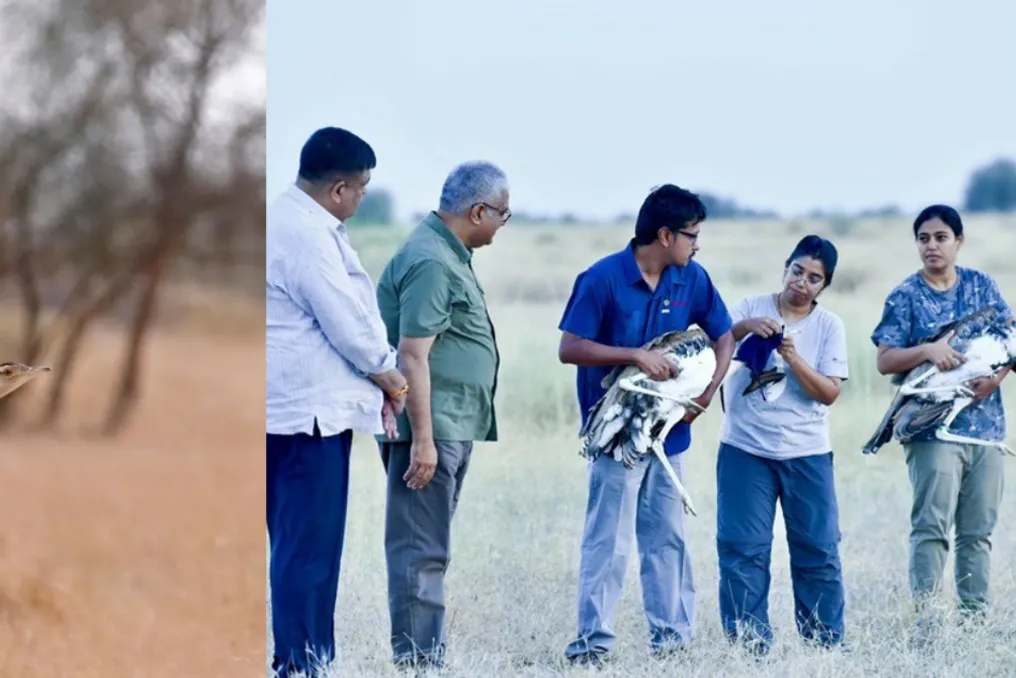
On Sunday morning, two male Great Indian Bustards (GIB) took their first flight in the desert within the Desert National Park in Rajasthan. Union Environment Minister Bhupender Yadav oversaw the release of the birds, marking a new phase in India's nearly decade-long effort to return this critically endangered species to its natural habitat.
These birds were not rescued from the wild; they were raised under India's conservation and breeding program at facilities in Jaisalmer. This significant step was made possible by years of dedicated work by scientists, researchers, and ground staff who spent years ensuring the return of GIB to the deserts of Rajasthan.
Minister Bhupender Yadav thanked Prime Minister Shri Narendra Modi for his continuous guidance, support, and encouragement, which allowed the scientific community to work on conserving all species, including the GIB.
First Breeding, Then Wilding
The question now is: can a human-reared bird learn to live without humans? Staff from the Wildlife Institute of India (WII), the Rajasthan Forest Department, and their partners are beginning to search for the answer.
The GIB, known locally as Godawan, is one of the most vulnerable species in India, with only a small number remaining in the wild. Conservationists have spent years protecting the remaining birds while simultaneously creating an captive population that can eventually be returned to the natural environment.
The release of these two males represents the first major test of this second strategy. The process began long before Sunday: since 2019, eggs collected from GIB nests in the wild have been artificially incubated, and chicks have been hand-reared. Over time, some of these birds began to breed in captivity. In March 2023, a chick hatched from an artificially incubated egg laid by birds in captivity, marking the first recorded instance of GIB breeding in captivity.
The breeding program has since expanded. Currently, 97 GIB are housed at the Ramdevra and Sama facilities. Forty birds originated from eggs collected in the wild, and 57 were bred in captivity. Of these, 86 remain for captive breeding, and 11 are designated for future release. In 2025, the program produced 24 live chicks, and in 2026, another 29.
However, chick production is only part of the equation. As Dr. Tushna Karkaria, lead veterinarian for the Great Indian Bustard project at WII, explained to The Better India, young birds require close monitoring before they can be considered for release.
She reported in March that initially, the birds are completely dependent on their mothers. In the wild, mothers distance themselves when necessary, but here they are kept with their mother for about four to five months. This period is crucial for assessing the bird's physical readiness for further actions. Dr. Karkaria added that only after they ensure the birds' growth and muscle development are complete will they be radio-tagged and released into the wild.
Freedom Begins Before the Desert
For the two birds released on Sunday, the transition did not happen at the edge of the desert. A new aviary site for rewilding was designed at Ramdevra, serving as an intermediate space between captivity and the wild. The large structure without supports allows the birds to fly without the restrictions of a traditional enclosure, enabling them to strengthen flight muscles and face conditions closer to those they will encounter outside.
This is the idea of soft release: instead of moving an animal raised in captivity directly from a controlled environment to an unfamiliar landscape, conservationists create a transitional period. These two GIB went through this process before being released into the Desert National Park. They were also fitted with satellite tags so that researchers could track their movements, study habitat use, diet, and adaptation.
Thus, the first two birds are not simply 'freed'; they are also part of a field experiment whose results will determine the fate of subsequent birds.
Survival Is Not Guaranteed
This uncertainty is inherent in the process itself. Predation and the ability to find food can make the initial stages particularly challenging. A bird raised under human care must now make decisions independently: where to feed, where to move, and how to react to threats.
Dr. Karkaria noted that 'the mortality rate will be high, but ultimately the success rate increases as they begin to adapt.' For a species with such a small number of remaining individuals, these figures cannot be ignored. Nevertheless, the goal of conservation is to create a sufficient number of individuals, knowledge, and suitable habitat to give the dwindling species another chance.
The Desert Must Also Be Ready
Therefore, GIB rewilding cannot be limited to an enclosure. The Rajasthan Forest Department is restoring the habitat in parallel with the breeding program, including about 200 sq km of fenced grassland within the Desert National Park. Long-term telemetry studies by WII identified these areas as key breeding grounds for the species.
Two Birds and a Much Larger Test
When the two males disappeared into the Jaisalmer landscape on Sunday, the team of conservationists witnessed not the end of the project, but the beginning of its most uncertain stage. Yadav, who witnessed the release, later wrote that scientists Dr. Sutirta Dutta, Dr. Tushna Karkaria, and Hrishika Sharma were disappointed during the bird release, highly praising the team behind the program.
For almost a decade, the question was: could India breed the Great Indian Bustard under human control? Now, if the experiment succeeds, the desert could eventually become home to a new generation capable of living there without human intervention.