Tando Soroshi from Lady Grey in the Eastern Cape began his journey in agriculture, despite his family previously being involved in livestock farming, which had to cease due to cattle theft. His connection to farming was restored after years thanks to a gift of four chickens from a member of his church.
Today, Soroshi manages crop and livestock farming while overseeing other aspects of his business. Although he initially dreamed of becoming a doctor, his interest in farming arose after observing Boer breed farmers in Lady Grey who successfully ran their operations using nature and animals.
In 2018, when he was still in primary school, a member of his church gifted him four chickens. This person noted his caring nature and wanted to see what would come of it. By the end of that same year, through research gathered from social media and online platforms, those four chickens had grown to one hundred heads. From that moment, Soroshi saw the commercial potential in poultry farming and the opportunity for agricultural diversification.
He discussed the need to purchase incubators with his family, and they supported him. The nearest seller was in Gauteng, so he traveled there and bought incubators capable of holding about 360 eggs. However, the first incubation attempt was unsuccessful: 'All 360 eggs rotted. I didn't know what I was doing. My research was probably half-done,' he admits. He repeated the attempt and got 280 chicks, which formed the basis for his flock's growth.
In 2022, Soroshi enrolled in an agricultural college in the Free State. By this time, he already understood that he wanted to build a farming business. Nevertheless, practical work with poultry was not the main focus at the school. He started raising broiler chickens, and with support from his family at home, he was able to sell them.
When Soroshi returned home in 2024, the poultry enterprise he developed in school began taking shape as a full-fledged business. He registered the company Soroshi Empire Pty Ltd, and his parents, Mzwandile and Nombali, provided support by giving him more chicks. His flock grew from hundreds to approximately 2000 birds.
Soroshi was just getting started. Thanks to profits and further parental assistance, he acquired his first four pigs, and with a small additional investment, his herd grew to about 30 pigs. He now produces around 300 piglets per year, noting that his sows give birth three times a year. His older brother, Khave Soroshi, also provided financial assistance as the business grew.
The business expanded beyond poultry and pig farming to include a shisanyama venue, and he plans to open a butcher shop. Four permanent employees are employed in livestock management, and three others work at the shisanyama. During planting and harvesting, he hires about 30 seasonal workers on three hectares where he grows spinach, cabbage, and tomatoes.
Soroshi notes that convincing his parents to start a farming business was not easy, especially given their history of cattle theft. His parents began viewing the business differently when his cousin Lifalahle Makubela left his job in Gauteng to return home and work with him on the farm. He also received mentorship from his mentor, Joseph Nkopane, a commercial farmer in Lady Grey.
In August of this year, the business received support from DEDEAT in the form of chicken coops capable of housing 644 chickens.
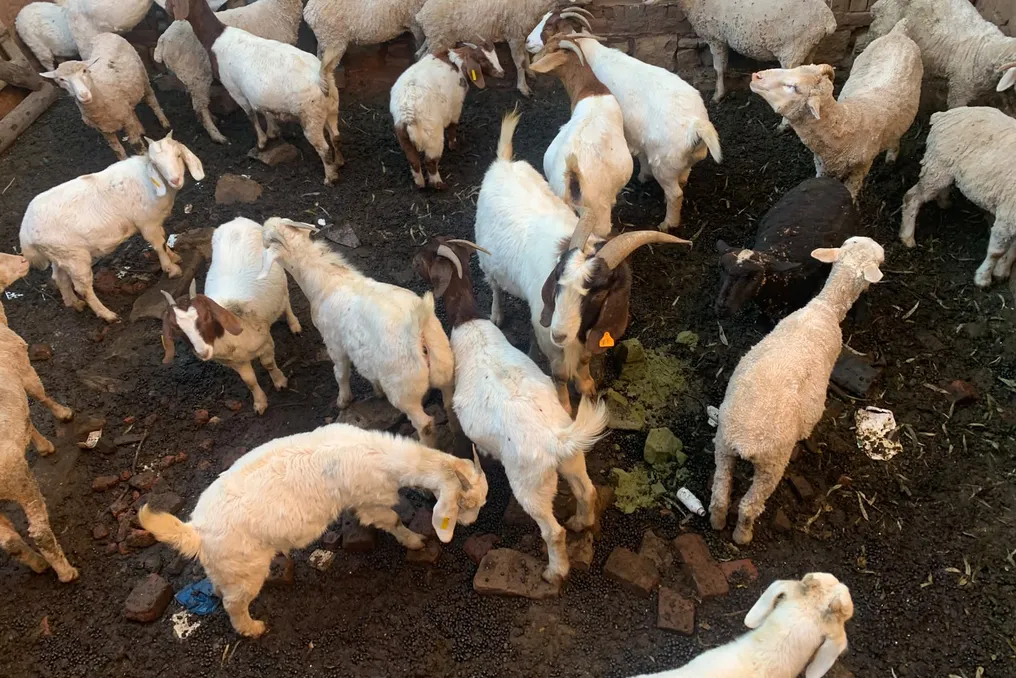
Soroshi told Food For Mzansi that his livestock and poultry include Merino sheep, local breeds of cattle, Large White pigs, Boer goats, Lohmann Brown chickens, and Ross 308 broilers, as well as White Leghorn chickens. Using local cattle breeds, he intends to crossbreed them with Bonsmara cattle for meat production.
The choice of Boer goats was also based on his research, which showed they reproduce well under proper livestock management conditions. 'They most often give birth to twins or triplets. This growth is a business for me,' he says. Merino, he says, has dual purposes, as the wool can be sold, and the sheep used for the meat market.
Regarding Ross 308 broilers, Soroshi points to issues with mortality and achieving desired weight in the birds. Other types of chickens, he says, grow well. His customer base has also expanded: local wholesalers and city buyers purchase chicken, eggs, pork, beef, and lamb from him.
Soroshi explains that his daily activities involve moving between different parts of the business. He starts the day by organizing affairs for the kitchen enterprise, and then goes to the farm to check all processes. This serves as proof that failure is just a step on the way to building an empire.