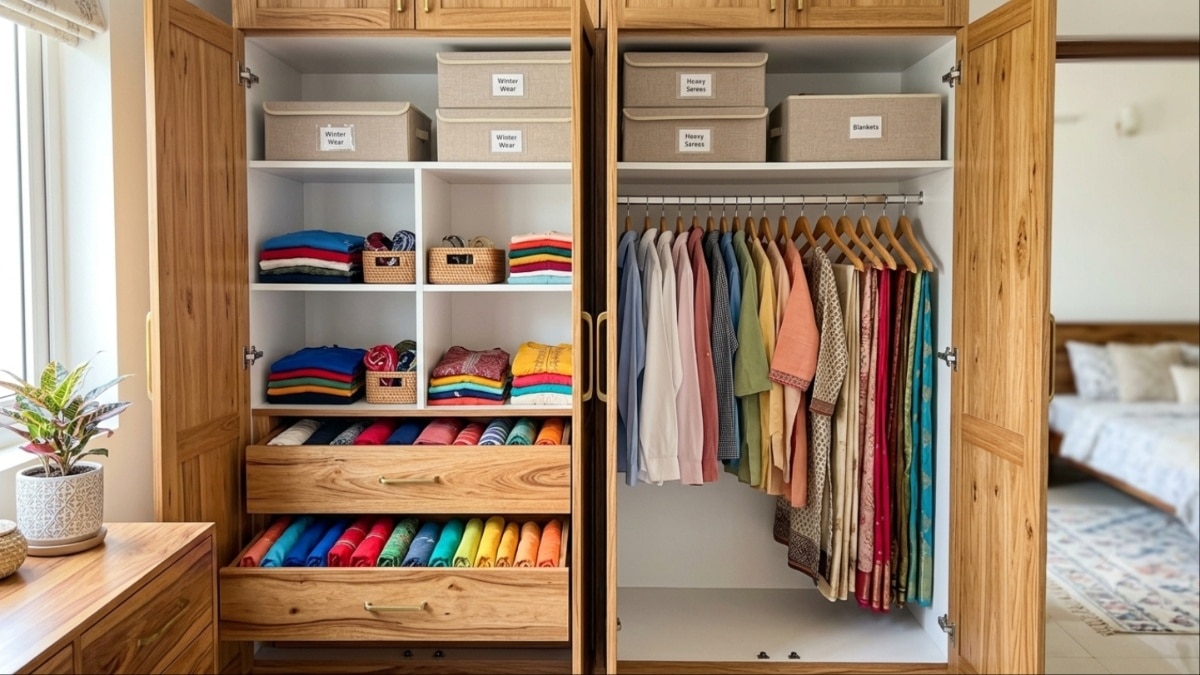
If you open your closet and see a mountain of clothes, and finding the right item takes a long time, the reason might not only be an excess of things. Often, the problem lies in the incorrect way of storing clothes. When items are stacked on top of each other, space fills up quickly, and within a few days, the closet becomes messy again.
In cold weather, space in the wardrobe is further reduced due to sweaters, jackets, and warm clothing, while in summer, light items like T-shirts, cardigans, and jeans take up more space. Under such conditions, small planning and dividing clothes into sections can be very useful. Simply changing your approach to organizing your wardrobe by following these several smart methods can allow you to fit all your clothes even in a small closet.
How to organize a wardrobe:
The first step is to completely empty the closet. By taking out all the items, you can understand how much clothing you have in total and which items you actually need. Clothes that you haven't worn for a long time or that are already unusable should be separated. This will free up significant space in the closet without the need to buy additional storage systems.
It is important to store clothes according to the season. Storing all seasonal items together leads to a quick filling of space. In summer, heavy sweaters and jackets are better stored separately, and off-season light items can be placed on top or in another compartment. This approach ensures that everyday clothes are easily accessible.
Everyday items should be placed in the most convenient place to access. Jackets, T-shirts, jeans, or office wear that you wear often should be visible so you don't waste time searching every morning. Less used items can be put higher up or in far corners.
It is necessary to categorize clothes by purpose. Instead of piling all items into one large heap, divide them into categories: jackets, jeans, T-shirts, business wear, evening wear, and casual wear. Dividing them into small groups significantly simplifies finding any item in the closet.
Clothes should be folded correctly. Excessive compression of items can lead to their damage. T-shirts, tops, and light items are best folded uniformly. They can be arranged vertically, which allows you to see many items at once, and you don't have to unpack the entire stack to get the bottom item.
A separate place must be allocated for bulky items. Items like sweaters, jackets, and thick shawls take up a lot of space, so they should be stored separately from light clothing. During the off-season, it is recommended to clean them and place them in special suitcases or storage boxes. This will save space for daily wear and ensure a tidy appearance of the closet.
Use hangers thoughtfully. Not every item requires hanging. Shirts, blazers, saris, or items prone to wrinkles should be hung on a hanger. However, T-shirts, leggings, and light casual wear can be folded to save the space taken up by hangers.
To prevent clutter from recurring, it is crucial to maintain order after organizing the closet. After taking out clothes, always put them back in their place, and before buying new items, check if there is enough space and need for them in the closet. Conduct a small closet audit every few weeks. This will prevent excess items from accumulating, and you will be able to find the desired item in just a few seconds.