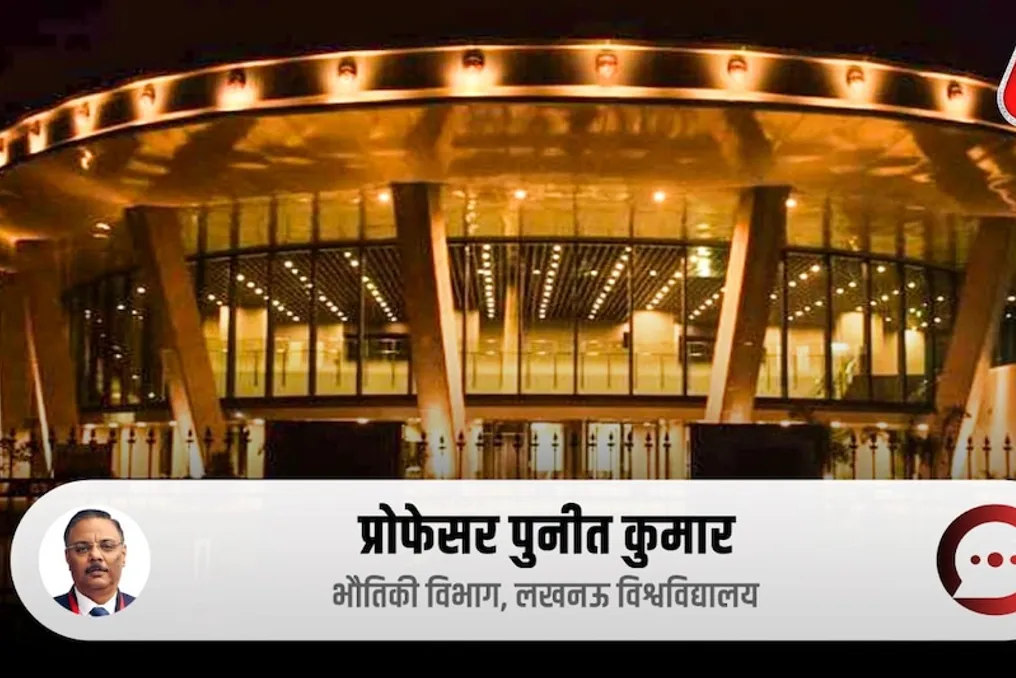
The region from Kashi to Jewar is demonstrating a technological revolution in the state of Uttar Pradesh, which is becoming a recognizable feature of India on a national scale. The context of opening a corridor in memory of former Japanese Prime Minister Abe Shinzo at the Rudraksha International Convention Centre in Kashi underscores the significance of this event. Under the Yogi government, Japanese capital and technology are being directed into industrial corridors along the Yamuna Expressway, forming factories, chip facilities, and IT parks. This also signals that Uttar Pradesh is transforming from a consumer to a manufacturing state that now exports its products globally, instead of just buying goods.
A consumer is someone who waits for others to produce a product and then buys it, whereas a producer is someone who takes the initiative, risks, and creates value through their labor. Notably, just ten years ago, Uttar Pradesh played exclusively the role of a consumer. In this densely populated region, many goods were sold from around the world, and production was limited. The land, once the cradle of civilization, remained a buyer in the economic chain, and its youth migrated to other cities in search of work.
Our political documents asserted that achievements are proven by hard work, not just desire. The Yogi government has demonstrated both diligence and willpower, the results of which have become evident. The perception of Uttar Pradesh has changed, and its potential is confirmed by statistics, projects, and the trust of foreign partners.
The identity of any economy is determined by its exports, as exports mean the world pays for the goods you create or the services you provide. A prime example is the export in the IT and ITES sector. In the fiscal year 2025-26, goods worth 101,970 crore rupees were exported from the state. This figure is important because it is the first time UP's exports have exceeded one hundred billion rupees. Five years ago, in 2020-21, this amount was 48,004 crore rupees, representing an increase of 53,966 crore rupees or about 112 percent. The structure of this growth is also balanced. Exports from the Software Technology Parks of India increased from 25,642 crore to 52,778 crore rupees, an increase of 27,136 crore rupees and a compound annual growth rate of 15.5 percent. Exports from Special Economic Zones grew from 22,362 crore to 49,192 crore rupees, meaning an increase of 26,830 crore rupees and a growth rate of 17.1 percent. Both these areas are developing in parallel, which indicates the health of a growing industrial state.
The social aspect must also be considered, which is more significant than just numbers. Ten years ago, the youth of Uttar Pradesh had to move to Delhi, Mumbai, Bangalore, and Hyderabad for better careers. Today, offices of companies like IBM, Genpact, and Teleperformance are located in Lucknow. In Phase-2 of IT City, HCL is expected to create approximately six thousand direct and indirect jobs through investments of about 500 crore rupees. Noida has transformed into a major IT hub. When employment opportunities become available right at home, talent migration slows down. The growth in employment opportunities has stopped the outflow of youth, meaning the state's human capital is now its strength, and the state benefits from its potential.
This youth potential is clearly visible in the technology sector. Over nine and a half years, the state's share in the production of about 60 percent of mobile phones and 55 percent of electronic components in the country has reached significant milestones. Electronics exports have grown from 3,800 crore to 45,000 crore rupees, with a target set for 2030 of two hundred billion rupees. An HCL-Foxconn chip facility worth 3,706 crore rupees is being built in Jewar. Proposals for data centers with a capacity of 644 megawatts have been presented, and the state has over 24,000 startups and eight unicorn companies. As Chief Minister Yogi Adityanath noted, the path goes from mobile devices to modules, and from modules to microchips.
Lucknow's ambitions regarding technology are also high. The Yogi government aims to make the capital a center for artificial intelligence, semiconductors, cybersecurity, and computing technologies, and to create 50 global AI startups. The goal of increasing IT-ITES exports to 2.5 lakh crore rupees over the next four years is ambitious, but if exports double or more than double in five years, it will not be impossible. In this context, the minister's visit to Japan and Singapore should be noted. During this trip, investment proposals worth about 2.5 lakh crore rupees were secured. A significant announcement was the development of a 'Japan City' within the Yamuna Expressway Industrial Development Authority area of 500 acres and the strengthening of the Japanese Invest UP department under the direct supervision of the Chief Minister's Office. The roots of this economic partnership lie in relations that began in Kashi, and the Abe memorial corridor serves as a pillar strengthening these relations.