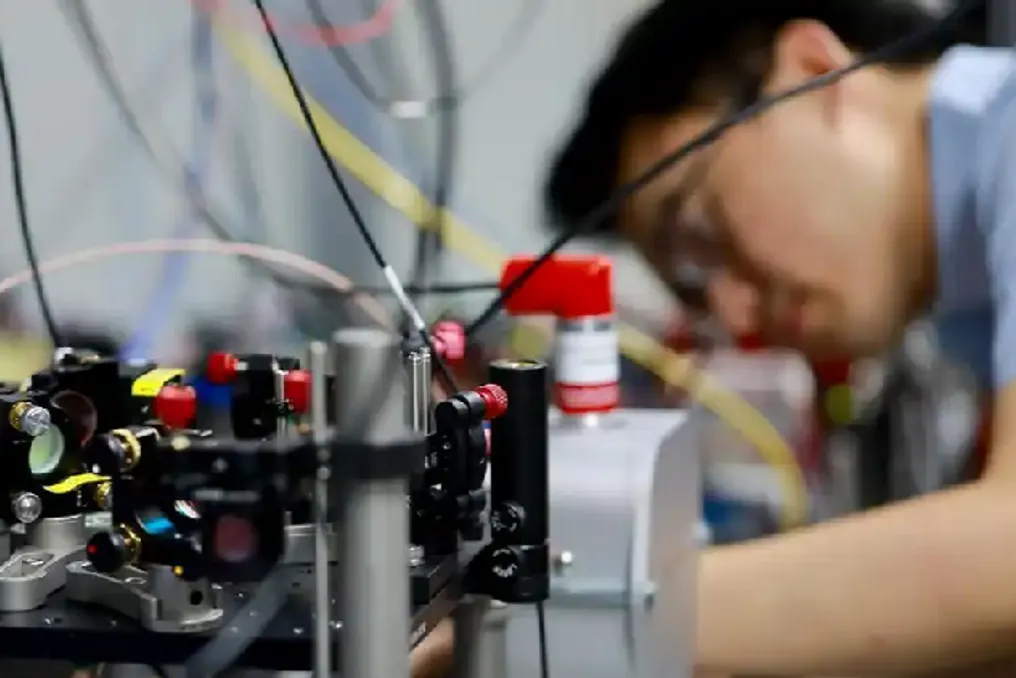
Chinese scientists develop nuclear optical clocks based on the thorium-229 atom
Read more
CGTN
cgtn.com

Chinese scientists develop nuclear optical clocks based on the thorium-229 atom

Chinese researchers have created nuclear optical clocks that utilize the nucleus of the thorium-229 atom to maintain time, marking a significant step forward in the development of a new generation of high-precision clocks.

The team led by Dean Shiqiang from Tsinghua University employed a specially developed continuous ultraviolet laser and a tiny crystal containing thorium-229 to precisely measure the transition within the atomic nucleus. The team then synchronized the laser frequency with this nuclear transition, allowing the system to function as a nuclear optical clock.

These results were published in the journal Nature on Wednesday. The Chinese group and a European team independently achieved the work of nuclear optical clocks around the same time.

Modern most accurate optical clocks are based on electron transitions in atoms. In contrast, nuclear optical clocks use the transition inside the atomic nucleus as a time standard. Since the nucleus is significantly smaller than the surrounding atom, it is less susceptible to external influences, potentially allowing for even higher chronometric accuracy.

This technology can also offer advantages in terms of size and engineering solutions, with potential applications in satellite navigation and deep space exploration, where high time accuracy is critical.

The main obstacle was the need for a continuous laser with a wavelength of 148 nanometers, which is necessary for accurately exciting the thorium-229 transition. Dean's team was the first to develop such a laser.

Furthermore, the team managed to solve the shortage of thorium-229. Using only 1.4 micrograms of this isotope, the researchers produced a millimeter-sized calcium fluoride crystal doped with thorium in a single batch. The amount of material used was about 200 times less than that used by the European team.

The nuclear clocks of the Chinese team demonstrated second-level stability that is nearly an order of magnitude better than that of the European team, thereby confirming the potential of nuclear clocks as a new standard for high-precision time measurement.
Similar stories

Vienna and Beijing Scientists Develop First Functional Nuclear Clocks
Read more
olhardigital.com.br

Vienna and Beijing Scientists Develop First Functional Nuclear Clocks

Scientists from Vienna, Austria, and Beijing, China, have independently managed to create the planet's first operational nuclear clocks. This advancement materializes a technology that physicists have aimed for several decades and has the potential to increase time measurement accuracy.

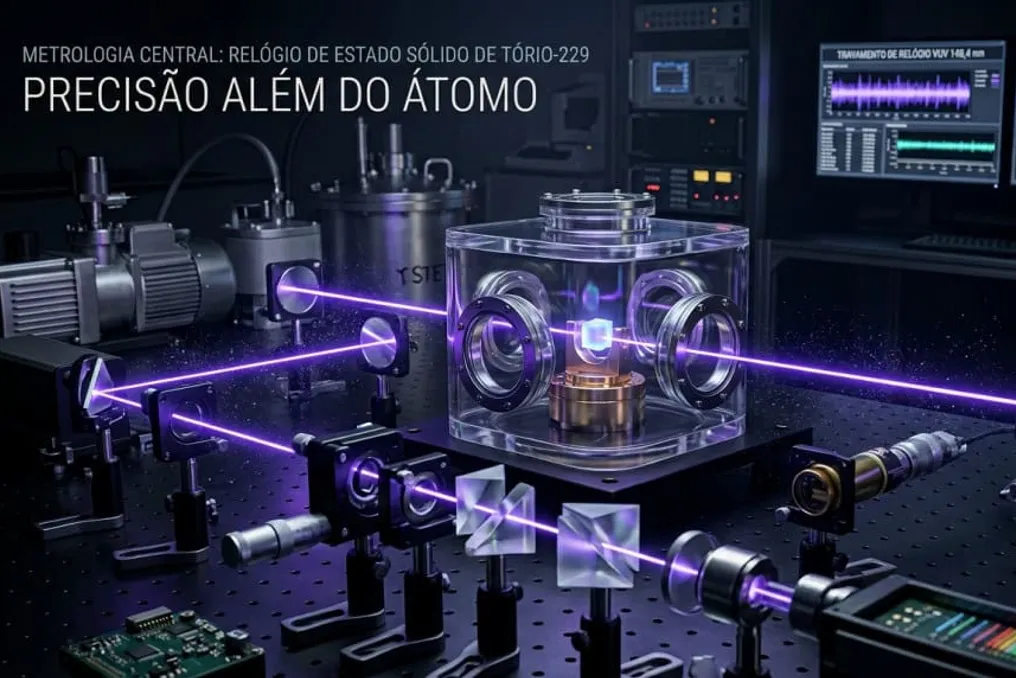
These devices use lasers to monitor energy changes in the nucleus of thorium-229 atoms. Although this technology does not yet surpass the most advanced atomic clocks, it can be applied in areas such as satellite navigation, data transmission, and fundamental physics research.

It is important to note that the term can cause confusion, as these clocks are not powered by nuclear fusion or fission reactions; the measurement is based on the interaction between a high-intensity laser and the atomic nucleus.

The crucial distinction from traditional atomic clocks lies in the point of observation. Conventional models measure time by tracking energy variations of electrons located in the outer shell of the atom, using lasers or microwaves to move these particles between different energy levels, employing elements such as cesium and strontium.

In nuclear clocks, the reference is internal to the atom. Lasers induce energy transitions involving protons and neutrons in the nucleus. Because this region is considerably smaller than the area of the electrons, researchers believe that tracking these modifications could enable even higher precision.

The equipment developed in Vienna and Beijing uses thorium-229 contained in solid calcium fluoride crystals. Both groups achieved functional thorium-229 nuclear clocks simultaneously, despite using distinct experimental methodologies. This fact is seen as a positive sign, as it demonstrates that the concept is solid and does not depend on a single technical approach.

Shiqian Ding, a physicist from Tsinghua University, commented on the development. The best current atomic clocks can deviate or gain only one second over billions of years, a precision already vital for satellite navigation systems and communication networks, including mobile telephony and fiber optics.

With improvement, nuclear clocks can expand these capabilities. The applications suggested by the scientists include: the clock created in Vienna was tested in a dark matter detection experiment, although no signal from this component of the Universe was found; nevertheless, the device demonstrated performance comparable to the best atomic clocks.

Both devices are still far from the ideal performance expected by researchers. The Vienna clock uses thorium crystals with higher concentration and better optical qualities, while the Beijing equipment features a more powerful laser.

More Information

For Thorsten Schumm, a physicist at TU Wien and one of those responsible for the Austrian project, combining these characteristics could substantially increase the yield of nuclear clocks. Schumm stated: 'Creating a nuclear clock was something physicists dreamed of for almost 50 years. My team has been working towards this goal since 2008.'

The researcher clearly summarized the scientific potential of the technology: 'This gives access to an entirely new universe of physics.'

Popular