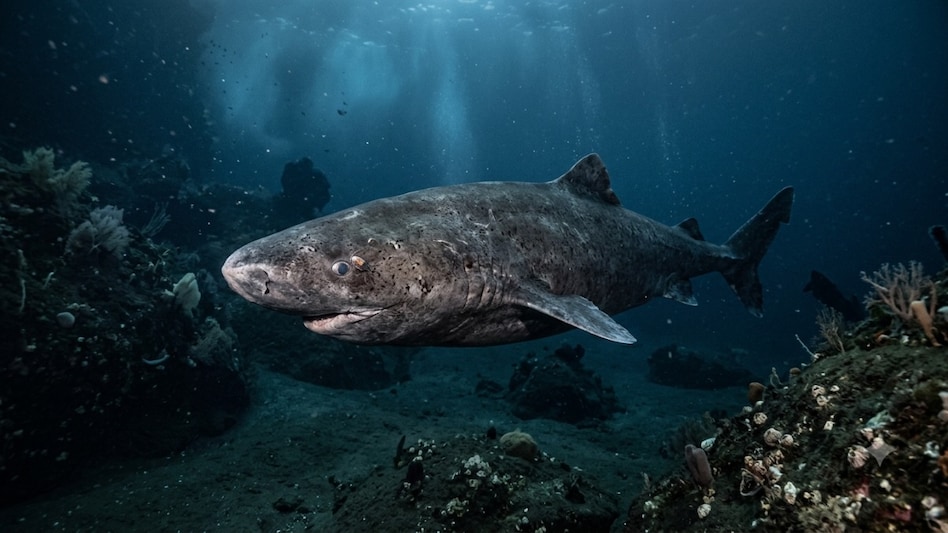
There is a species of shark considered the longest-living cartilaginous animal on the planet; this species can live for over 400 years. Notably, it reaches reproductive maturity at approximately 150 years, and gestation can take more than ten years.
Despite the exceptional rarity and extremely slow growth rate of this shark, demands have arisen to destroy a significant number of individuals. According to a report by the New York Post, some fishermen from Greenland are expressing dissatisfaction and demanding the killing of about 1000 such sharks. Previously, it was even proposed to pay money for each shark's heart.
The situation is unfolding on the west coast of Greenland, in the municipality of Avannaata. Local fishermen complain that Greenland sharks get entangled in their fishing gear and hooks. This leads to damage to expensive fishing equipment. A 27-year-old fisherman, Henrik Jensen, reported that they lost about 6000 hooks just this year. Sometimes the damage accumulates so quickly that in one day, equipment worth about 30,000 Danish kroner, equivalent to approximately 4500 US dollars, can be ruined.
Fishermen warn that if the situation continues, it will directly affect their income. Due to these difficulties, the municipality of Avannaata approved a plan to destroy Greenland sharks in February of this year.
According to the proposal, it was planned to kill about 1000 Greenland sharks, with a payment of about $45 per shark's heart. Local authorities argued that this measure was necessary to ensure the income of fishermen and the preservation of their catch so they could maintain the traditional food system for future generations. However, as soon as this information became public, active protests against the initiative began.
The Greenland shark is not an ordinary fish; it is among the longest-living cartilaginous animals in the world. Scientists suggest that its lifespan may exceed 400 years. Its life cycle is also characterized by extreme slowness: females reach sexual maturity at approximately 150 years, which is an age when a person has time to see several generations. Furthermore, it is believed that fetal development in the womb can last over 10 years. This is why the mass destruction of these sharks could lead to a very long recovery period for the population.
Marine conservation expert Nick Dalby warned that from a biological perspective, the Greenland shark is one of the most vulnerable to overfishing in the sea. This is because its growth, reaching reproductive age, and giving birth occur at extremely slow rates. If a large number of individuals is destroyed simultaneously, the species' population could sharply decline, and recovery would require many generations.
The International Union for Conservation of Nature (IUCN) classified the Greenland shark as Vulnerable in 2020.
Greenland sharks inhabit primarily cold marine areas around Greenland, Northern Canada, and Europe. These animals are capable of long-distance travel. According to a report, one shark can cover about 1240 miles, which is approximately 2000 kilometers in a year.
This circumstance raises additional concern among environmental organizations. The marine conservation organization Oceans North Calalith Nunat notes that even if a campaign to destroy sharks is carried out in one region, new individuals may arrive from other areas. Thus, eliminating the problem in only one place will not lead to its final resolution.
Opponents of the proposal in Greenland are convinced that killing sharks is not a solution to the problem. Oceans North Calalith Nunat warns that introducing a reward system for such a large-scale hunt could be a dangerous step. The organization emphasizes that even if the current proposal was rejected, similar demands could arise in the future.
The director of the organization, Jenserek Poulsen, believes that the shark represents only a visible part of the main problem. In his opinion, overfishing and the large number of vessels in Greenland's fishing industry may be the real cause of the problems.
Thus, on one hand, fishermen are concerned about their earnings and the safety of their expensive property, while on the other hand, scientists and conservation groups are concerned about the shark population, which nature has given hundreds of years to grow and reproduce. Currently, the plan to destroy 1000 sharks in Greenland has been suspended, but this entire dispute has raised an important question: what is more important—the livelihoods of the fishermen or the preservation of this shark population?