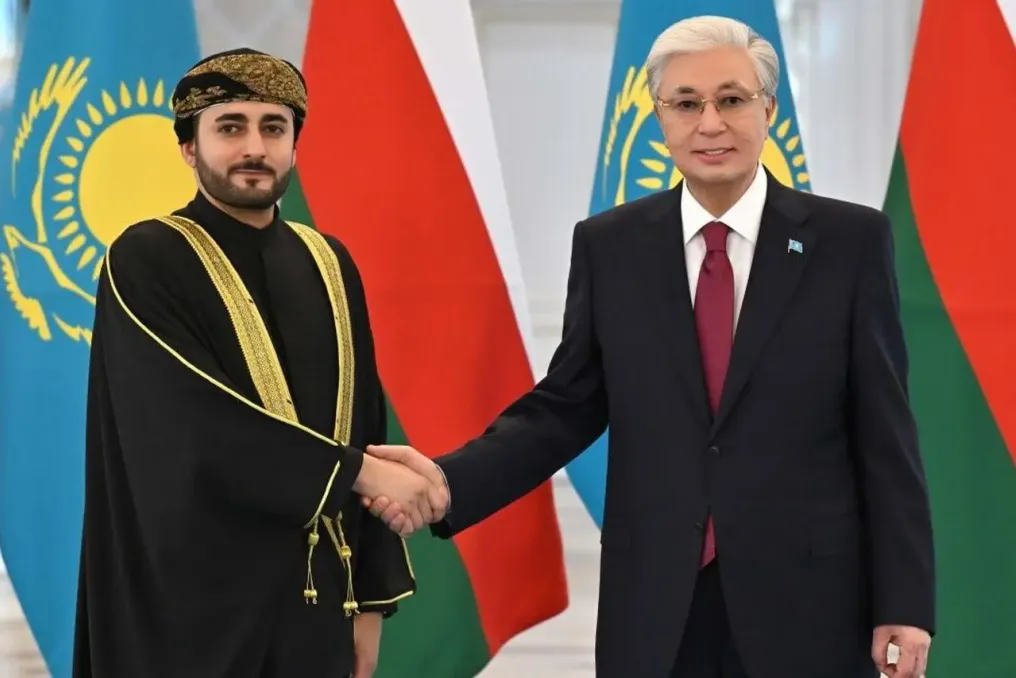
The state visit of the Sultan of Oman, Haitham bin Tariq, to Kazakhstan on October 6, 2026, is viewed as a significant development in relations between the two countries, extending beyond Astana's simple expansion of ties with Gulf states. Cooperation between Kazakhstan and Oman is built on three complementary elements: capital, resources, and logistics.
This visit marked the Sultan of Oman's first trip to Kazakhstan and his first visit to Central Asia as a head of state. Following negotiations, the parties formalized an extensive package of documents, which includes five agreements, ten memoranda of understanding, and several individual arrangements in the fields of investment, energy, and other sectors.
The reasons for the rapprochement between Kazakhstan and Oman are driven by pragmatic needs. Kazakhstan requires new sources of long-term capital, technologies, and alternative routes to external markets. In turn, Oman is implementing a policy of economic diversification and seeking projects outside traditional Middle Eastern markets. Central Asia represents a relatively new direction for Muscat, and Kazakhstan, due to the scale of its economy, resource base, and location between China and Europe, becomes a natural entry point to the region.
Preparations for the current visit began back in December 2025, when the first meeting of the Intergovernmental Commission of Kazakhstan and Oman took place. At that time, the parties identified promising areas for investment: finance, energy, transport, agriculture, technology, tourism, and pharmaceuticals. This meeting continued at the level of diplomatic and investment institutions throughout 2026.
Investment Becomes the Basis of Partnership
One of the key outcomes was reaching an agreement on mutual promotion and protection of investments. Furthermore, the Oman Investment Authority and the Kazakh side agreed to establish a joint investment fund. This is a significant step because, instead of financing scattered projects, the parties aim to create a permanent investment mechanism.
The Omani side has already outlined potential areas, including natural resources, manufacturing, food products, healthcare, renewable energy, logistics, tourism, mining, and artificial intelligence. For Kazakhstan, this format is attractive because it can attract long-term capital from Gulf countries. However, results should be assessed cautiously: the creation of the fund and the investment protection agreement only lay the infrastructure for future investments, but do not guarantee a large influx of capital on their own; the key indicator of success will be the speed at which political agreements translate into concrete projects and funding volumes.
Oil Remains an Important Part of Cooperation
Energy was the second most significant area of discussion. KazMunayGas and OQ Exploration & Production agreed to cooperate in the field of oil and gas exploration and production. Special attention was paid to the situation surrounding the Dunga field. Before the visit, Kazakhstan announced the resolution of long-standing disagreements regarding this project. The new agreement allows the parties to move forward with the field development plan for the period 2026–2039, which provides for the extraction of 67.4 million barrels of oil and a new investment cycle.
Thus, Dunga holds significance beyond just one oil asset. For foreign investors, it is a test of Kazakhstan's ability to resolve complex disputes around major resource projects without allowing them to freeze for extended periods. For Oman, the continuation of the project also creates a basis for expanding the presence of its energy companies in Kazakhstan. The parties are already looking beyond the traditional hydrocarbon sector: a separate agreement between O-Green and Samruk-Energy concerns strategic cooperation in renewable energy, and another agreement provides for the creation of a Kazakhstan-Oman artificial intelligence center for geological exploration. Energy cooperation is gradually expanding from hydrocarbon extraction to technologies, geological exploration, and green energy.
Logistics Becomes the Main Strategic Issue
The most interesting part of the negotiations in the long term is transport. Kazakhstan's geography is both an advantage and a limitation: the country is located between the largest economic centers of Eurasia but lacks direct access to the world's oceans. Oman is in the opposite position, and its ports provide direct access to the Indian Ocean, and subsequently to the markets of South Asia, the Persian Gulf, and East Africa.
This complementarity was particularly emphasized by Sultan Haitham bin Tariq. During the talks, the possibility of developing a trade corridor through Omani ports connected to international transport routes passing through Kazakhstan was discussed. For Astana, this could be another element of its export route diversification policy. This does not mean replacing existing routes through Russia, China, the Caspian Sea, or the Trans-Caspian International Transport Route; rather, Kazakhstan is gradually building a network of alternative exits, allowing the choice of a route depending on the cargo and target market. Oman could become a southern maritime gateway in this system.
If transport links through Iran and onward to Omani port infrastructure prove economically competitive, Kazakhstan will gain an additional route to the Indian Ocean. This could be particularly relevant for trade with India, Gulf countries, and East Africa. However, there is also the biggest gap between political potential and economic reality here: the corridor will only be significant if there are competitive tariffs, coordinated customs procedures, sufficient cargo volumes, and reliable railway and port infrastructure.
From Governments to Business
Another important outcome was the establishment of the Kazakhstan-Oman Business Council. Until now, relations between the two states have developed predominantly 'top-down', through presidents, governments, state funds, and national companies. However, this is insufficient for sustainable trade growth. In the summer of 2026, the Omani side expressed interest in Kazakh agricultural and industrial products. The creation of a permanent business council can help transform this interest into direct company-to-company contacts. This is especially important for Kazakhstan's non-resource exports. Oman itself is not a huge market, but its significance may lie in its role as a gateway to the wider Persian Gulf and Indian Ocean region.
What Does This Mean for Kazakhstan?
For Kazakhstan, the results of the visit align with several strategic goals. Firstly, the country continues to diversify sources of foreign capital, expanding its investor base beyond traditional partners—Russia, China, the European Union, and the United States—and actively attracting sovereign capital from Gulf countries. Secondly, Kazakhstan gains another potential partner in energy and mining. Thirdly, the geography of its transport policy expands: Kazakhstan is increasingly moving beyond the 'China-Europe' axis and gradually developing the 'Central Asia-Persian Gulf-Indian Ocean' direction. Finally, cooperation with Oman fits Kazakhstan's multi-vector economic policy model: instead of replacing one major partner with another, the country increases the number of its external economic ties.
Why Is This Important for Central Asia?
The regional significance of the visit may be even greater than its bilateral aspect. For a long time, the economy of Central Asia was oriented primarily along north-south and east-west routes through a limited number of transport corridors. Today, this structure is becoming significantly more complex. The development of the Trans-Caspian route strengthens the western direction, while expanded ties with China reinforce the eastern one. At the same time, Kazakhstan, Uzbekistan, and other countries in the region are increasingly seeking southern access to Iran, Afghanistan, Pakistan, and the Gulf countries. Oman can become part of this emerging transport geography. If agreements on connecting international corridors are implemented, the potential may extend beyond Kazakh exports: Kazakhstan could act as a transit hub for goods from other Central Asian countries destined for Indian Ocean ports. This is precisely why the Sultan of Oman's first visit to Central Asia carries a certain symbolic weight: Muscat is effectively beginning to develop its own economic line in a region where Gulf states are becoming increasingly prominent investors.
What Comes Next?
The results of the negotiations between Kazakhstan and Oman cannot yet be called an economic breakthrough, as much of the new cooperation architecture is still taking shape. However, the visit is important for another reason: within one round of negotiations, the parties integrated investment, oil and gas, renewable energy, geological exploration, artificial intelligence, aviation, business, and transport infrastructure into a relatively integrated model of cooperation. According to official Omani data, about 20 documents were signed during the visit.
The key task now is their implementation. If the joint investment fund begins financing real projects, cooperation between OQ and KazMunayGas will transition to new assets, and the idea of a transport corridor through Omani ports will gain economic justification. Relations between Astana and Muscat could thus go far beyond ordinary bilateral partnership. For Kazakhstan, this means another source of capital and another route to global markets. For Oman, it provides an opportunity to strengthen its position in Central Asia's largest economy and gain access to emerging Eurasian transport chains. For Central Asia as a whole, this will be another sign of a more fundamental process: the region is gradually ceasing to be a space between several great powers and is transforming into an independent node where the interests of Europe, China, South Asia, and the Gulf states intersect.