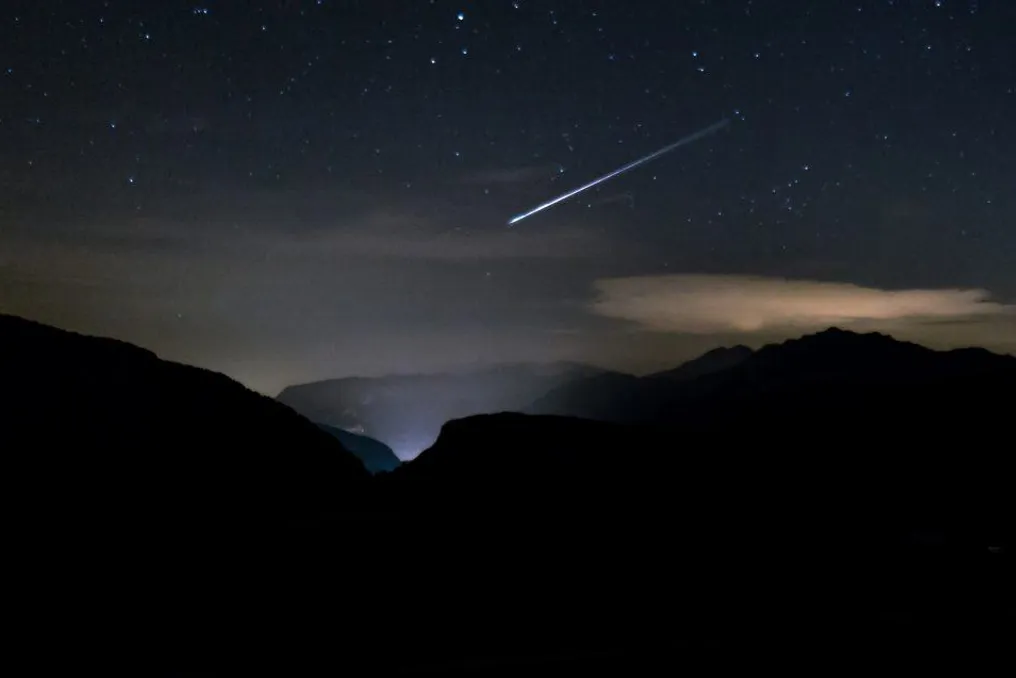
An incredible celestial spectacle is expected in the coming days, associated with two meteor streams: the Draconids and the Southern Taurids. Meteor showers occur when Earth passes through a cloud of debris left behind by comets.
The Draconid debris originates from Comet 21P/Giacobini-Zinner. The name of this stream is linked to the constellation Draco, where its radiant is located, near the head of the dragon.
Taurid meteors form from fragments of Comet 2P/Encke, which is the second periodic comet discovered after the famous 1P/Halley. This stream's radiant is located in the constellation Taurus (Touro).
Periodic comets move regularly through the Solar System without approaching the Sun closely enough to disintegrate. Since the debris is quite large, it often creates colorful fireballs as it passes through Earth's atmosphere.
The Draconids are a short-lived stream active annually from October 6 to 10. According to InTheSky.org's astronomical observation guide, the best time for viewing is on Friday (the 9th), when peak activity is reached.
Furthermore, this phenomenon is quite inconspicuous in the Southern Hemisphere because the constellation Draco is located in the northern celestial hemisphere. Marcelo Zurita, author of a column in Olhar Digital, president of the Paraíba Astronomical Association (APA), and member of the Brazilian Astronomical Society (SAB), noted that 'it can hardly be seen in Brazil. And even if it were, it is a very weak stream.'
He added that even in the Northern Hemisphere, where observation is easier, only one or two meteors are observed per hour. In Brazil, however, it will be a stroke of luck if anyone can capture anything, although the dark sky at the end of the waning moon phase favors observations.
Zurita classifies the Draconids as a 'minor' meteor stream due to the low frequency of events (about 10 per hour). He emphasized that although it is known, its intensity is so low that it does not warrant significant observation efforts.
The Southern Taurid meteor stream is also weak but has a longer period of activity, covering the period from September 10 to November 20, according to InTheSky.
Although the peak activity is scheduled for November 5, the StarWalk guide predicts an initial maximum on Saturday (the 10th). Under ideal conditions, this early peak usually produces about five meteors per hour. At this time, the Moon will be in the first day of the new moon, creating favorable conditions for astronomical observations—a scenario that will repeat next month during the true maximum.
Additionally, the IMO Meteor Shower Calendar for 2026 indicates that activity this year may be slightly above average, increasing the chances of seeing 'fireballs'—extremely bright meteors that can surpass the brightness of Venus and remain visible longer.
The radiant of the Southern Taurids is located in the constellation Taurus, closer to the orange star Aldebaran. However, it slowly shifts over weeks, and at the beginning of the activity (late September and early October), it may appear close to the border between Taurus and Centaurus.
For those who want to try to see meteors this week, even knowing that both streams are not very significant, it is recommended to avoid city light pollution and go to places with the darkest skies possible.
The best time to observe the Draconids is after dark, until approximately 8:00 PM Brazilian time, as the radiant reaches its culmination late in the evening and remains sufficiently high for a short time after sunset.
As for the Southern Taurids, the best displays will likely occur between 1:00 AM and 3:00 AM, when their radiant will be higher.
Observation apps such as Stellarium, Star Walk, or Sky Safari help locate the constellations Draco, Taurus, and Centaurus to search for 'shooting stars'. And, of course, don't forget to make your wish, as tradition dictates.