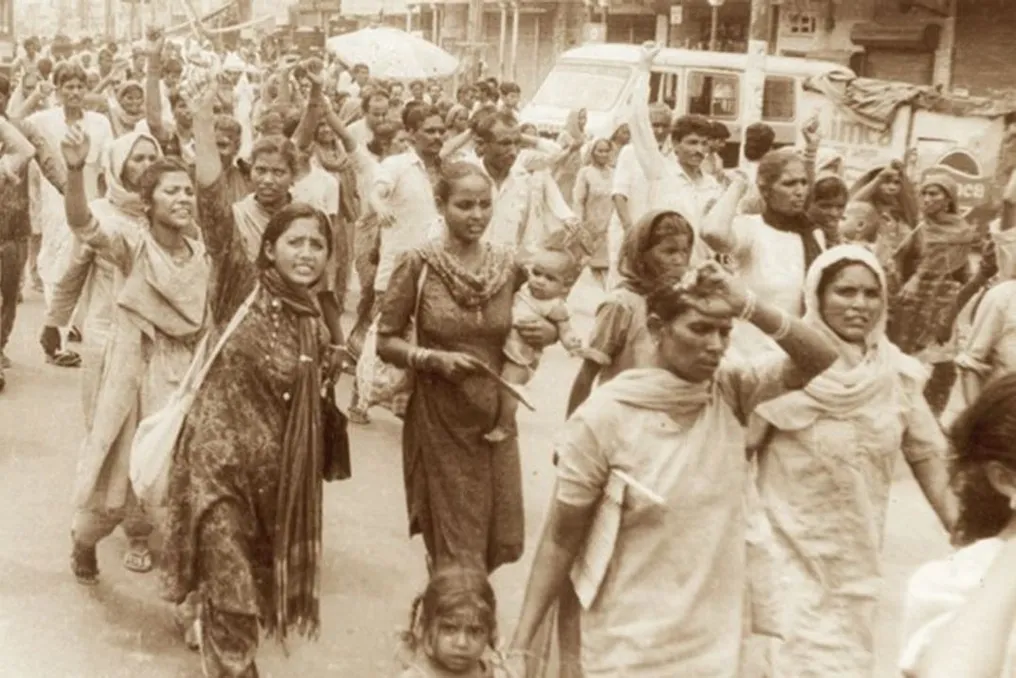
In 1991, a group of women from the village of Dubagunta, located in Nellore district of Andhra Pradesh state, organized a protest, forcing a local liquor store to close using brooms, sticks, and chili powder.
Many of these women had recently been learning to read through evening literacy courses for adults. After two years, the anti-liquor movement spread across the state and compelled the government to impose a ban on the sale of this cheap spirit, which was eroding the financial well-being and peace of families, starting October 1, 1993.
How education changed the discussion
The anti-liquor movement did not begin with a protest, but with an educational initiative. In January 1990, the Literacy Mission launched its campaign in Nellore. As the women attended reading classes, they began openly discussing the problems troubling their households, many of whom cited hard liquor as the cause of these issues.
Researcher Rekha Pandey notes that the spark occurred when drunken men insulted the literacy instructors, and the present women drove them away. The publication Deccan Chronicle adds that the story of a woman named Sitamma from the evening school further inspired the activists.
The scale of their discontent was significant. According to Pandey, there were 864 liquor stores operating in Nellore. The agency Feminism in India reports that state excise revenue grew from 39 crore in 1970–71 to 812 crore in 1991–92. In the same year, the average family in Andhra Pradesh earned 1840 rupees and spent 830 rupees on alcohol.
Brooms, chili powder, and the warehouse
Vardhini Resama, then an illiterate agricultural worker around sixty years old, led the women from Dubagunta. As noted by the New Indian Express, she joined the movement in 1991, inspired by the book 'Mahila Meluko.'
Deccan Chronicle reports that they first destroyed toddy barrels, assuring families dependent on that trade, and then stormed the liquor store despite police intervention. Historian Jidigunta Chalapati Rao adds that they attacked the local warehouse and expelled alcohol smugglers, with most early protesters being poor women from Scheduled Caste and Educated Class.
Women from neighboring villages followed them. The Nellore NGO Jagruti filed a public interest lawsuit against auctions, and the campaign turned into a confrontation with contractors, local officials, the police, and ultimately, the minister. Feminism in India records that contractors funded gangs to protect their monopoly, while the government claimed it could not close stores because the money from alcohol sales was used for social programs.
Pandey presents calculations of this argument: the state spent 1.50 rupees for every kilogram of subsidized rice but received 3.50 rupees from alcohol. The women countered by proposing daily wages instead, demonstrating that they offered an alternative rather than just objecting. They also questioned why water and schools were in deficit while hard liquor was always available, as noted by Feminism in India.
When about 50,000 people, 80% of whom were women, marched against liquor sales auctions in 1992, the police attacked the protesters. In 1992, women in Goa also fought against a bar license in the village of Tivrem and succeeded in having it revoked after a long struggle that included demonstrations and visits to government offices.
From liquor ban to total prohibition
The pressure proved effective. Subsequently, the minister banned the sale of hard liquor starting October 1, 1993, according to The News Minute. Since foreign spirits continued to be sold, the women's groups insisted on a complete ban, and N. T. Rama Rao of the Telugu Desam party promised this during the 1994 election campaign. He implemented a total ban on January 16, 1995, shortly after taking office as minister.
What the ban left behind
The ban did not survive the government that introduced it. On April 1, 1997, approximately 28 months after the ban began, the next minister repealed it. Although the effectiveness of alcohol bans is still debated, the idea that women can decide what is sold in their own neighborhoods has resonated since. In 2016, women from the village of Kachabali in Rajasthan campaigned until 94% of voters supported closing the only liquor store in the village.
Resama died on August 7, 2016, at the age of 93. In recent years, she lived in difficult conditions and underwent dialysis after the land allocated to her by the government was seized. Nevertheless, the woman who could not read when she picked up a broom gave her name to the village, and every report of her death referred to her as Dubagunta Resama.