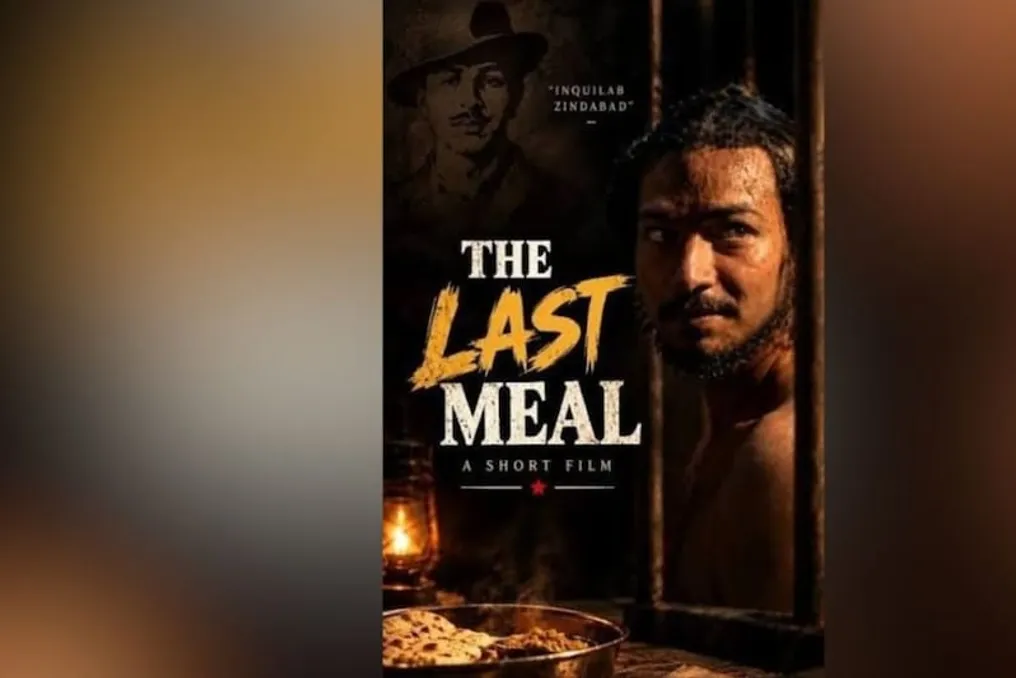
The question of what a person wants to eat a few hours before death seems ordinary, but in the case of Bhagat Singh, it takes on an exceptional character. Ketki Pandey's short film 'Last Meal' places this very question at the center of its narrative. On the evening of March 23, 1931, as the hour of Bhagat Singh, Sukhdev, and Rajguru's execution approached at Lahore Central Jail, Bhagat Singh asked the prison cleaner, Bogu, to prepare food for him. He addressed Bogu as 'Babe.' In the film, makki-roti and sarsa-saag become this final dish.
However, the significance of this episode lies not in what Bhagat Singh wished to eat one last time. The main point is who he wanted to prepare the food from. Bogu occupies a low position in the social hierarchy, where the caste system and discrimination are part of life. Bhagat Singh's request for food prepared by him is an expression of the idea of equality, not just speech. For Bhagat Singh, facing death, human identity is more important than his caste.
This is the most touching moment of the film. Ishthik Khan, in the role of Bogu, subtly conveys the indecision and social shyness inherent in his character. Before him is a prisoner who is about to be executed, but in his interaction with Bhagat Singh, he feels no sense of superiority or humiliation. Akash Dahiya, as Bhagat Singh, conveys this naturalness and resilience. There is no excessive fervor or forced bravery in his performance; the young man's calm before death becomes the strongest aspect of his acting.
The scene with the food is also very impressive because the desire to eat at home and the impending death coexist. Makki-roti and sarsa-saag cease to be mere dishes; they become a memory of home, of comfort, and of the life that Bhagat Singh is about to leave forever. But within the choice of this food is also the question of social equality.
It is here that 'Last Meal' differs from other films about Bhagat Singh. In many films about him, the focus is on his revolutionary struggle, bombs in the assembly, court, prison, and execution. There, his heroism is manifested in grand events. Ketki's film goes beyond these grandiose events and focuses on a single plate. Here, the revolution is shown not in an explosion or a speech, but in the desire to accept food from a person whom society did not grant equal status.
Today, the significance of this episode is growing. Photographs and the name of Bhagat Singh are still widely used in political speeches, posters, and social media. However, his ideas are often reduced merely to his valor and self-sacrifice. 'Last Meal' reminds us that viewing Bhagat Singh only as a martyr diminishes his personality. For him, issues of social equality and humanity were just as important.
Ketki Pandey's direction guides the entire story without unnecessary noise. The tension building amidst the dim light of the prison, the shadows of the bars, and the clinking of keys against the backdrop of food preparation allows one to feel that last night. The film exerts its influence not through the scene of execution as a climax, but through the moments preceding it.
The true value of 'Last Meal' is that it allows us to see Bhagat Singh's last wish, rather than simply repeating his martyrdom. The makki-roti and sarsa-saag prepared by Bogu ultimately become a plate that contains not so much hunger as a sense of belonging, and not so much food as the idea of equality. After watching the film, it is not the execution scene that remains in memory, but this last meal, and perhaps therein lies the greatest success of this short film.