
Simon Harmer notes Proteas' collective resilience ahead of Australia match in Durban
Read more
IOL
iol.co.za

Simon Harmer notes Proteas' collective resilience ahead of Australia match in Durban

Simon Harmer asserts that the current Proteas squad thrives on collective resilience rather than the individual brilliance characteristic of past eras.

Spin veteran Simon Harmer believes that the growth of the Proteas team in Test format over recent years is due to collective fortitude, not reliance on star players.

Proteas will play against Australia in the first match of the three-match series at Kingsmead stadium on Friday. This will be the first Test match at home since their triumphant victory in last year's Test World Cup final against Pat Cummins' team at Lord's.

At the start of that final, the Proteas team faced difficulties. However, as has been the case throughout the tenure of coach Shukri Conrad, they fought and managed to secure a convincing victory over the high-caliber Australian side.

Australia Tour of South Africa

Before the series began, Harmer stated: 'Since returning to this Test structure, it is a group of guys who always find a way out. They have a common goal, and everyone moves in the same direction—it is a very cohesive group.' He added that 'when problems arise, there is a willingness to fight for a teammate. That is the strongest trait: the ability to find ways to win.'

Harmer compared Test cricket to a game of chess, where there are hours or sessions that do not go according to plan. He emphasized that the essence lies in problem-solving and finding solutions, which the team demonstrated exceptionally well.

Harmer debuted in Tests during an era when Proteas possessed numerous world superstars—batsmen with averages in the late 40s and 50s, supported by an attack of fast bowlers that drew envy in world cricket.

Despite the fact that few players in the current squad would make a world XI, the cohesion forged under Conrad turned them into World Test Champions.

Harmer recalled that in the past, there were players like AB de Villiers, Hashim Amla, and Dale Steyn who could win matches single-handedly, and they did so for South Africa repeatedly. He noted that the situation in the current squad is different: 'it is teamwork. Someone else is always reaching out. We do not have this dependence on specific individuals, where 'if they succeed, we succeed'. '

He believes this is likely the main difference between the time he started playing for the national team and what the team has become now.

As Australia arrives in Durban aiming to avenge the loss in the 2025 World Cup final, Harmer expects an extremely tense series, despite the modern T20 tournament having softened off-field hostility.

Harmer warned that 'the Australian team is always competitive; they fight until the end.' He also noted that 'their lower order always seems to score many runs—that 'never give up' attitude. They fight till the end.'

He compared this quality to the South African one: 'We are resilient and probably do our best when our backs are against the wall. This was shown to the world in the Test World Cup final, where people thought Australia would win easily, but this team found a way.'

Harmer is confident that Australia will want revenge for that defeat and will perform extremely competitively. He concluded that the times of huge rivalries, where teams played each other every 18–24 months and created field conflicts, are over. Although T20 cricket has somewhat softened this, he does not think they will be soft in any sense.
Similar stories

Proteas defeated Australia and secured a series win in the ODI match
Read more
iol.co.za

Proteas defeated Australia and secured a series win in the ODI match

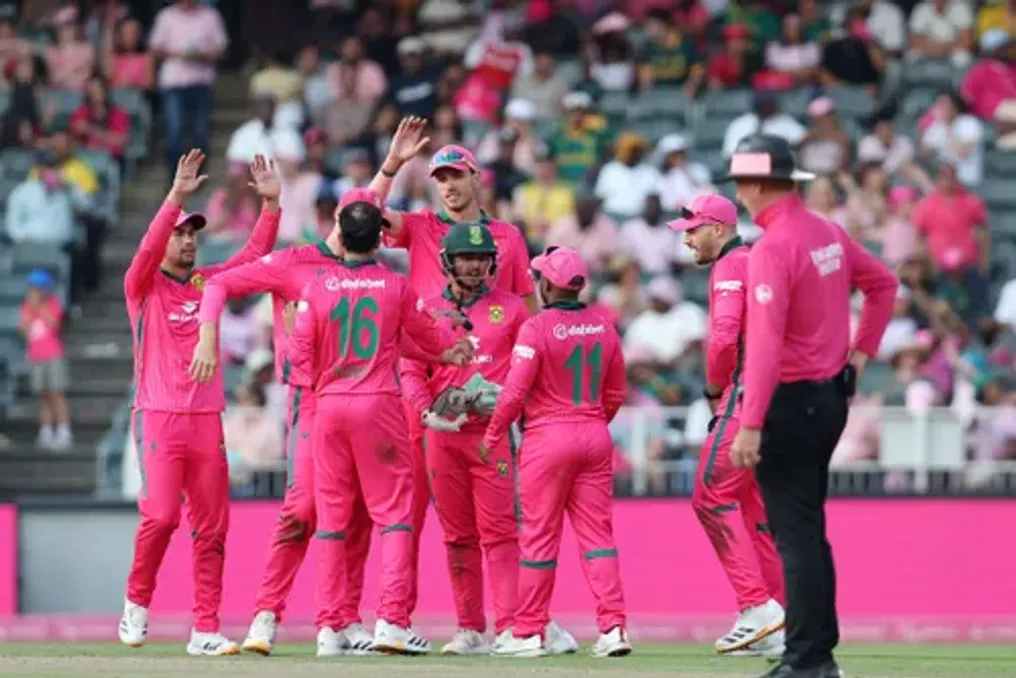
The Proteas team managed to stop Australia's chase attempt, thereby securing a series victory in the match held on Pink Day.

Proteas successfully defended their total of 365/9 at the DP World Wanderers Stadium, after which Australia was bowled out for 333 runs. This victory allowed South Africa to cement their series lead with a buffer of matches.

Earlier, the team captain, Temba Bavuma, played a key role in the game, scoring a confident 103 runs off 116 balls. Following him, David Miller mounted an impressive attack against the Australian batting lineup, scoring 142 runs from just 93 deliveries, including nine sixes and twelve fours.

Australian newcomer Jack Edwards slowed down the pace towards the end of the game, finishing with figures of 5/67. Australia started the chase aggressively, with Mitchell Marsh scoring 84 runs off 53 balls, and Travis Head adding 64 runs. However, the Proteas attack dismantled crucial partnerships, derailing the visitors' attempts to score and leading to a comfortable victory for the South African side.

Mathew Britzke demonstrated the mentality required for World Cup battles after reaching his second century in ODIs
Read more
iol.co.za

Mathew Britzke demonstrated the mentality required for World Cup battles after reaching his second century in ODIs

Mathew Britzke, the Proteas team's centurion, highlighted the necessity of deep inner effort to manage pressure during the match against Australia in the South Africa tour.

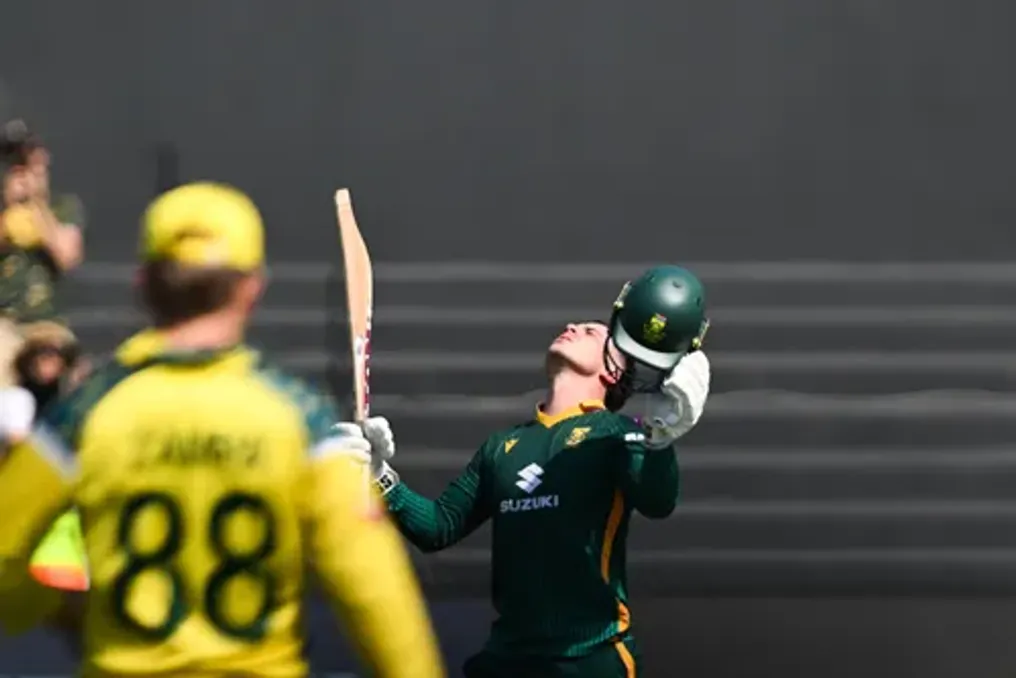
On Thursday at Kingsmead in Durban, Mathew Britzke celebrated his second ODI century during the first match against Australia. While any international century is a significant achievement, some moments become more special. For instance, coming onto the field when the team was in a critical position of 29/2 in the eighth over against the world champions, under conditions favorable to bowlers like Josh Hazlewood and Mitchell Starc.

The task was complicated by the fact that teammates, including the captain, continued to make errors. Nevertheless, he kept going, meeting every new challenge and taking on all the pressure until he reached his well-deserved second century after exactly 100 balls.

After his decisive performance in the first ODI match against Australia at Kingsmead, Mathew Britzke explained: 'When the first two wickets fell against a world-class attacking team, I really had to dig very deep, and it drained me a lot, but I am just grateful that I could get through it and score those 100 runs for everyone.'

He added that it was a moment of pride for him and his family, but in his opinion, the main difficulty lay in the initial phase and the need to overcome it mentally. He mentioned there were moments when he wanted to take risks, but the team kept losing batsmen, so reaching the hundred-run mark was a relief, and he is very grateful.

When other players' methods faltered, Britzke explained his approach at the crease: 'The talk was simply about playing straight. I think as soon as you start looking too square, you see a couple of balls that lead to the leading edges and so on. So you just had to play straight, have good body language, and get through it.'

During the game, Britzke showed strong competitive spirit. After Australian wicketkeeper Josh Inglis attempted a run-out, Britzke and his partner Marco Jansen managed to run one extra run at the end of the overs—an action that goes against the spirit of the game but does not violate the rules. Australian fast bowler Nathan Ellis was clearly upset and expressed his displeasure at both players, who exacerbated the situation by taking the next two balls for six consecutively.

Britzke stated: 'Honestly, I was in the moment. If this were the World Cup, I probably would have done it again. If I were on the field, I would also heavily punish the batter, so it's just part of the game.'

Following his magnificent 112 runs off 106 balls, which helped Proteas win by 67 runs, he was interviewed. Jansen, positioned on the other side of the field, not only contributed to potential confrontations but also helped relieve the pressure on Britzke. Jansen played a key role in increasing the tempo of the innings, scoring an impressive 75 runs off 59 balls (7 fours and 4 sixes).

Their partnership of 107 runs for the sixth wicket, consisting of only 81 balls, proved decisive for the match, especially considering Britzke did not hit a single four in the first 55 runs of that partnership. Britzke noted: 'It was a special innings from Marco. He helped my innings a lot there.' He continued: 'I think if you look at him when he is in top form, he aims to attack. There was never a plan for him to play aggressively. He connected with the ball, and then just used that momentum. We fuel each other's energy, and I was happy to give him the opportunity to score.'

Thanks to this second century, Britzke's average rose to 63.23, making it the third highest among all players who have played at least 10 matches, and his 822 runs are the highest among all batters who have completed 14 ODI innings. As the home World Cup is approximately 12 months away, the Gqeberha-born batter confidently asserts his right to be the permanent number 4 in the Proteas.

Popular