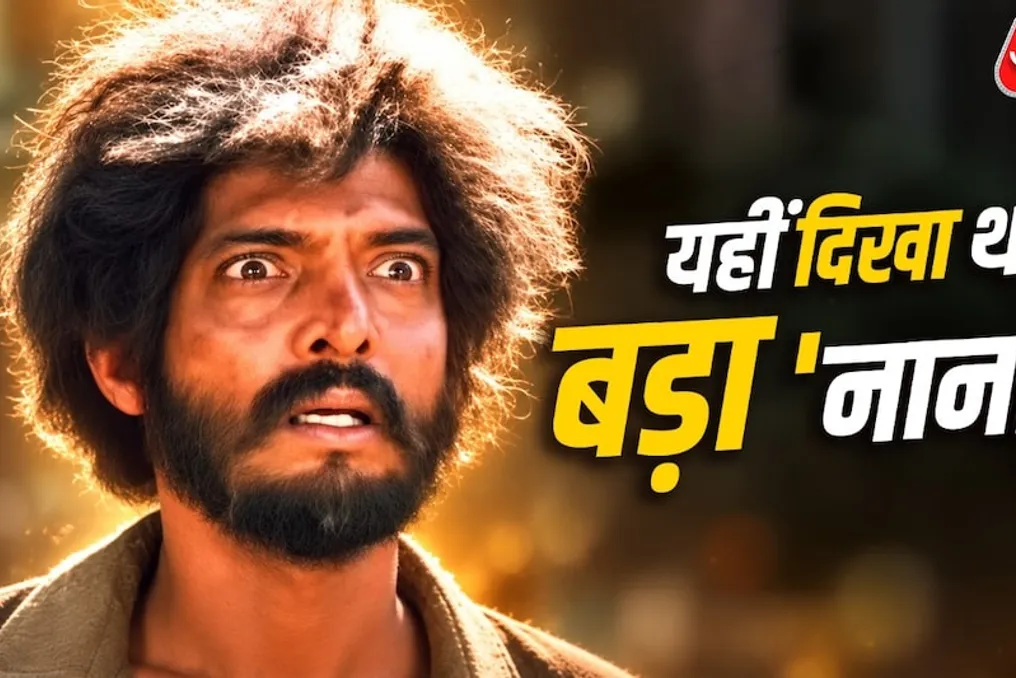
Following the passing of actor Nana Patekar, it became evident how unique his mastery was. His performances were distinguished by the audience feeling not just acting, but the presence of a living person on stage. Anger resonated in his voice, anxiety in his eyes, and silence carried an entire dialogue, reflecting life experiences.
To remember Nana, naturally, one wants to return to his most famous works, such as 'Parinda,' 'Krantivir,' 'Ab Tak Chhappan,' and 'Welcome.' However, for a complete understanding of his acting journey, it is recommended to watch again one film that marked an early milestone in his career—this is 'Pratighat.'
The film, released in 1987, differed greatly from the Indian cinema of that time. The plot centered on Lakshmi, played by Sujatha Mehta, and the intertwining of politics with crime. It was in this story that Nana Patekar portrayed Karmavir, a former police officer.
It is interesting that Nana, who later became one of the most influential actors in Indian cinema, was not the main protagonist in this film. Nevertheless, his character left an indelible mark. This was Nana's greatest strength: he did not need leading roles; he knew how to transform supporting characters into significant ones.
Karmavir was not a bright hero; he was a broken man—a former policeman whose life was ruined by crime and violence. After a terrible incident involving his wife, his mental state deteriorated. Nana didn't just portray him as a 'mad policeman'; he captured the inner pain, the helplessness hidden behind the anger, and the defeat concealed by anxiety. This is where Nana differed from other actors.
He didn't embellish the character; he showed its flaws. This characteristic manifested in almost every memorable role: whether it was Anna in 'Parinda,' Pratap Narayan Tilak in 'Krantivir,' Sadhu Agashe in 'Ab Tak Chhappan,' or Uday Shetty in 'Welcome.' Each character was unique, but they all shared one thing—they seemed absolutely alive. Nana did not impose his stamp on the characters; he became a part of them.
So, Karmavir appeared on screen, Anna appeared, Pratap appeared, Sadhu Agashe appeared. This is the sign of a great actor. An actor delivers a dialogue, but a great actor brings to the stage the human being behind that dialogue.
'Pratighat' shows this too. It was not just a story of revenge; it was a sharp critique of the relationship between politics and crime of that era. The film touched upon the theme of systemic failure and the fear of power confronting women.
When violence occurs against Lakshmi, the system does not support her. Yet, she does not give up. She fights, uniting people around her and ultimately challenging the very power that tried to destroy her. Thus, 'Pratighat' was ahead of its time. But Karmavir introduces a different kind of tragedy into this story. Lakshmi chooses resistance, while Karmavir is a broken man living within this system.
One chose confrontation, the other broke. And Nana played this broken man so truthfully that his image remains in memory even after the film ends. This is where one can understand the revolution in Nana's acting skill. He proved in Indian cinema that an actor does not have to look flawless, speak like a hero, or deliver dialogues spectacularly. Sometimes a tired face, a trembling voice, and anxious eyes say more than any words.
Nana's acting had exactly this raw quality. He wasn't brilliant; he was sincere. Perhaps that is why no one else could fully replicate his voice. His anger cannot be copied, his silence imitated, and his manner of delivering dialogues belonged only to him. Because Nana's true strength lay not in the dialogues, but in the anxiety preceding them. That is why an entire story emerged from each of his small scenes.
Today, one should watch 'Pratighat' again because it shows Nana Patekar during a period when he was not yet 'Nana Patekar.' No huge star status, no hit dialogues, no role for which the film would be sold. Only acting. And perhaps that is the most beautiful thing. The genius of his acting manifested even before he became a great actor.
Later, he received big roles, big dialogues, big awards. People recognized his voice, noticed his anger, observed his laughter, and even his silence. But the seed of this path was sown long before, perhaps in 'Pratighat,' in Karmavir, in this broken policeman, in whom deep pain lay beneath the anger. That was Nana. He made the character greater than the actor. Therefore, calling Nana Patekar simply a successful actor would be unfair. He was one of those artists who taught Indian cinema that acting is not just about delivering dialogues. Sometimes you act with your eyes, sometimes with your body, sometimes with your voice, and sometimes—simply with silence.