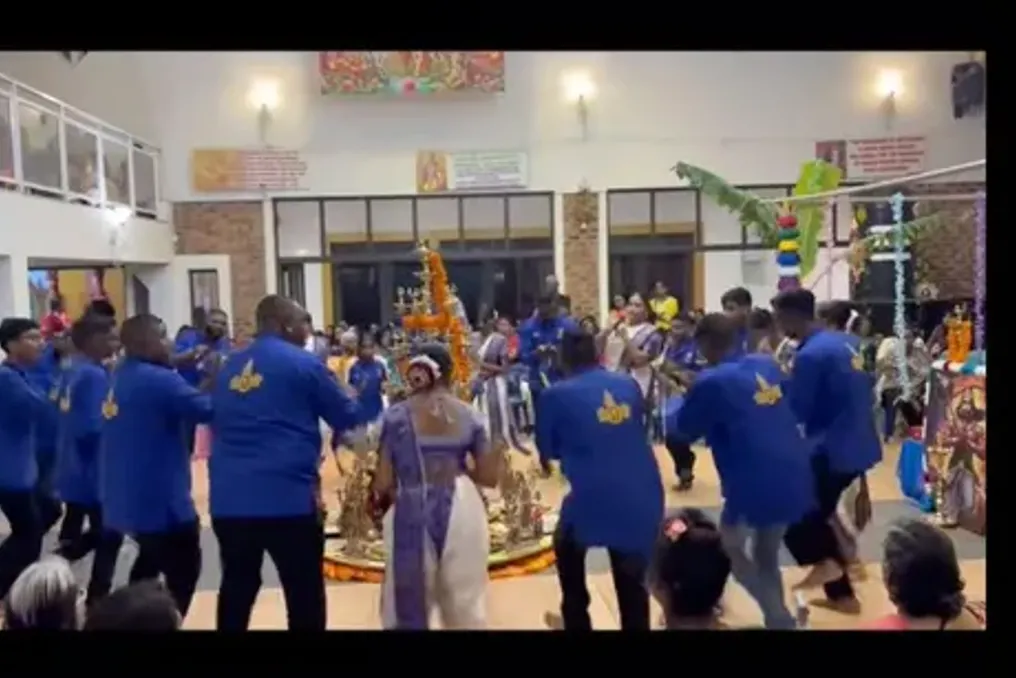
The author reflects on what modern Ram Bhajan represents in South Africa from a religious perspective, noting the significant evolution of this experience. What was initially understood as religious singing has transformed in many South African communities into something larger: a religious gathering, a cultural expression, a social event, and increasingly, a noticeable phenomenon on social media.
Attending Ram Bhajans, which are usually held during the month of Purattasi dedicated to the worship of Lord Vishnu, makes the subject clear. Lord Rama is the seventh incarnation of the Hindu god Vishnu. The singing can be energetic, the claps rhythmic and coordinated, and movements that all participants know are often present. Attendees are aware of the specific sequence of the evening, and soon the predominantly Telugu-oriented community not only sings in chorus but also moves together, acquiring a recognizable energy and atmosphere.
However, the history of this seemingly modern phenomenon is much older. Bhajan is rooted in the Hindu tradition of devotional singing, where music serves as a medium for expressing bhakti, or devotion. Singing the names and stories of the divine is not just entertainment; it can be an act of remembrance, humility, and collective worship. In the case of Rama, these traditions are linked to the extremely influential traditions of the Ramayana, which have spread throughout India and among the Hindu diaspora in various linguistic and cultural forms.
South Africa's relationship with these traditions has its own unique history. Starting in 1860, Indians arrived in Natal as indentured laborers, bringing with them religious practices, languages, music, stories, and forms of worship. These traditions subsequently transformed under the influence of the realities of life in South Africa. It is important to remember that there was no single Indian religious tradition transported whole from India to South Africa. The arriving communities came from different parts of India and spoke different languages, and their religious practices reflected these historical particularities. Thus, the South African version of Ram Bhajan is already a result of adaptation.
The author is interested in how this process of adaptation continues in modern Ram Bhajan. One of the most noticeable changes is the role of choreography. There are now Ram Bhajans where specific movements, gestures, and sequences are performed collectively. The choreography may not belong to a formal classical dance lexicon, but it possesses structure and a common physical language. Participants know when to clap, when to move or jump to the center, when to gesture through eye contact with each other, and when to change formation. This is important because it reminds us that religious practice is not limited to words; it can be embodied.
When an entire group moves synchronously, something more happens than an individual act of singing. People physically connect through repetition and rhythm. A person who does not know all the words can still participate through movement. Notably, a wonderful network of Ram Bhajan groups has formed in Durban, each with its own character, history, and community of followers. Among them are Shree Radha Krishna Bhajana and Thirupathie Seva Raam Bhajan Group, Campbells Town Shree Raam Bhajan Group, Shree Pranava Bhajan Group, DL Roberts Andhra Bhajan Group, and Sri Suria Narayan Temple Bhajan Group, and the landscape is much broader than one might initially assume. There are also long-established and popular groups like Venkateswara Raam Bhajan Society, Rossburgh Shree Raam Bhajan Group, Illovo Ram Bhajan Group, and others, which continue to perform at religious and cultural events in and around Durban.
A notable aspect is the growing participation of youth, especially young women. Girls are no longer just observers or accompanying family members at these gatherings; they actively participate in singing, movements, and organizing events. Of course, no Ram Bhajan goes without snacks and sweets—such as bhajiya, samosas, vadas, murukku, guggula, and its cousin model-S Vorende, poli, gulab jamun, and tons of sweet confectionery. It is no wonder that the Andras of Hill Pointe are known for their sweet tea.
Naturally, it is impossible to discuss the social life of modern Ram Bhajan without acknowledging its rather entertaining role as a new space for Indian socializing. What was once merely a reason for prayer and community gathering has, in some circles, become an opportunity for young people to meet, for families to observe, and perhaps for several aunties to quietly notice who is standing next to whom. In this sense, Ram Bhajan has become as much a social space as a spiritual one—a place where faith, community, culture, and sometimes romance share one room, all by the blessings of Hari Narayana.
And, of course, there are social media. Modern Ram Bhajan is increasingly perceived not only by those physically present at the venue but also by those watching through a phone. There are numerous live streams and recordings of these gatherings circulating on social media platforms, allowing people who could not attend to watch remotely. Celebrations taking place in Durban can be viewed by relatives in Cape Town, Johannesburg, London, or any other part of the diaspora in real time. Young people browsing social media can enjoy Ram Bhajan even if they have never attended. They hear the music, observe the movements, and can imagine the divine and festive atmosphere of the gathering. Bhajan becomes a visually accessible form in a way it never was before.
Ram Bhajan in South Africa has undergone an incredible journey, not to mention transformation. Its history is tied to migration, forced labor, religious devotion, community formation, and the preservation of cultural memory. Ultimately, a tradition that has survived generations is unlikely to remain completely unchanged.