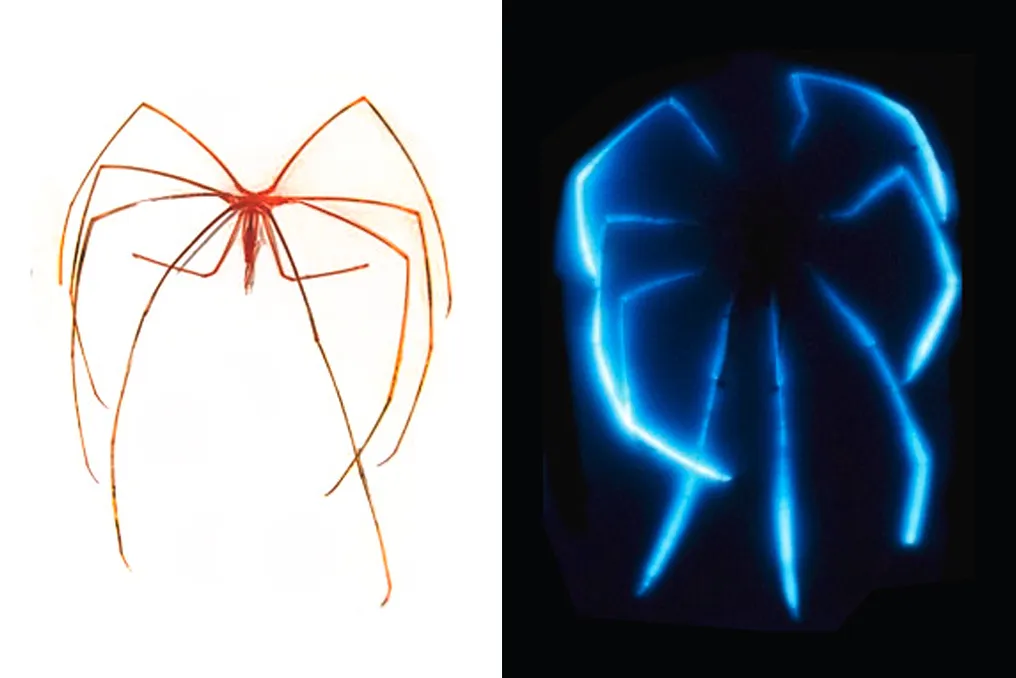
In 2017, during a marine survey conducted in the deep waters off the east coast of Australia, thousands of meters deep, scientists detected a glow in the oceanic darkness. This phenomenon revealed the presence of giant sea spiders that emit a blue light. The identified species were Colossendeis tasmanica and Colossendeis minor, which had not been formally documented or photographed until then.
Currently, there is little information available about bioluminescent marine spiders in general. The scientific community has not yet established firm conclusions about the light emission mechanism, questioning whether the luminescence is generated by the organisms themselves or acquired from other creatures.
Given this, researchers opted to collect samples of the animals. Seven specimens of Colossendeis tasmanica and two of Colossendeis minor were taken to the research vessel for analysis, found at depths ranging between 1,006 and 4,977 meters. The findings of this study were published this month in the scientific journal Deep Sea Research.
The first experimental test consisted of exposing the spiders to a dark room. It was observed that when the animals were stimulated by light pinches or chemical substances, they began to glow, strongly suggesting that the light was produced internally by the animals themselves.
Scientists also made detailed measurements of the luminous characteristics, such as intensity and color. In the specific case of Colossendeis tasmanica, the light presented a dark blue hue, being stronger on the legs and progressively decreasing along the body. Additionally, the glow induced by manual manipulation by the researchers was weaker and more ephemeral, while the chemical stimulus could last up to ten minutes.
Subsequently, biochemical experiments were conducted in the laboratory on land. Microscopic analysis of the spiders' tissues allowed identification that the bioluminescence is generated by cells located in the intestine, present in the animals' legs. This points to a possible link between the light and some type of food ingested by the spiders.
An additional chemical assay demonstrated that the combination of hydrogen peroxide and calcium caused the animals to glow, suggesting the existence of a photoprotein production system, similar to that found in jellyfish.
With these preliminary discoveries, the research aims to deepen the understanding of this mechanism, which still presents many questions. The authors of the study emphasize that the ecological function of the bioluminescence of C. tasmanica—whether for defense against predators, hunting, or reproduction—remains a hypothesis and requires more detailed investigation of this abyssal species.