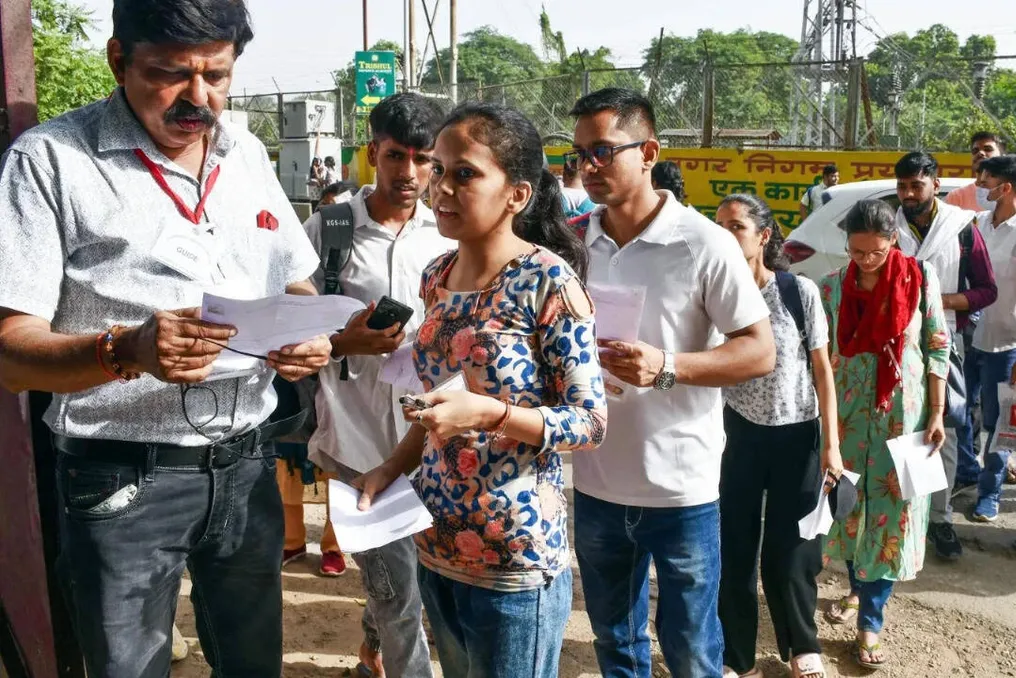
CUET-UG 2027 may become shorter and simpler: changes to the entrance exam format are being considered
Read more
The times of India
timesofindia.indiatimes.com

CUET-UG 2027 may become shorter and simpler: changes to the entrance exam format are being considered

Significant changes may occur in CUET-UG 2027, including a reduction in the number of subjects, shortening of test durations, and the introduction of a new grouping system. The goal of these changes is to allow candidates to complete the entire entrance examination in a single day, eliminating the need for multiple visits to examination centers.

Sources reported that the University Grants Commission and the National Testing Agency are developing methodology to shorten the overall examination cycle and simplify the process for applicants.

According to one of the proposals under consideration, the time allocated for individual tests could be reduced so that a student taking five subjects could complete all tests in approximately 180–200 minutes.

Furthermore, CUET-UG is considering reducing the number of subjects from five to four. The Ministry of Education, UGC, and NTA recently held discussions on the proposed adjustments and instructed officials to study how the exam can be condensed without violating university admission requirements.

Similar stories

NMC requested report on harassment allegations at Indore medical college following resident's suicide
Read more
timesofindia.indiatimes.com

NMC requested report on harassment allegations at Indore medical college following resident's suicide

Several weeks after the alleged suicide of a postgraduate student in Surat, which once again raised concerns about bullying and harassment in medical educational institutions, the National Medical Council (NMC) demanded a page-by-page report within 24 hours from MGM Medical College and MY Hospital in Indore.

This report must concern allegations of psychological harassment, public humiliation, and academic intimidation of a first-year resident.

Gauteng spends over 183 million rand annually on renting 10 education district offices
Read more
iol.co.za

Gauteng spends over 183 million rand annually on renting 10 education district offices

The Gauteng government spends over 183 million rand annually on renting ten education district offices from private landlords. Meanwhile, the provincial government is assessing the possibility of using some of its own buildings to house these institutions.

Jacob Mamabolo, Gauteng's Minister of Cooperative Governance and Traditional Affairs (CoGTA) and Infrastructure Development, stated in the Gauteng Provincial Legislature that there are currently no suitable government buildings for the needs of the respective education districts.

Mikhail Waters, the DA representative in Gauteng for education, questioned why 10 out of the 15 district offices of the Gauteng Department of Education are privately owned, and asked if vacant or underutilized provincial properties could be used instead.

Waters noted that the province spends millions on private accommodation despite questions about utilizing state facilities. He added that the Minister acknowledged that the Department of Infrastructure Development and the Gauteng Infrastructure Finance Agency (GIFA) are still analyzing needs and housing assessments.

Waters also challenged Mamabolo's assertion that government buildings should be excluded until the provincial assessment of available facilities is complete. In response, Mamabolo explained that Gauteng aims to divest from rented accommodation because the funds spent on leases do not generate assets for the province.

Mamabolo emphasized that the province wishes to utilize its owned buildings more actively instead of continuing to spend money on rented premises. He reported that they intend to start by using their own buildings through a public-private partnership deal promoted by GIFA.

He specified that the province is conducting a needs analysis and housing assessment jointly with GIFA, including studying the suitability of existing government properties. This follows Mamabolo's statement on September 8th to the legislature that 'there are currently no suitable, available, and sufficiently capacious buildings owned by the Government of the Gauteng Province' in certain districts for housing education district offices.

Mamabolo also mentioned that details were requested in February regarding 41 unused Gauteng government buildings, including 12 in Johannesburg and 29 in Tshwane, concerning ownership rights, lease agreements, and associated expenditures.

The Minister clarified that the province's plans for more effective use of government buildings include not only relocating offices into existing space. He noted that the GIFA process he mentioned regarding the Johannesburg CBD differs from the current assessment of education district offices.

Mamabolo added that some provincial buildings in the Johannesburg CBD have been deemed unsuitable and require renovation, but the province lacks sufficient funds to carry out all the work independently. Therefore, as he said, they need to collaborate with the private sector.

He also reported that the process in the Johannesburg CBD will be replaced by a second phase that will review regional offices, including those used by the Department of Education. The current housing assessment considers the province's office needs, living conditions, and available state facilities, among which options for renovation, restructuring, consolidation, and utilization of existing government buildings are being considered.

Study shows many students in no-fee schools fall behind by third grade
Read more
iol.co.za

Study shows many students in no-fee schools fall behind by third grade

According to a four-year longitudinal study conducted in the Western Cape, children who start school within age norms are much less likely to stay on track by third grade if they attend zero or low-fee schools.

The 'Roots & Shoots' study, funded by the Mr Price Foundation and conducted in collaboration with Stellenbosch University, tracked the progress of 557 students who began in Grade R in 2022. These students attended 75 public primary schools across five educational districts: Metro Central, Metro East, Metro North, Metro South, and Cape Winelands.

At the final stage in 2025, 401 students in third grade were re-assessed. Of the 75 schools, 91% serve historically disadvantaged communities and do not charge fees or charge them for a very low amount.

Literacy Gap

The study results revealed a significant disparity in learning outcomes depending on the type of school. By third grade, 92% of students in medium-fee schools achieved the target reading level for third grade, whereas this figure was only 49% in no-fee schools and 36% in low-fee schools.

Among the students observed at both the initial and final stages, the proportion considered to be on track decreased from 56% to 40% in no-fee schools and from 58% to 32% in low-fee schools. In medium-fee schools, this figure remained stable, increasing from 88% to 90%.

Octavius Pukubye, the foundation director, noted: 'School readiness is necessary, but not sufficient. Even when children start school within age norms, many in poorer schools fall behind.'

He added that without improving the quality of teaching and learning at the foundational education stage, there is a limit to what early interventions alone can achieve for children.

Dr. Helen Hofmeyr, a senior researcher at Stellenbosch University, emphasized that observing the same group over four years allowed for a clearer picture of learning development over time. She stated: 'The findings show that early advantage does not persist uniformly. The school context appears to play a crucial role in whether children stay on track as they progress through the foundational education stage.'

The study also found a gender gap in literacy: 60% of girls reached the third-grade target level compared to 42% of boys. A similar gap was not found in mathematics.

The findings align with international data. Studies in the United States have shown that early developmental advantages are maintained only when children transition to high-quality primary institutions. A Princeton University study documented persistent gaps in school readiness between children from poorer and wealthier families, while research conducted in Tennessee established that effective teachers or quality schools alone are insufficient to close achievement gaps, but the presence of both factors was linked to sustained progress in math and English.

The researchers argue that the implications extend beyond access to early childhood development. Quality early education depends on capable and well-supported teachers and an educational environment, especially in no-fee and low-fee schools where gaps are greatest. They insist that resources must account for different starting points, concentrating funding, coaching, and student support where children face the highest risk of falling behind.

The study authors believe that the data strengthens the argument for coordinated action among government, researchers, implementers, sponsors, and civil society, with the government playing a central role in ensuring system-wide coherence.

Popular