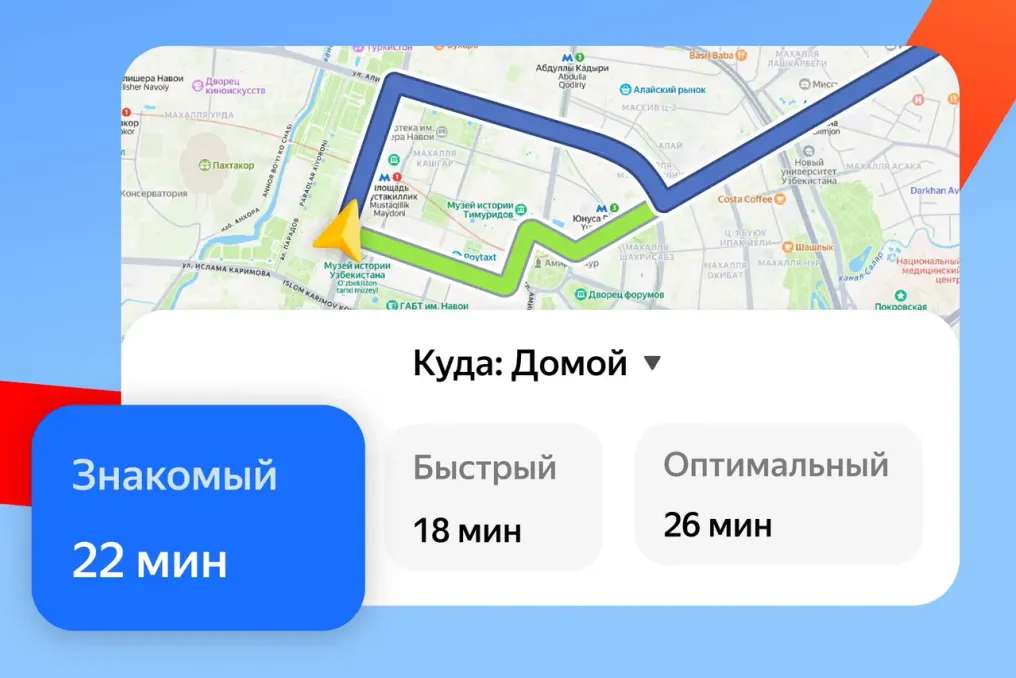
Yandex Maps and Yandex Navigator services have started providing users with individually customized routes that take into account each person's driving characteristics.
When planning a trip, these services analyze the user's travel history and suggest the most suitable road options. The choice can range from the fastest route to a more familiar or simpler one.
The new feature is designed to make the navigation process more convenient for both novice and experienced drivers. Drivers who are newly learning to drive can choose less complex routes with fewer maneuvers and intersections, while experienced users can stick to their usual roads.
Route personalization is achieved through the use of machine learning and artificial intelligence technologies. The machine learning model studies the route options calculated by the navigation engine, as well as aggregated data on user behavior during trips.
The system takes into account how often the driver deviates from the suggested path, which road options are chosen most frequently, and the typical distances they cover.
Depending on the current traffic situation and the specifics of the particular journey, the services can offer more than ten different types of routes. For example, if the standard option includes many complex turns, crossings, or U-turns, the driver may be offered a 'Simple' route.
For regular trips, such as the commute from home to work, the 'Familiar' option is available, which helps users follow their usual path. When traveling within the city, users can use the 'Through the Centre' and 'Bypass' options.
If saving time is the priority, the system will suggest the 'Fast' route with the least travel time. The 'Short' option focuses on minimizing the distance traveled, while the 'Optimal' route considers multiple factors, including travel time, distance, and traffic conditions.
When roads are clear, the service can also suggest a 'No Traffic' route to help avoid the most congested sections. Thus, navigation gradually transitions from a universal approach to a more individualized model: different drivers heading to the same destination may be offered different routes depending on their experience, habits, and current priorities.
The available options can be selected directly on the car's display. This feature is supported in Yandex Maps and Yandex Navigator when the smartphone is connected to the vehicle's multimedia system via Apple CarPlay or Android Auto.
The development of personalized navigation demonstrates how machine learning technologies are transforming the everyday driving experience. Modern navigation systems are beginning to consider individual behavior instead of simply calculating the shortest or fastest route and adapting recommendations to each driver.