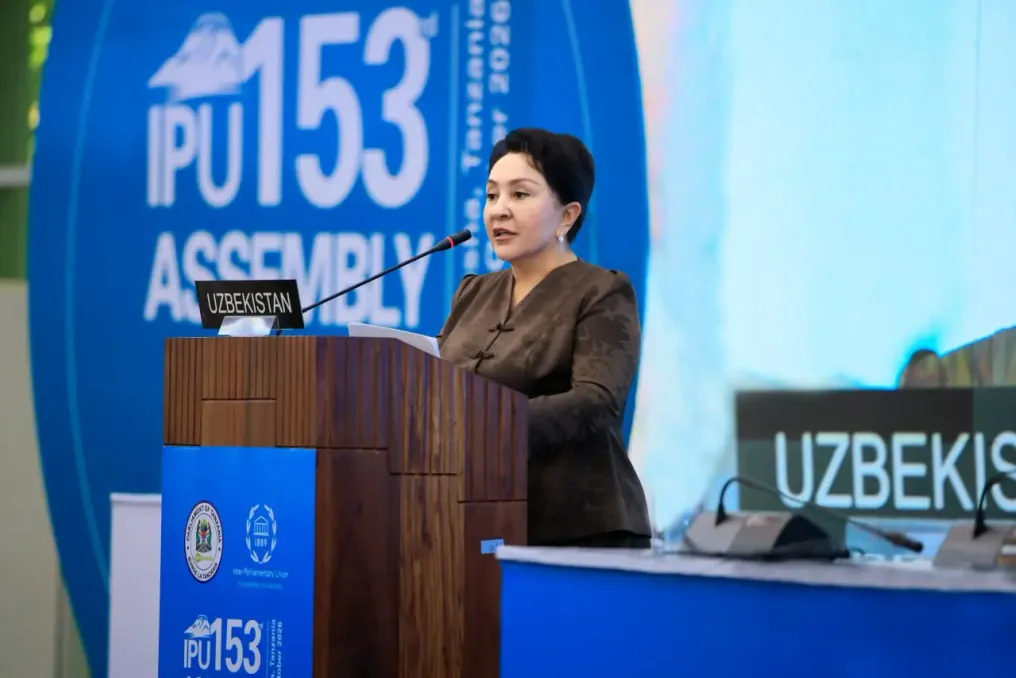
Tanzila Narbaeva presented Uzbekistan's experience at the Parliamentary Union Assembly
Read more
UzDaily
uzdaily.uz

Tanzila Narbaeva presented Uzbekistan's experience at the Parliamentary Union Assembly

During the 153rd Assembly of the Parliamentary Union (IPU), general debates were held focusing on strengthening effective governance and expanding opportunities for communities based on the principles of inclusivity, trust, and equal chances.

The discussions centered on enhancing trust in state structures, increasing citizen participation in decision-making, ensuring equal opportunities, and raising the role of parliaments in achieving tangible changes in people's lives.

Tanzila Narbaeva, head of the Uzbek parliamentary delegation and Chairman of the Senate of the Oliy Majlis, presented the country's experience in implementing the principles of a social state, reducing poverty levels, and strengthening the legal foundations of social policy.

She also highlighted efforts aimed at improving legislation and strengthening parliamentary oversight of the implementation of state policy. During the debates, Uzbekistan presented initiatives designed to better align the legislative and supervisory activities of parliaments with the needs of the population.

Specifically, these initiatives call for greater attention to public opinion and the views of local representative bodies when developing laws, as well as assessing state programs and budgets from the perspective of ensuring equal opportunities. Special attention is suggested to be paid to the practical results of adopted decisions and their impact on people's lives within the framework of parliamentary oversight.

Participants also discussed the resolution 'Strengthening the Role of Parliaments in Social Development,' which was adopted by the UN General Assembly at Uzbekistan's initiative. It was noted that this document aims to increase the accountability of parliaments for social development, ensure equal opportunities, and promote human well-being. In this regard, the importance of further strengthening inter-parliamentary cooperation to implement the provisions of this resolution was emphasized.


Similar stories

Leading Universities in Uzbekistan to Receive 500 Million Sums for Successful Graduate Employment
Read more
podrobno.uz

Leading Universities in Uzbekistan to Receive 500 Million Sums for Successful Graduate Employment

Uzbekistan is implementing a Higher Education Graduate Quality Index designed to assess how successfully graduates find and retain employment, as well as the income they receive.

According to the plan, twenty universities demonstrating the best results will annually receive financial support of 500 million sums. The index calculation will be based on four key criteria: the percentage of employed graduates, the stability of their employment, average monthly earnings, and employment category. Graduates from both bachelor's and master's programs of the corresponding year will be included in the assessment.

The evaluation of results will be conducted by the Agency for Ensuring Education Quality. For this purpose, a specialized digital platform will be developed that automatically collects data from state body information systems. The launch of this platform is scheduled for before November 10, and the connection of all necessary databases is planned for before December 1.

Educational institutions will be able to track their indicators through personal accounts. If attempts to artificially inflate indicators are detected, the institution risks being excluded from the rating for the current year. Annually, 20 universities with the highest indicators will receive 500 million sums from the state budget, part of which is directed towards supporting university career centers.

It should be noted that earlier reports indicated that approximately one out of six graduates from Uzbek universities could not find employment in the 2024/2025 academic year.

Uzbekistan changes employment accounting methodology, including the self-employed and individual entrepreneurs
Read more
podrobno.uz

Uzbekistan changes employment accounting methodology, including the self-employed and individual entrepreneurs

Uzbekistan is implementing changes in approaches to calculating employed citizens and unemployment rates. The state plans to aggregate information on population work and income from multiple state sources, including tax, labor, and migration databases.

These adjustments are officially enshrined in a Cabinet of Ministers resolution adopted on September 29th and effective from September 30th. Now, when determining the size of the working population, not only data on formal employment will be taken into account.

Individual entrepreneurs, self-employed persons, agricultural workers, artisans, citizens temporarily abroad for work, and people engaged in activities on their own land plots will be included in the calculation.

Specifically, information on self-employed individuals and individual entrepreneurs in the agricultural sector will come from the Tax Committee database, while data on company employees will be taken from the Unified National Labor System. Furthermore, income tax declarations submitted by citizens for land plots used for agriculture and other activities will be analyzed.

To achieve a more complete picture of employment and unemployment, authorities will integrate data from the information systems of the Tax Committee, the Migration Agency, the Ministry of Internal Affairs, the Ministry of Agriculture, and the 'Khunarmand' Association.

In addition to tracking current employment, the needs of the labor market will be studied. The Institute of Poverty and Labor Market Research organizes surveys among companies and organizations annually until July 1st to determine the most in-demand professions and necessary qualifications. Based on the data received, proposals for training and education of personnel meeting market demands will be developed.

The resolution also approves a new form of labor resource balance, as well as the methodology for calculating employment and unemployment indicators, and the regulations for compiling lists of unemployed and informal sector workers.

Previously, there was a measure allowing some laid-off workers nearing retirement age to retire early if they failed to find suitable employment within three months. This benefit applied to men aged 58 to 60 with at least 25 years of experience and women aged 53 to 55 with at least 20 years of experience.

Popular