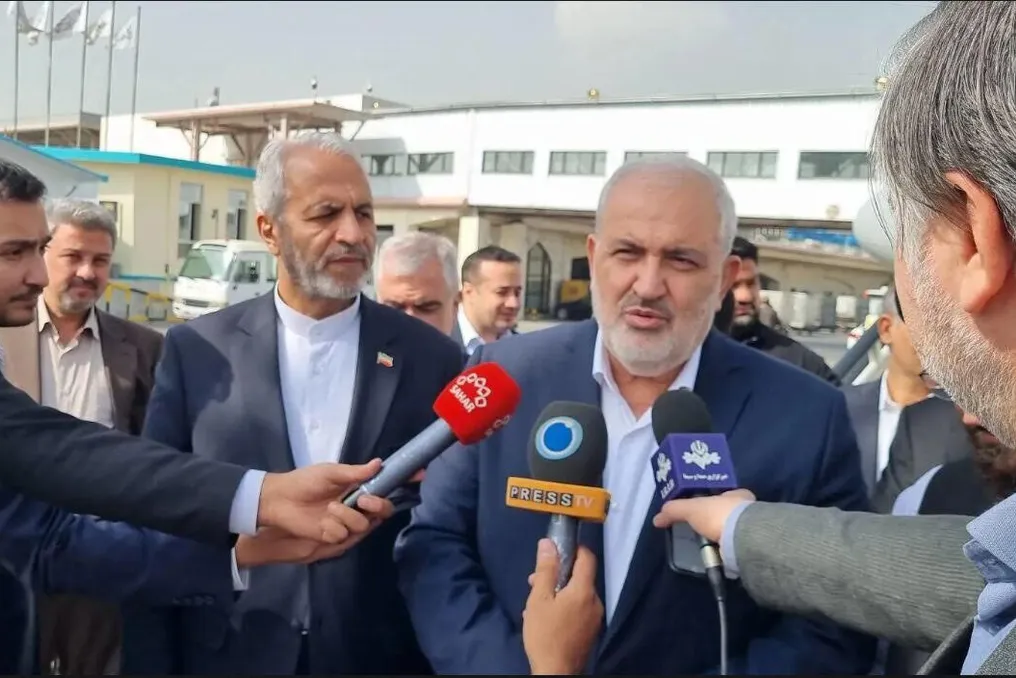
The Minister of Energy visited Afghanistan to discuss the goals of his trip, which include expanding technical and engineering interaction with neighboring countries. He noted that there are good relations between the two countries.
According to IRNA of the Ministry of Energy, Abbas Aliyabadi, upon arriving in Afghanistan on Wednesday, emphasized the historical, linguistic, and cultural commonalities between Iran and Afghanistan, which create a favorable basis for developing cooperation in various fields.
Explaining the objectives of the trip, the Minister of Energy stated that the visit to Kabul was necessary to hold negotiations and meetings with officials in the water resources and energy sectors. Furthermore, one of the most important goals was visiting the fifth 'Abu Hanifa' International Exhibition and increasing technical and engineering cooperation with neighbors, including Afghanistan.
Aliyabadi reported on the potential for exporting technical and engineering services between the countries and the desire to increase this volume, noting that a good opportunity has arisen to expand such cooperation.
Afghan media reported the arrival of a trade delegation from the private sector of Iran, consisting of 180 people, to participate in the International Exhibition in Kabul and discuss expanding exchanges and investments between the two states.
According to IRNA, this 180-member trade delegation from the Iranian private sector, headed by Mohammad Siyadat, head of the Iran-Afghanistan Joint Chamber of Commerce, entered Kabul on Tuesday.
Members of this large economic mission plan to visit the 'Imam Abu Hanifa' International Exhibition in Kabul and meet with Afghan economic figures to explore ways to expand trade exchanges and joint investment opportunities.
Afghan economic experts consider the meetings of delegations from Tehran and Kabul important for strengthening economic and commercial ties, believing they can contribute to expanding trade, investment, and transit.
Abdul Nasir Rashtia, an Afghan economic expert, stressed the vital importance of establishing strategic and favorable relations with neighboring countries for Afghanistan. He added that the more routes of neighboring countries used for import and export, the lower the transport costs will be.
The exchange of economic delegations takes place against the backdrop of Tehran and Kabul setting the goal of increasing bilateral trade volume to 10 billion US dollars annually.
Reports indicate that the fifth Imam Abu Hanifa national and international exhibition begins on October 7 and will last for one week. Traders, investors, and companies from more than 20 countries, including the Islamic Republic of Iran, Russia, India, Turkey, Japan, Uzbekistan, Kazakhstan, and Turkmenistan, will participate.
Over the years, the exhibition has served as a platform for concluding major trade contracts and demonstrating the region's economic potential in vital sectors such as industry and mining, agriculture and livestock, crafts and carpets, telecommunications, banking, and medical equipment.
The Deputy for Economic Diplomacy of the Ministry of Foreign Affairs held consultations with the Deputy for Financial and Administrative Affairs of the Afghan government regarding the expansion of economic and trade cooperation between the two countries.
According to IRNA, Hamid Ghanbari, Deputy for Economic Diplomacy of the Ministry of Foreign Affairs of the Islamic Republic of Iran, met on Tuesday with Mohammad Naim, Deputy for Financial and Administrative Affairs of the Ministry of Foreign Affairs of Afghanistan. During this meeting, the parties discussed and exchanged views on expanding economic and trade partnership, especially in the field of infrastructure development and strengthening, including the construction of the Herat–Mazar-i-Sharif railway.