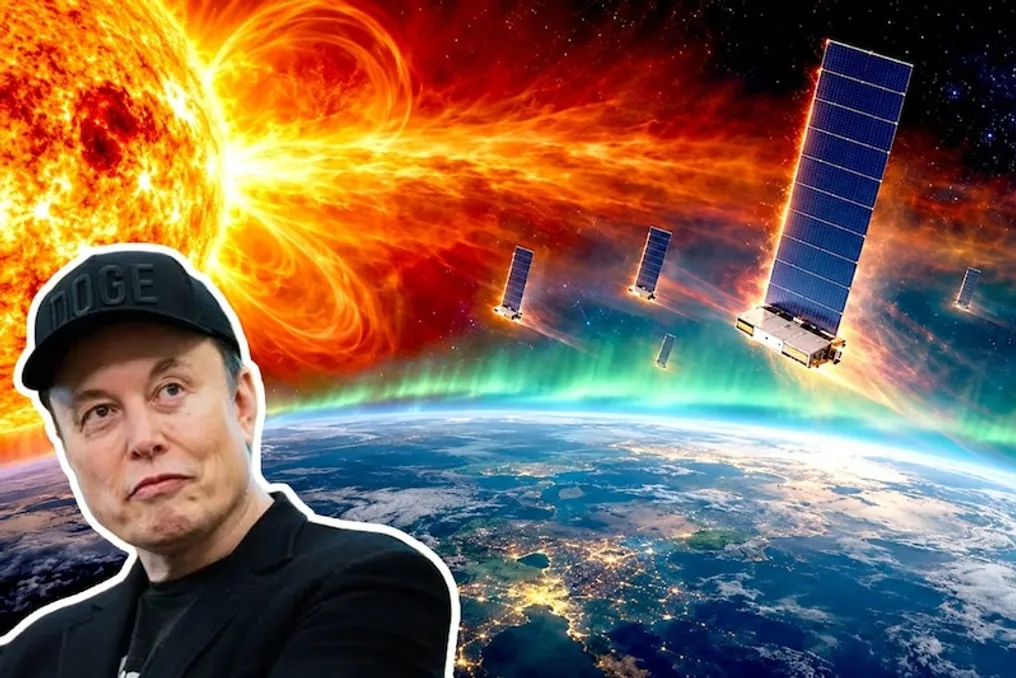
Thousands of Starlink satellites orbit the Earth, but they face a serious threat originating from the Sun. When intense processes occur on the Sun and solar storms happen, this affects the upper layers of the Earth's atmosphere. The atmosphere heats up and expands, leading to increased atmospheric drag on the satellites and a decrease in their altitude.
The consequences of this were evident in February 2022. SpaceX launched 49 Starlink satellites. A geomagnetic storm followed. At that time, these satellites were at an altitude of about 210 kilometers. Due to the storm, the atmosphere in that region became denser, which increased the tension on the satellites. As a result, 38 satellites could not maintain their orbit and burned up upon entering the Earth's atmosphere a few days later.
This information was presented in a study published in 2023. The Sun constantly emits energy, and periodic powerful bursts can reach Earth, causing geomagnetic storms. During such events, the upper layers of the Earth's atmosphere heat up and expand significantly, increasing the number of gas particles in the satellite's path. Since the satellite moves at a very high speed, collision with these particles causes an increase in resistance known as atmospheric drag. This increase in drag forces the satellite to gradually lose altitude; if it is not brought back into orbit, it continues to descend until it enters the Earth's atmosphere.
In February 2022, the 49 Starlink satellites launched at that time were initially at an altitude of about 210 kilometers, with plans for further raising to an altitude of about 550 kilometers. However, a geomagnetic storm occurred immediately after launch. According to the study, the atmospheric density at an altitude of 210 kilometers increased by approximately 20–30 percent compared to normal, leading to greater stress on the satellites. Although SpaceX tried to save them, 38 out of 49 satellites began moving toward Earth and burned up upon atmospheric entry due to intense heating.
The risks are particularly high in Low Earth Orbit (LEO), where satellites like Starlink operate. Here, the Earth's atmosphere is very thin but not entirely absent, so some atmospheric drag is always present. On normal days, this drag is minimal. However, during solar storms, atmospheric expansion increases this drag, which can lead to a rapid decrease in the satellite's altitude. If the satellite is not raised, it will continuously descend and eventually enter the atmosphere and burn up.
As the Starlink network grows, the number of satellites in Low Earth Orbit also increases, raising the need to ensure their safe operation and prevent collisions in space. The study indicates that more powerful geomagnetic storms in the future could have an even greater impact on satellites at lower altitudes. Therefore, it is crucial to monitor solar activity and space weather. The February 2022 incident demonstrated that solar activity is capable of damaging satellites located millions of kilometers from Earth, with increasing atmospheric drag posing a serious threat to satellites in Low Earth Orbit.