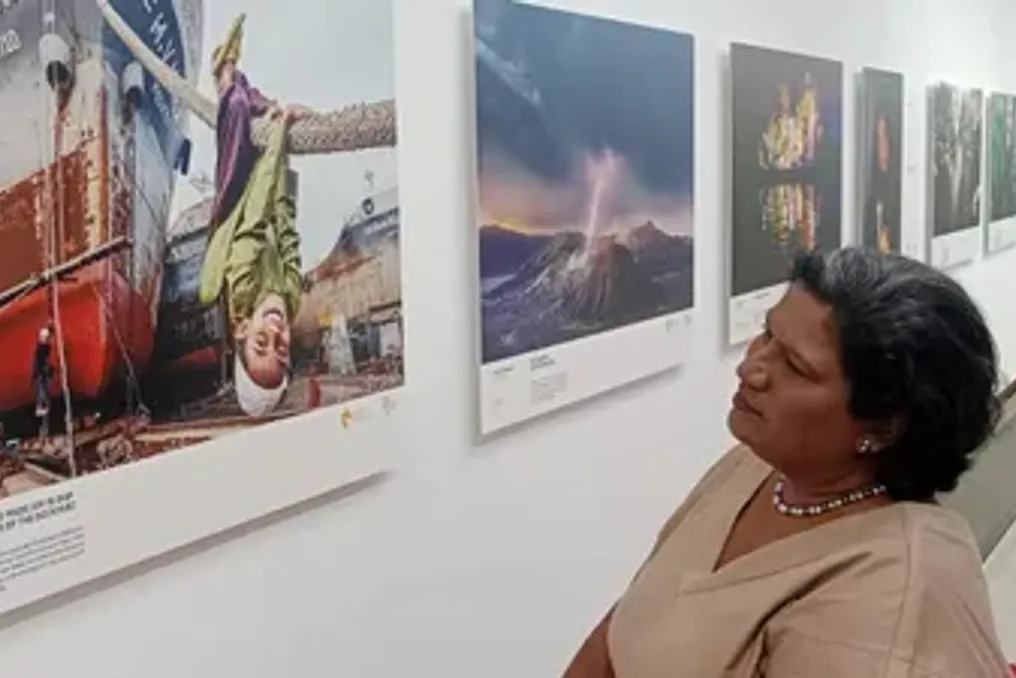
Ramandzhalu Kubashni visited the gallery at Durban Media House to view the exhibition of images, which will be available until October 23rd. The venue, formerly an ordinary canteen on Osborne Road in Greyville, Durban, has been transformed into an outstanding photo gallery comparable to exhibitions at places like the Metropolitan Museum of Art (MoMA) in New York or Somerset House in London.
The exhibition, dedicated to Andrei Stenin's international press photography contest, was organized jointly by Sputnik News Agency and Radio, African News Agency, IOL, and National Media Group. The photographs were reproduced with high quality and accompanied by brief captions that provided necessary context without distracting from the image itself.
The author noted the striking clarity, deep emotionality, and sometimes harsh truthfulness of the presented shots. These photographs demanded not just viewing, but stopping and reflecting, which, in the author's opinion, is the exceptional strength of a photojournalist.
In an era where millions of images are created daily, quickly disappearing in the digital space, great press photography can stop the viewer. It can capture joy, sorrow, courage, sporting achievements, historical events, and, most importantly, the everyday life of ordinary people.
Andrei Stenin's contest is held annually in memory of the young Russian photojournalist Andrei Stenin, who died while working. The contest, promoted by Sputnik Agency from the Russian Federation, has become a significant international platform for talented photographers, both established and emerging. In 2025, the contest includes categories such as 'My Planet,' 'Portrait of the Hero of Our Time,' 'Sports,' and 'Top News.'
As the exhibition progressed, it became clear how intense the jury's work must have been. Almost every image seemed alive. Attendees, selected by the chairman of Survey Group Holdings, looked equally captivated. It was a gathering where journalists, businessmen, artists, and representatives of the wider social sphere could contemplate together.
Ramandzhalu Kubashni's personal favorite was the photograph by Rabikul Alam Khan titled 'Abbas Finds Joy on the Ship's Ropes at the Dock.' The picture shows Abbas, a young student from Keragon Madrasa, hanging upside down on a ship's rope against the backdrop of a huge tanker. His face is illuminated by an infectious smile.
The author emphasized that there is something simple and beautiful in this image, as well as a skillful use of light. The rusty tanker symbolizes the all-consuming industrial world of trade and shipping, while the smiling boy embodies childhood innocence, imagination, and the ability to turn an ordinary moment into something magical. Khan's caption states that Abbas 'turns ordinary moments into pure magic,' which the picture proves.
Although Khan specializes in photography of social justice and human rights, here he presented an image of pure joy. This serves as a reminder that photojournalism does not always have to show suffering to convey something important about the human condition.
Another memorable series was Ashura Mustafa AbdulHadi's series from Bahrain. One shot of a little girl with a burning candle in front of her conveyed the deep tenderness of this special rite among Shia Muslims. This picture was quiet; it did not need spectacle, as the candle, the child, and the surrounding atmosphere spoke for themselves.
However, the most captivating aspect of the exhibition for the author was the geographical diversity of the photographers presented. For a long time, international news photography was often dominated by photographers and media institutions from North America and Western Europe. Here, the visual narrative proved much broader.
Photographers came from different cultures and places, including India, Russia, China, Bahrain, and Bangladesh. It was not just an exhibition of pictures, but a reminder that the world looks at itself from many different points of view.
Another choice by the author was the photograph that won first place in the 'My Planet' category, taken by Chendan Zhu from China. Her work focused on rural farming communities. The picture, showing fruit farmers picking plums from trees growing under protective nets on Oiling Mountain in Fengkai County, was particularly impressive.
The reason for using these nets is as interesting as the image itself. Extreme weather conditions force farmers to protect their fruit trees from frost and pests, leading to the appearance of these unusual tent structures spread across the mountains. This is a story not only about agriculture but also about human ingenuity in the face of nature's whims.
The best press photograph allows one to see worlds that would otherwise remain inaccessible. It brings the distant close, gives a face to statistics, and humanizes history. Sometimes a photograph achieves in a fraction of a second what an essay of thousands of words cannot.
The morning at Durban Media House possessed a certain old charm. There was something cultured about how journalists, businessmen, artists, and members of the wider social and cultural community gathered not just by invitation, but to view art and discuss what they saw. For the author, visiting the exhibition was an enrichment of the soul, restoring faith in the continuing power of journalism at a time when the media is often described as being in crisis due to lack of resources.
The exhibition served as a reminder that the media is still alive, and that telling news through images remains one of the most powerful forms of communication. The great press photographer stands between the moment and history: the moment disappears, but the photograph remains.