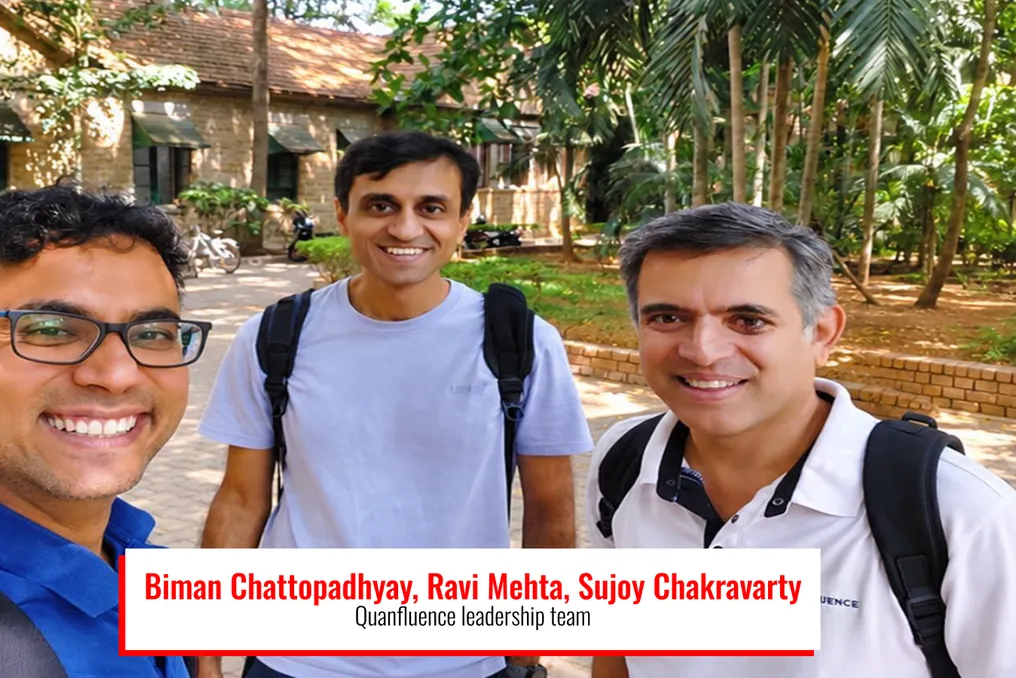
The deeptech company Quanfluence has raised $10 million in a funding round led by the venture firm Chiratae Ventures, which specializes in early-stage technology investments in startups.
Pi Ventures, an early-stage fund focused on deep tech and artificial intelligence, which previously led Quanfluence's seed round in 2024, as well as Rainmatter from Zerodha, also participated in the round.
Quanfluence was founded in 2021 and was part of the IIT Madras Incubation Cell incubator. It is developing quantum computers that use photons, or particles of light, to process quantum information.
The founders include engineers and scientists with experience in semiconductors and quantum optics. Among them, three previously co-founded Silicon and Beyond, a company dealing with semiconductor intellectual property, which was later acquired by Synopsys.
Quanfluence stated that it plans to use the raised capital to create a fully functional photonic quantum computer. This involves integrating proprietary photonic chips, control electronics, and software into a single system, rather than developing components separately.
The company's roadmap includes the appearance of early processors by 2027 and larger, scalable machines by 2029. The Pune-based firm noted that it has already designed and manufactured numerous photonic integrated and electronic integrated circuits, developed methods to reduce losses when connecting chips to optical fiber, and demonstrated the generation of quantum light states. Furthermore, work on photonic chips for light-matter interactions has advanced.
In parallel with research, Quanfluence has commercialized a photonic isobaric machine—a specialized system used for optimization tasks—and claims that some of its quantum devices are already commercially available.
Co-founder and CEO Sujoy Chakravarty stated that the company's goal 'never was to create the best experiment,' but rather 'to create a useful quantum computer.' Venkatesh Peddi, Managing Director and Partner at Chiratae Ventures, noted: 'Quantum computing is at an inflection point, and we believe photonics is one of the most viable paths to a machine that can scale beyond the laboratory.'
These developments reflect a broader shift in India's quantum sector. India's National Quantum Mission, valued at ₹60,036.5 crore and approved in 2023, covers quantum computing, communication, sensors, and quantum materials, including the creation of four thematic centers and dedicated infrastructure.
Capital is also beginning to follow this infrastructure build-up. QpiAI recently secured debt financing of ₹50 crore after raising $32 million in July 2025 and has since expanded its hardware and deployment efforts, while quantum security company QNu Labs raised ₹200 crore last month.
Abhinav Singh Negi, Lead Climate and Deep Tech Specialist at Rainmatter by Zerodha, commented: 'They skillfully mitigate the risks of a massive long-term hardware challenge through short-term revenue streams while creating a key element of India's sovereign quantum power.' He added that this is 'a bet on the future of Indian deep tech, hardware-oriented and patent-protected.'
Regarding photonic computing, the possibility is associated with significant engineering challenges. Recent research highlights the advantages of scalability and integration but also points to optical losses and the complexity of creating a large number of high-performance components as major obstacles.