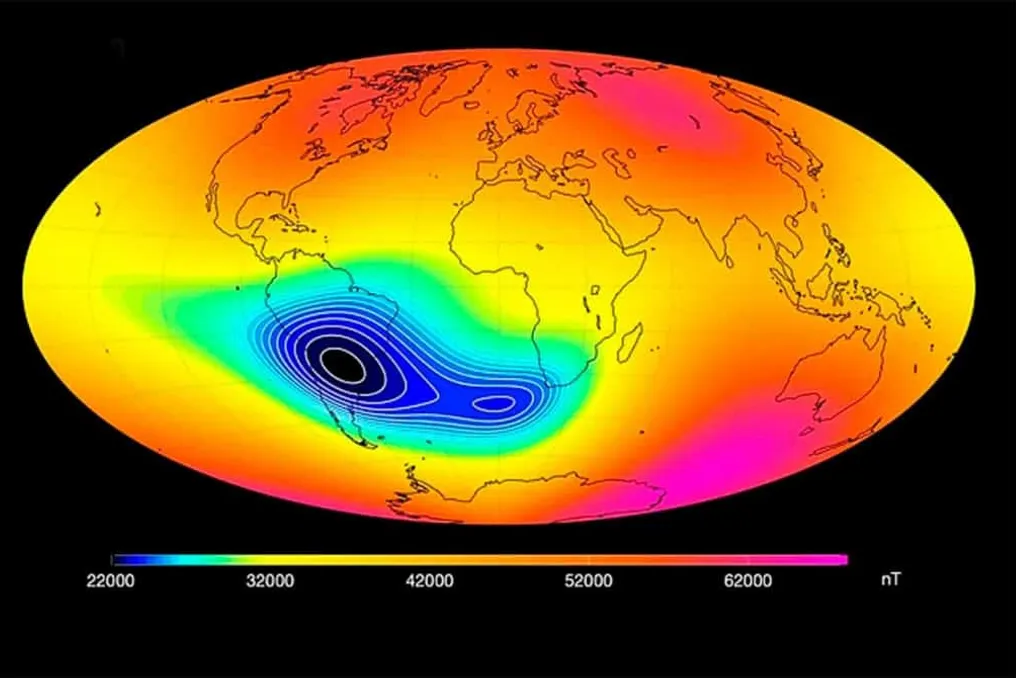
An invisible area of risk, known as the South Atlantic Magnetic Anomaly (SAMA), extends across Brazilian territory, characterized by a weaker terrestrial magnetic field. Recent research indicates that this anomaly has developed a second point of minimum intensity, which modifies the behavior of the planet's protective shield.
A study published in the journal Journal of Geophysical Research: Solid Earth points out that this observed division is related to the dynamics of liquid iron currents present in the Earth's outer core. These deep variations cause changes in force lines on the surface, resulting in complex configurations that are constantly transforming.
The existence of two weakened-field cores increases the vulnerability area for satellites and space missions operating in low orbits. Electronic equipment passing through these zones is more exposed to cosmic radiation flow, requiring continuous adjustments to its technical operations.
Close monitoring of these dual configurations allows for the prediction of fluctuations in the space environment. By understanding how these centers evolve, scientists can improve geomagnetic prediction models, ensuring greater stability for orbital navigation and communication technologies affected by the phenomenon.
Researchers emphasize that the formation of multiple minimum points reinforces the non-static nature of terrestrial geomagnetism. Monitoring the rotation and movement of these foci aids in understanding the intricate internal dynamics responsible for the planet's invisible defense.
Although the anomaly is expanding and moving westward, specialists warn that the impacts are mainly felt in orbiting infrastructure. At ground level, the atmosphere continues to function as an effective shield against radiation from the Sun.
The magnetic field serves as an essential barrier to protect the Earth from the constant flow of solar particles. According to Gelvam André Hartmann, a professor at the Institute of Geosciences at the State University of Campinas (Unicamp), he contributes, along with the atmosphere, to forming the magnetosphere, which acts as a shield, deflecting much of these particles and reducing their direct interaction with the atmosphere.
Importance of Environmental Protection
In an interview given to Olhar Digital, the specialist, who holds a doctorate in geophysics, emphasized the importance of this protection for long-term environmental maintenance. He stated that this defense is crucial because solar wind can interact with the upper layers of the atmosphere, potentially leading to the loss of atmospheric particles into space over extended periods. Thus, the magnetic field is a determining factor in preserving the conditions that allow for Earth's habitability.
In addition to retaining the Earth's atmosphere over long timescales, the magnetic field reduces the exposure of space infrastructure to charged particles. However, this protection is not absolute; solar events can intensify the flow of energetic particles, causing changes in the space environment and harming the operation of satellites and other technological systems.
This type of occurrence also destabilizes the ionosphere, which is the electrified layer of the upper atmosphere responsible for enabling telecommunications and navigation. Variation in the ionic layers interferes with radio signal transmission and systems like GPS, complicating the precise calculation of routes in ground receivers and generating operational failures in sectors dependent on this technology.
In the specific area of the magnetic anomaly, the weakness of the Earth's shield allows solar space radiation to reach lower altitudes. This increased exposure to magnetic bombardment constitutes a direct risk to satellite electronic components. For this reason, operators frequently implement safeguard measures, such as placing sensitive instruments in safe mode, depending on circumstances and the mission.