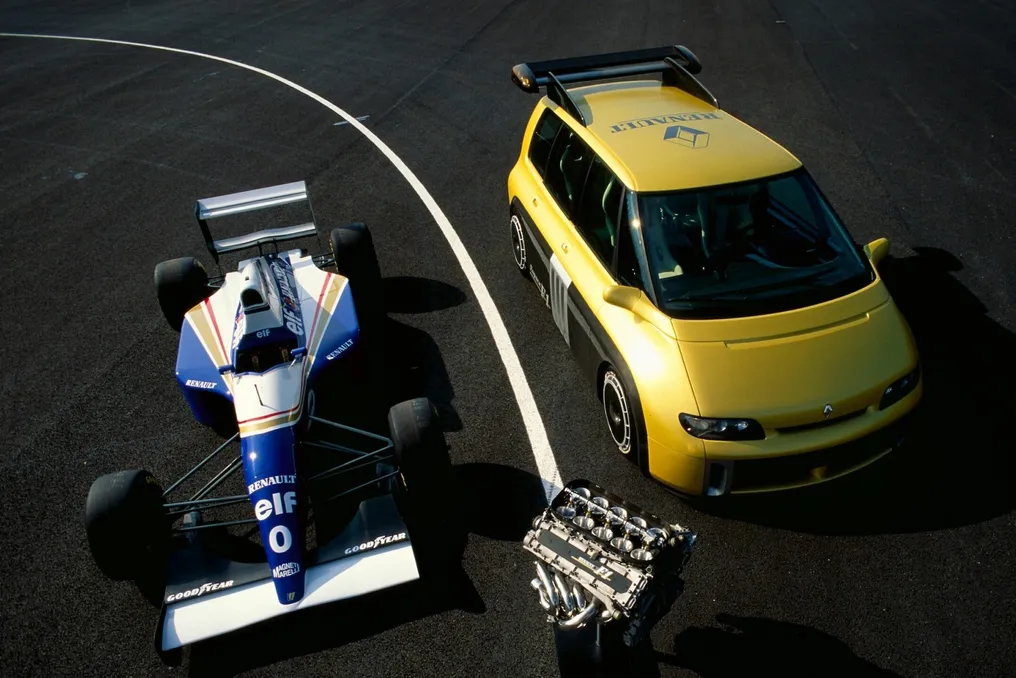
Minivans are traditionally not aimed at automotive enthusiasts; they are intended for families who need space for shopping, luggage, and children's sports equipment, prioritizing practicality over the concept of 'driving fun'. In the United States, the vehicle is often seen as a sign of the end of the passion for sports cars and the beginning of a more mature and responsible phase in an individual's life.
The Renault Espace has always been a typical minivan model. Its initial development took place in the late 1970s, under the direction of British designer Fergus Pollock, at Chrysler Europe. Chrysler collaborated with its French partner, Matra, where Greek designer Antonis Volanis refined the concept, aiming for a practical minivan with a modular cabin, level floor, and large glazed area.
In 1978, Chrysler transferred its European operations to PSA (Peugeot/Citroën). Although the group took over the project, it eventually backed away, considering the proposal excessively risky commercially for the standards of the time. However, Matra maintained belief in the concept, took full control, and in 1982, presented the idea to Renault, which decided to invest and launch the Espace two years later.
The start of sales was modest: in July 1984, only nine Espace units were sold in the first month. However, as the public realized the internal versatility, thanks to the swivel seats and flat floor, sales skyrocketed. The Espace established itself as one of the first successful modern minivans on the market, even generating a national clone, the Grancar Futura, designed by Toni Bianco and based on the mechanics of the Ford Del Rey (with a 1.8L engine from Volkswagen).
In Brazil, during the 80s and early 90s, due to the restricted import market, the Futura was a curious fiberglass replica seeking to replicate the futuristic appeal of the French pioneer.
However, the Espace discussed in this article differs significantly from the 1984 version. The special edition was conceived ten years later, in 1994, to celebrate the tenth anniversary of the original Espace. Furthermore, in 1994, Williams won its third Constructors' title in Formula 1 since starting to use Renault V10 engines, perfect enhancements for the advanced FW14 and FW15, designed by Adrian Newey, which competed between 1991 and 1993, and for the FW16, which, despite being limited by FIA decisions (such as the ban on active suspension, traction control, and ABS brakes), still secured the Constructors' title that year.
The V10 engines developed by Renault Sport in Viry-Châtillon were the maximum standard on the grid. With impressive power and exemplary reliability, the French manufacturer dominated world motorsport, accumulating notable victories with drivers such as Nigel Mansell, Alain Prost, and Damon Hill.
This situation represented the ideal opportunity to combine the celebration of a decade of the vehicle that popularized the minivan segment in Europe with absolute supremacy on the tracks. Thus, the Renault Espace F1 was born. Despite retaining the minivan name, it bore more resemblance to a Formula 1 single-seater—specifically, the engine from the FW15C, named Renault RS5.
To understand the importance of the RS5 engine, it is necessary to analyze what made this V10 the excellence of motorsport at the time. Renault pioneered the implementation of pneumatic valve technology in Formula 1. This complex system replaced conventional steel springs with compressed nitrogen gas, solving the chronic problem of valve float at high RPMs. This allowed the V10 to operate aggressively and stably, exceeding the limits of competitors.
This V10 has 3.5 liters (3,493 cm³), naturally aspirated, dual overhead camshafts, and 40 valves. The 67-degree angle between the cylinder banks was not random; it reflected the commitment of French engineering to create an extremely compact engine, narrow enough to optimize aerodynamics, but with a very low center of gravity. During Formula 1 races, its power ranged between 700 and 780 hp, but for the Espace F1, Renault opted for the qualifying tune, resulting in an impressive 820 hp and 71 kgfm of torque.
Placing this engineering marvel into a minivan did not result in a conventional practical vehicle. Unlike a regular car, the Espace F1 did not have a simple ignition switch. As an authentic and demanding Formula 1 car, the V10 required a rigorous pre-ignition ritual, needing a team of engineers with laptops to monitor injection telemetry, as well as external systems to preheat oil and coolant before starting. Starting the engine cold would be disastrous for the microscopic tolerances of the forged pistons. Only after the fluids reached the ideal temperature was an external starter connected to the rear of the minivan to bring the engine to life.
The engine was coupled to a six-speed sequential semi-automatic gearbox with paddle shifters on the steering wheel, identical to that of the F1 car. The resulting performance was remarkable: the minivan could reach 100 km/h in 2.8 seconds, 200 km/h in 6.9 seconds, and achieve a top speed of 312 km/h. For comparison, in the 1990s, renowned supercars like the Ferrari F40 took almost twice as long to reach 200 km/h.
The dynamics of moving such a machine bordered on science fiction. A Formula 1 engine is designed to propel a 500 kg chassis molded in a wind tunnel. Applying this power source—whose useful torque range is very short because it was made to operate at the limit of rotation—to move a much larger mass required substantial adaptations. The power curve was extremely vigorous, almost a punch to the abdomen with every gear change. Above 250 km/h, pure physics came into play: the force required to displace dense air with a minivan's frontal area above 300 km/h required the V10 to operate at full capacity.
It is important to note that this minivan resembles a Formula 1 car more than the original second-generation Espace (launched in 1991). Its body, designed by Thierry Metroz and Axel Breun, incorporated some fiberglass elements from the original model, such as the roof, hood, and tailgate, in addition to the windows. However, much of the panels were replaced by lighter and stronger carbon fiber components, whose shapes were redesigned to improve aerodynamics, including flared fenders, large side air intakes for cooling, and a prominent rear wing mounted on the roof to generate negative lift at high speed.
Structurally, the vehicle was radically different: while the street Espace had a front engine, front-wheel drive or all-wheel drive, and up to seven seats, the F1 version used a steel tubular chassis integrated into a carbon fiber monocoque, with the V10 engine positioned in the rear-center, acting as a structural element. It was comparable to stretching the chassis of a hypothetical two-seater F1 car and putting a minivan body on it, adding two more seats.
The entire assembly was carried out by Matra engineers in Romorantin. The suspension used the same arrangement of overlapping triangular arms with pushrod dampers found in racing single-seaters. Frank Williams supported and financed the project, also providing the technical knowledge and labor of his team of mechanics. After testing the vehicle as a passenger, the respected team boss expressed satisfaction with the dexterity and determination required by a Formula 1 car.
There was no insulation whatsoever between the engine and the occupants—two in the front and two in the back, one on each side of the V10. The four were accommodated in individual carbon fiber bucket seats manufactured by Recaro and secured by six-point competition harnesses. The sound experience was intense: the furious roar of the ten cylinders, close to 14,000 rpm, occurred just inches from the ear. The rear passengers felt literally glued to the cylinder banks. Since the engine was part of the structure, it did not rest on soft rubber mounts to absorb impacts. Every explosion in the combustion chambers and every rough vibration of the crankshaft spinning at high speeds resonated directly into the occupants' bodies. The heat from the exhaust manifolds invaded the cabin, and the toxic and strong smell of fuel permeated the environment, all inside a French minivan.
To control the approximate mass of 1,300 kg, the braking system used Brembo carbon-ceramic discs on all wheels. The deceleration capability was extraordinary: the car could accelerate from zero to 270 km/h and stop completely in less than 600 meters. The G-force generated during braking was sufficient to press the occupants against the harnesses with the same intensity as a Le Mans prototype.
A famous video shows the Renault Espace F1 completing a fast lap at the Magny-Cours circuit with Alain Prost. Reports indicate that he enjoyed doing fast laps to prank journalists, pushing the passengers to the limit of fear and nausea in high-speed corners while the V10 emitted its characteristic sharp metallic howl.
For most enthusiasts who have never seen the prototype accelerating on European circuits, the chance to experience this machine came through video games, specifically in Gran Turismo 2. In this PS1 classic released in 1999, the Espace F1 was one of the most coveted vehicles. Driving it in the game was a challenge due to the high center of gravity and the 820 hp applied solely to the rear wheels, which created a constant struggle against oversteer.
Only two units of the Renault Espace F1 were built. One is the functional track version, kept in perfect working order by the Renault Classic division in Flins and occasionally displayed at events such as the Goodwood Speed Festival. The second unit is a static display model, currently exhibited at the Matra Museum in Romorantin-Lanthenay.