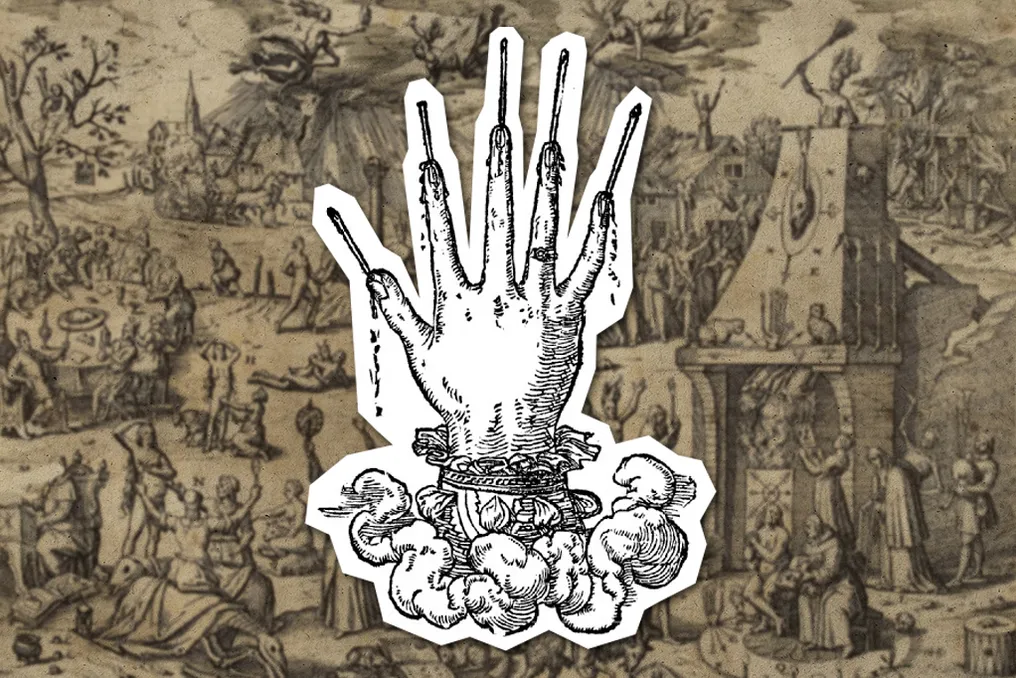
In the 18th century, Europe was a stage for grimoires, books containing guidance on various areas such as astrology, alchemy, folk medicine, divination, occultism, and religious practices. Although the term 'grimoire' was not used at the time, these volumes, which could be manuscripts or printed, compiled ancient texts that were frequently copied, altered, and mixed with new knowledge.
The content of these books ranged from invocations to spirits and demons to methods for creating magical amulets and talismans, as well as formulas to attract prosperity and love, and medical recipes. Essentially, any knowledge related to mysticism or pseudoscience was considered valid.
One notable grimoire is Le Petit Albert, dated 1722, which detailed the creation of a gruesome object known as the Hand of Glory. This supernatural artifact was initially documented (without a name) in 1440 in England and only received its name in 1707 in the English language, gaining notoriety thanks to Le Petit Albert.
The Hand of Glory consisted of the severed hand of a deceased criminal, cut while he was still hanging on the gallows, and served as a holder for a candle. Allegedly, this item affected people while they slept, preventing them from waking up. Due to this property, it was highly desired by thieves, who used it to invade residences at night undetected.
Generally, the right hand of the deceased individual was used, unless the crime was murder, in which case the left hand was used. Some versions indicated that the hand should not hold a candle, but rather that one of the dead person's fingers should be lit with fire. In both scenarios, the flame could only be extinguished by blood or by 'blue' milk (skimmed).
For the creation of the Hand of Glory, the deceased's hand required specific preparation. According to the Le Petit Albert guide, it was wrapped in a shroud and preserved in a mixture composed of salt, saltpeter, peppers, and various bodily fluids. Subsequently, it was dried under the sun during the summer or cooked in an oven. The candle used was made from the fat of the executed criminal himself, mixed with virgin wax and sesame seeds.
Another recipe, found in a North Yorkshire manuscript from 1823, titled 'A true recipe for preserving and obtaining a Hand of Glory, as well as for making a Glory Candle,' established a different procedure. In this version, the hand should be removed from the body of the criminal on the gallows, preserved in salt and urine from various animals (human, female, dog, horse, and mare), smoked with herbs and hay for a month, hung on an oak tree for three consecutive nights, left at a crossroads, and finally, displayed at the door of a church for one night. During this vigil, the maker should remain in the porch, waiting for fear not to drive him away.
The name Hand of Glory derives from the French 'maindegloire', which is a corruption of the Latin 'mandragora'. The latter designated a Eurasian plant whose roots resemble human shapes. Historically, mandrake roots were used as an amulet to attract wealth, and the plant had connotations linked to death and occultism. The association with the Hand of Glory occurred because the French pronunciation was identical.
Furthermore, the symbolism of the hand belonging to a hanged criminal reflects a post-medieval European popular belief that dead bodies possessed magical powers. Many people touched the dead seeking healing or took a piece of the rope for the same reason. The Hand of Glory is seen as a manifestation of this popular culture.
Currently, only one Hand of Glory is preserved, located in the collection of the Whitby Museum in England. This artifact was discovered in the early 20th century, hidden in the wall of a thatched-roof house in the countryside. It was handed over to the local stonemason and historian Joseph Ford for safekeeping. Based on popular legends about such objects, Ford immediately identified it as a 'Hand of Glory' and donated it to the museum in 1935.
Since this hand does not have burned fingers, it is presumed that it was used to hold a candle in the past. According to museum information, accounts of the use of these hands became common throughout Europe, extending from Finland to Italy and from western Ireland to Russia, over the last four hundred years. Many artistic works from this period, including paintings and books, depict Hands of Glory. The Italian priest and exorcist Francesco Maria Guazzo, known for his writings on demonology, illustrated Hands of Glory in his woodcuts as part of his work to instruct on practices associated with witchcraft.
However, it is essential to recognize that all available knowledge about Hands of Glory comes from ancient records and narratives, often written by biased sources. There is a possibility that much of these stories is laden with sensationalism or prejudice, and that, when retold and represented in fiction over the centuries, they have acquired a character of veracity. Nevertheless, there is no absolute certainty that European thieves actually created and used Hands of Glory.