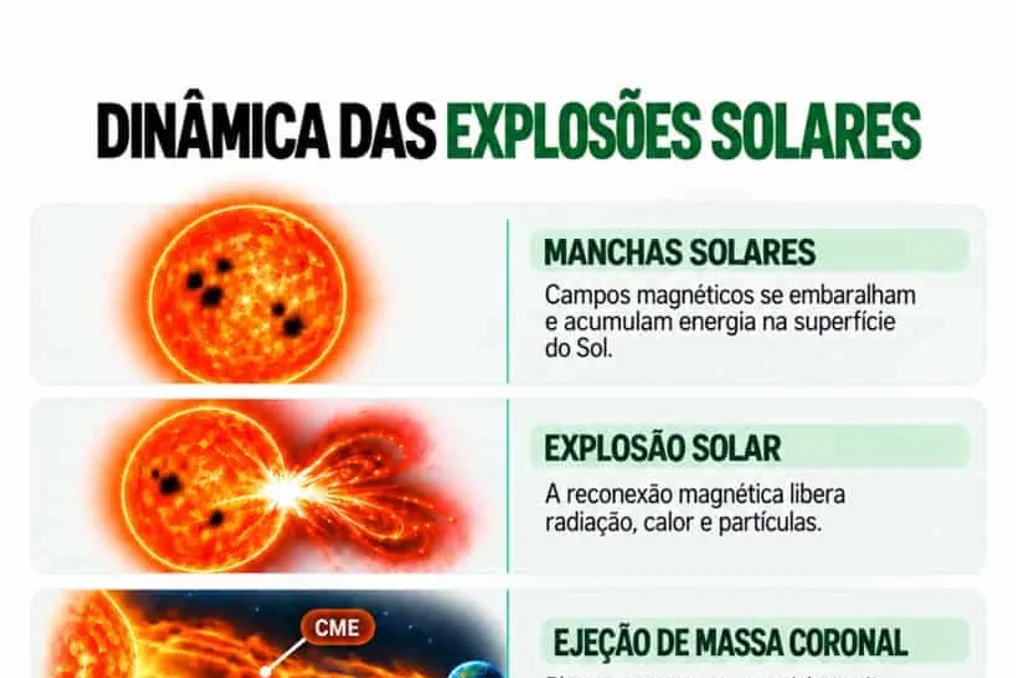
After days of low-intensity eruptions, the Sun has once again attracted attention due to three M-class explosions (classified as moderate) recorded in the last 24 hours. Two of these explosions originated in the AR4549 region, a cluster of sunspots that showed accelerated growth and developed an intricate magnetic structure.
Analysis of Solar Flares
In a conversation with Olhar Digital, physicist Adriana Valio, full professor at Mackenzie Presbyterian University and researcher at the Mackenzie Center for Radio Astronomy and Astrophysics (CRAAM), detailed the mechanics of solar flares. According to the researcher, energy release occurs primarily through a mechanism called magnetic reconnection. This process happens when magnetic field lines reconfigure, transforming part of the magnetic energy into radiation, plasma heating, and particle acceleration.
The AR4549 region, located east of the center of the solar disk, expanded rapidly, forming a large group of spots. Its magnetic configuration is classified as beta-gamma-delta, which is the most complex among the categories used to describe active areas of the Sun. Structures of this type concentrate various magnetic fields, which facilitates both the storage and subsequent release of energy.
Because of this, the region requires vigilance in the coming days. It has the potential to generate new M-class flares and also X-class events, which are the most powerful on the scale used to measure such explosions. Additionally, since AR4549 is directed towards Earth, any ejection of material launched by it could reach our planet.
According to data from the EarthSky.org observation platform, the largest of the three recent flares was classified as M1.8 and peaked this Tuesday (6) at 5:05 AM (Brasília time). This phenomenon caused an R1-level radio blackout, considered of lower magnitude, which occurred almost instantaneously over the Arabian Sea, near the eastern coast of Somalia, due to radiation interference with communications.
Observations made immediately after the event also detected a dark coronal widening around the explosion area, an indication that part of the solar atmosphere may have been projected into space. Since the region was in a favorable position relative to Earth, the possibility arose of a coronal mass ejection being on a collision course with us.
Scientific Assessment and Forecasts
It is not yet possible to confirm the exact scenario or the severity of the impact. In a post on X, space physicist and aurora photographer Vincent Ledvina, residing in Alaska, USA, emphasized that the available images were very recent and therefore did not allow for a safe estimation of the amount of material that had escaped the Sun or its direction.
This continuous analysis depends directly on modern space monitoring infrastructure. Adriana Valio explains that current science possesses crucial resources to track this evolution in real time. She states that there are ground telescopes and satellites capable of continuously monitoring the evolution of sunspots and measuring their magnetic fields. Such observations enable the identification of active regions that accumulate large volumes of magnetic energy and consequently have the potential to cause intense explosions.
However, the specialist points out that predicting the precise intensity of an event transcends mere visual observation of the affected area. She adds that, besides the amount of stored magnetic energy, it is essential to consider the complexity and arrangement of the magnetic fields, as these define how that energy will be released.
At this moment, space meteorologists use coronagraph images and computational models to calculate the speed and trajectory of the material. This forecast is relevant because, if there is considerable interaction with the Earth's magnetic field, the episode could trigger a geomagnetic storm and promote the appearance of auroras at latitudes further south than usual.
The severity of this storm will depend, among other factors, on the orientation of the magnetic field contained in the solar material upon reaching Earth. Simultaneously, the AR4545 spot region also remains pointed towards the planet with growing activity, and the approach of coronal holes should intensify the flow of fast solar wind, signaling another period of high geomagnetic activity for the weekend.