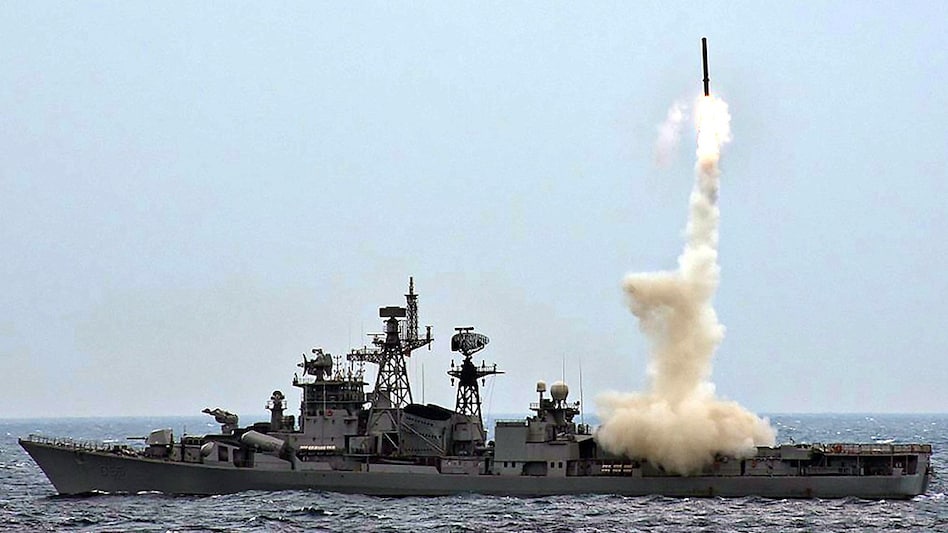
Ministry of Defence concludes deal with BrahMos Aerospace for INR 661.50 million to procure BrahMos launch systems for Indian Navy warships
Read more
Aaj Tak
www.aajtak.in

Ministry of Defence concludes deal with BrahMos Aerospace for INR 661.50 million to procure BrahMos launch systems for Indian Navy warships

On October 6, 2026, the Ministry of Defence signed an important agreement with BrahMos Aerospace Private Limited in New Delhi. Under the terms of this deal, BrahMos fire control and launch systems will be acquired for ships of the Indian Navy. The total value of the contract is 661.50 crore rupees.

The agreement was concluded in the presence of the Secretary of the Ministry of Defence, Rajesh Kumar Singh. This procurement is carried out under the Indian-IDDM category, which requires the inclusion of at least 68 percent domestic components. This step is significant for strengthening India's defence industry and enhancing the naval security of the fleet.

The Ministry of Defence entered into this deal with BrahMos Aerospace Private Limited to make the BrahMos missile system more effective on various warships of the Indian Navy. The BrahMos system is a primary sea-based missile capable of striking land and sea targets. It is capable of delivering precise strikes over long distances at supersonic speeds.

The fire control system and launch systems are critical elements of this system, aiding in accurate targeting and missile launch. Under this project, at least 68% of materials will be manufactured in India, providing opportunities for active participation from many Indian industries, especially MSMEs. It is projected that this project will create new jobs over the next three years.

This contract is viewed not merely as a purchase but as a step reinforcing the 'Atmanirbhar Bharat' (Self-Reliant India) campaign. India has long sought to reduce its dependence on foreign weaponry. The localization of advanced technology such as BrahMos is a major milestone in this direction.

The BrahMos missile is a joint venture between India and Russia and is considered one of the fastest supersonic cruise missiles in the world. Its speed far exceeds the speed of sound, leaving very little time for the adversary to react. It can be launched from ships and is capable of hitting distant targets.

The fire control system is responsible for providing target information, guiding it, and ensuring a precise strike. The launch systems ensure the safe and effective launch of missiles from the ship. The BrahMos system is already installed on many key warships of the Indian Navy, and the installation of new fire control and launch systems will enhance their potential. This is extremely important from a maritime security perspective, as challenges in the Indian Ocean are growing.

Amid disputes over maritime borders with neighboring countries, ensuring the safety of sea trade routes, and regional tensions, the possession of a powerful missile system puts the fleet in a more advantageous position. This contract will strengthen the navy's capability to conduct maritime attacks.

The contract worth 661.50 crore rupees benefits not only the defence sector but also the economy. The high percentage of domestic materials will provide orders for local companies. MSMEs will be involved in manufacturing parts, assembly, and other auxiliary work. This will lead to skill development and the spread of technical knowledge at the local level. Job creation over three years will provide opportunities for the youth.

BrahMos Aerospace already manufactures missiles in India, and this new deal will strengthen the company's production capacity. This demonstrates the government's priority in developing and manufacturing advanced military technologies domestically. The IDDM category means that the product is based on Indian design, development, and manufacturing. This not only promotes self-sufficiency but also opens prospects for future exports.

In the modern era, maritime security is paramount for any country, as most trade takes place via sea routes. The Indian Navy is responsible for ensuring security in the Indian Ocean. Systems like BrahMos allow the fleet to quickly and accurately attack enemy ships or coastal targets. Thanks to supersonic speed, stopping such an attack by the adversary is extremely difficult.

This contract is part of the Ministry of Defence's policy aimed at prioritizing indigenous weapon systems. Many large deals have been concluded in this direction in recent years. The success of BrahMos has shown that high-tech systems can be developed through cooperation between India and Russia and subsequently localized. In the future, similar systems may be installed on new navy ships.

Overall, this deal aims to enhance the firepower of the Indian Navy, stimulate domestic industry, and strengthen self-reliant defence production. Concluding this deal in the presence of the Secretary of the Ministry of Defence clearly shows that the government gives it the highest priority. When these systems are installed on ships in the coming years, the strength of the navy will become evident. This step will prove beneficial for the country from military, economic, and industrial perspectives.


Similar stories

Updated Honda Elevate Released: New Design and Improved Features in the SUV
Read more
www.aajtak.in

Updated Honda Elevate Released: New Design and Improved Features in the SUV

Booking for the new Honda Elevate began on the first of this month, and delivery will commence after the prices are announced. In the market, this model competes with vehicles such as the Hyundai Creta, Kia Seltos, Skoda Kushaq, and Maruti Grand Vitara. The new Elevate has been presented, marking the first major update since its release in 2023.

The company aimed to eliminate several shortcomings related to design, features, and interior in the updated version. This SUV is available in five trims: SV, V, VX, ZX, and the new ZX+, which also offers a Black Edition option.

It is important to note that the base price of the SUV remains unchanged. However, the highest-end versions have become more expensive by 1.94 lakh rupees compared to the previous model.

The most noticeable exterior changes to the new Elevate concern the lighting and the front grille area. A new segmented LED Daytime Running Light (DRL) has been added above the grille, connecting both LED headlights. The grille has been updated with a new mesh pattern and a glossy black coating. Additionally, the fog light housing elements now feature body-colored paint, and the Honda logo has been moved from the grille to the front hood.

Changes were also made to the rear: a new LED strip connects both taillights. Meanwhile, the overall design of the vehicle remains the same, and the wheel design has not changed, matching the previous model. Honda introduced the new Elevate in Nordic Forest Pearl color, available in both solid and two-tone finishes. The body cladding around the vehicle has also received a glossy black finish instead of matte.

The engine mechanism of the Honda Elevate has not changed; it uses the same old model's 1.5-liter, 4-cylinder atmospheric gasoline engine. This engine generates 121 hp and a peak torque of 145 Nm. It can be paired with either a 6-speed manual transmission or a Continuously Variable Transmission (CVT).

Regarding fuel efficiency, the SUV demonstrates good performance. According to the company, the vehicle consumes 15.31 km per liter with a manual gearbox and up to 16.61 km per liter with the CVT variant.

Inside the Honda Elevate facelift, significant functional changes have been made. The most outstanding feature is the introduction of rear seat ventilation. Furthermore, the front seats have been equipped with heating and ventilation functions. The SUV now features a 360-degree camera and rear LED reading lights with capacitive sensors. The dashboard design has also been slightly modified: instead of wood trim, a large upholstery of white eco-leather with stitching is used. Previously, ambient lighting was installed by dealers, but now it is provided by the company in higher trims.

The vehicle is still equipped with a 10.25-inch infotainment screen, a semi-digital instrument cluster, a single-piece sunroof, lane departure warning, wireless charging, wireless phone connectivity, and six airbags. Versions with the CVT gearbox also include an electronic parking brake-assisted hold function. Honda has also updated safety systems: front parking sensors, rear disc brakes, and the Honda Sensing driver assistance package, which includes low-speed adaptive cruise control, available only in the CVT variant.

According to Honda, to address the noise, vibration, and harshness issues complained about by owners of older models, more sound-absorbing materials have been used in the updated lineup, which should reduce noise and vibration levels inside the cabin.

Fiat presents Multiplay concept, combining pickup and SUV characteristics, inspired by the Multipla
Read more
autopapo.com.br

Fiat presents Multiplay concept, combining pickup and SUV characteristics, inspired by the Multipla

Fiat announced a new concept called Multiplay, which seeks to revive the spirit of the Multipla, a historically controversial vehicle often listed as one of the ugliest cars in the world. The first image of this concept was released by the Italian automaker, and it will be displayed at the Paris Motor Show, with press access on October 12th and public viewing from October 13th to 18th.

Although it has proportions similar to a compact minivan, the Multiplay will not follow the traditional format of its predecessor. According to Fiat, the vehicle will integrate the open cargo capacity and versatility of a pickup truck with the comfort and adaptability of an SUV, allowing easy switching between these two configurations.

The brand describes the Multiplay as a 'new mobility concept,' characterized by being flexible, accessible, and 'radically useful.' Currently, no details have been provided regarding its dimensions, powertrain, or passenger capacity.

The revealed image shows the overlapping silhouettes of the two generations of the Multipla: the 1956 model, the 600 Multipla, and the 1998 minivan. The original design of the Multipla had a functional reason: to accommodate six people in two rows of three seats within a body under four meters, comparable to the length of a contemporary Fiat Argo. To achieve this, the car was built with the width of the brand's largest sedan, the Kappa.

The notorious 'step' between the hood and the windshield was also intentional. The cabin configuration, which resembled a helicopter due to its large glazing, resulted in this stepped nose, as a standard hood would require a more inclined and larger windshield. Furthermore, the side windows, larger than the bodywork itself, were designed to help children have better external visibility, minimizing motion sickness during trips.

This vehicle was designed by Roberto Giolito, who later designed the 2007 Fiat 500. The Multipla generated polarized opinions; it was awarded Car of the Year by the British program Top Gear in 2000 and exhibited at MoMA, the Museum of Modern Art in New York, in 1999, but maintained its reputation for questionable design. In 2004, it received a more conventional visual redesign and was discontinued in 2010.

The first Multipla, based on the Fiat 600, already operated under this same premise, transporting six people in just 3.5 meters, a smaller space than the Fiat Mobi. According to the British magazine Autocar, the Multiplay signals the direction Fiat intends to take with its future E-Cars, small and economical electric vehicles. One of these models would be priced around 15 thousand euros (about R$ 90 thousand), and another is speculated to be a successor to the Pandina. The publication indicates that these models could be launched in 2028, manufactured in Pomigliano d’Arco, Italy, using the same platform as future Citroën and Opel vehicles.

For now, Fiat has not confirmed a production version of the Multiplay, stating only that the concept will serve as inspiration for the brand's future affordable family cars. It is important to note that the Multiplay should not be confused with the Multiplina, a four-seater electric quadricycle derived from the Topolino, presented by Fiat in June.

Farmers from Fergana Region are working in Bashkortostan
Read more
uza.uz

Farmers from Fergana Region are working in Bashkortostan

Previously, it was reported about a group of farmers from Uzbekistan who, at the proposal of the President of Belarus, went to Gomel region and established farms for raising meat and milk.

It is now known that farmers from the Fergana region are working in Bashkortostan.

Popular