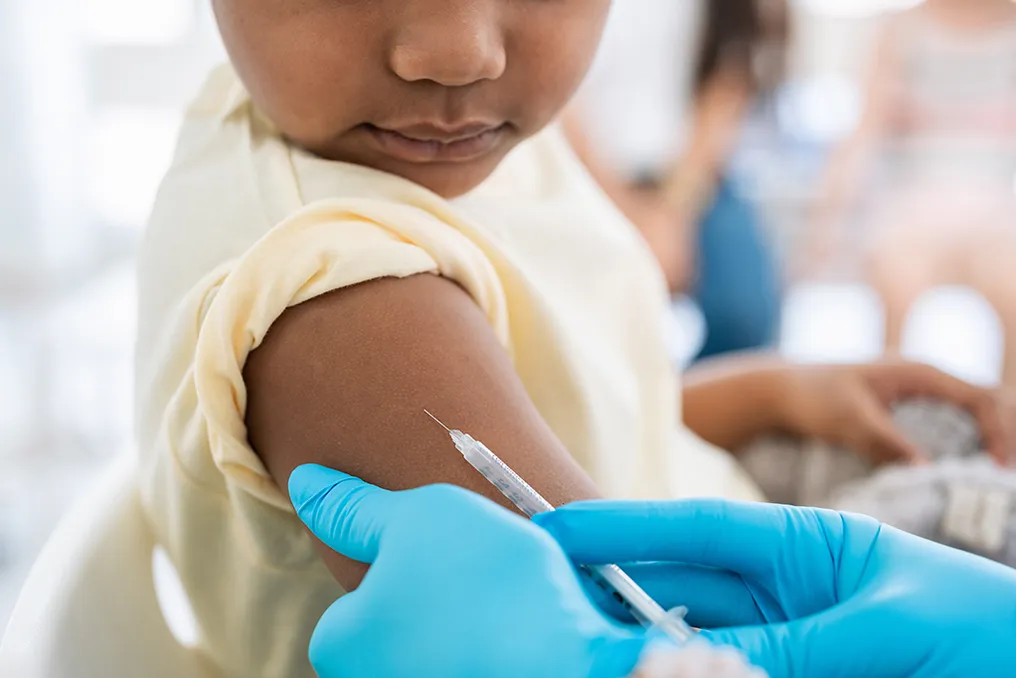
Scientists from the Faculty of Public Health (FSP) at USP released an article detailing the effectiveness of pediatric vaccines against COVID-19. The findings indicate that administering three doses of the Pfizer/BioNtech vaccine in children aged between 6 months and 4 years is linked to a 97% decrease in rates of Severe Acute Respiratory Syndrome (SARS) related to sars-cov-2.
The study observed that a lower number of doses did not provide consistent benefits, as the effects are notably altered by age group. This research underscores the importance of maintaining vaccination in this population group to prevent severe forms of the disease.
USP JOURNAL
The analyses were conducted across 24 Brazilian municipalities that presented the highest volume of COVID-19 cases and hospitalizations, during the period between July 2022 and December 2024. The studied cohort included 2,093,745 individuals aged 6 months to 4 years, representing 18% of the entire Brazilian pediatric population, according to data from the 2022 Census by the Brazilian Institute of Geography and Statistics (IBGE).
This represents the first study to investigate the effectiveness of the COVID-19 vaccine specifically in children. Although previous research has confirmed the safety and efficacy of these immunizers, available evidence for children under five years old was scarce, especially in the context of the Omicron variant.
In Brazil, despite the first dose of the immunizer being administered in January 2021, childhood vaccination only began in 2022 because these children were not classified as high-risk groups. However, with the increase in population immunity, severe cases and deaths began to concentrate disproportionately in vulnerable populations or those with incomplete vaccination schedules, increasing the vulnerability of those under five years old.
Isaac Negretto Schrarstzhaupt, a data scientist and researcher at FSP and the article's first author, stated that the study provides crucial information about vaccine functionality and the need for high vaccination coverage to reduce severe cases, especially in this polarized moment.
Initially, the National Immunization Program (PNI) of the Ministry of Health suggested the CoronaVac vaccine for children aged 3 years and older, but the Pfizer-BioNTech vaccine was later adopted for the 6-month to 4-year-old group. Currently, Pfizer/BioNTech and Moderna vaccines against sars-cov-2 are part of the PNI calendar.
To conduct the investigation, the authors used hospitalization data obtained from the Influenza Epidemiological Surveillance Information System (Sivep-Gripe), which is the mandatory record of hospitalized SARS cases for any reason. Additionally, they analyzed official records from the COVID-19 vaccination campaign of the National Health Data Network (RNDS), the mandatory national repository for all vaccination records in Brazil, including COVID-19. 2022 Census data was used to estimate the total number of children aged 6 months to 4 years residing in the analyzed municipalities.
The scientists segmented the analyses into two main groups. In the first, they compared children vaccinated with Pfizer/BioNtech against groups of unvaccinated children. In the second, they compared children vaccinated with CoronaVac against those who were unvaccinated.
The total cohort amounted to 37,687,410 child-months monitored. During this period, 1,384 hospitalizations for SARS attributed to COVID-19 were recorded, corresponding to an overall incidence of 3.67 cases per 100 thousand person-months, including 27 related deaths.
The data confirms that the complete three-dose regimen of the Pfizer/BioNtech vaccine generated a sharp reduction in the rate of SARS in children aged 6 months to 4 years. However, a regimen with fewer doses did not show consistent benefits, and the effects were significantly influenced by age.
Within the same group, the unvaccinated category represented the largest portion of the follow-up time (28 million person-months), accounting for 85% of hospitalizations (1,175) and 23 of the 27 deaths. There were no recorded deaths in children who completed the primary regimen (three doses). Of the four deaths among vaccinated children, two belonged to the one-dose group and two to the two-dose group of the Pfizer/BioNtech vaccine.
Regarding CoronaVac (Sinovac), the two-dose regimen in patients aged 3 to 4 years did not show a significant reduction in SARS. Although 92% of children who completed the primary series were 4 years old, the decrease in SARS risk for this age group was small and did not reach statistical significance. No deaths were recorded in any of the groups vaccinated with this vaccine. The coverage of a third vaccine dose was insufficient to assess its link to SARS risk.
Fredi Diaz-Quijano, the study's advisor, clarified that these results do not discredit CoronaVac, recognizing its initial importance during the pandemic when it proved its efficacy in other age groups. He added that, being an inactivated virus vaccine, it requires continuous review and reevaluation in light of time or the emergence of new variants.
It is relevant to note that the flu vaccine is reformulated annually due to mutations in the influenza virus. Global scientists monitor circulating strains to develop vaccines aligned with the current virus.
A weakness pointed out by the authors is the natural immunity acquired by the population after widespread viral circulation. Data from the Epicovid 2.0 study indicate that 28% of people have had at least one SARS-CoV-2 infection between March and June 2024. The researchers warn that immunity obtained through infection in unvaccinated children may have reduced the contrast in incidence rates and weakened the estimated effectiveness of certain vaccination regimens.
For the first author, the study offers important support for decision-makers to create public policies focused on COVID-19. He emphasizes the need to vaccinate children and protect them in the same way as the elderly and pregnant women, groups where vaccination coverage is considerably higher.
Fredi Diaz-Quijano concludes by emphasizing that the research demonstrates the benefits of an accessible intervention promoted by institutions. According to him, this type of work strengthens confidence in vaccines and demonstrates academia's effort to keep information updated so that the population is aware of efforts to improve health, especially that of children.