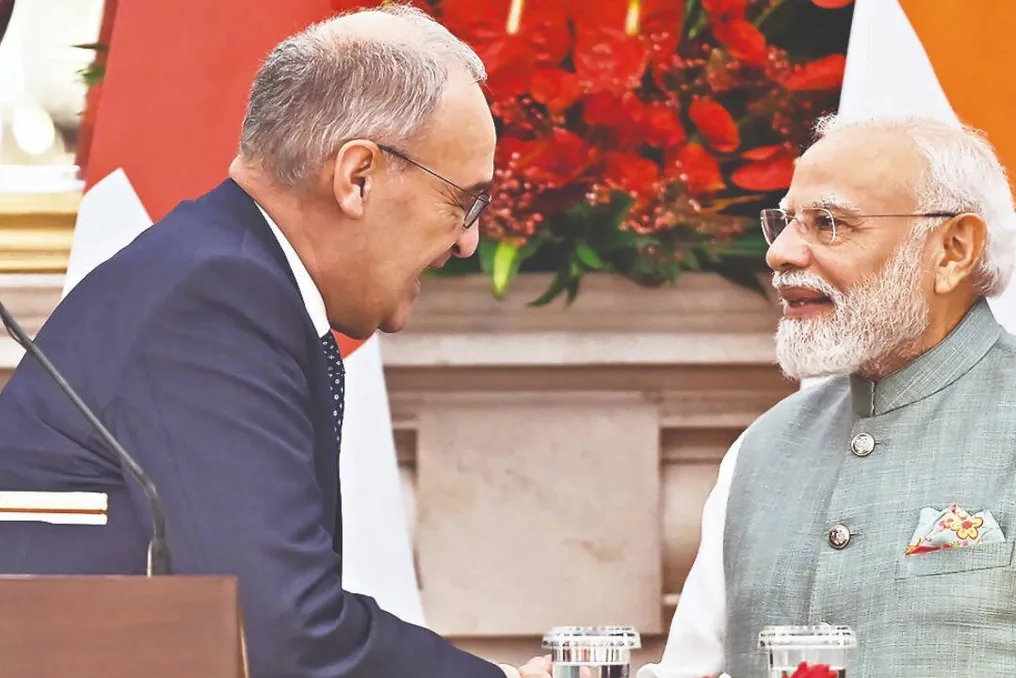
India and Switzerland aim to strengthen their interaction in the fields of trade, investment, technology, defense production, and nuclear energy during the meetings between Prime Minister Modi and the visit of Swiss President Guy Parmelin. During these negotiations, both countries signed five agreements, including a partnership in migration and mobility, as well as an agreement on the exchange of young specialists.
Modi emphasized that innovation, infrastructure, and advanced technologies are key pillars of the bilateral partnership, stating that India and Switzerland will give a new impetus to these relations, taking them to a new level.
A special committee was established to facilitate trade and investment and resolve trade-related issues. This initiative is based on the Trade and Economic Partnership Agreement (TEPA) concluded between India and the European Free Trade Association (EFTA) countries in 2024. Modi recalled that TEPA became India's first agreement with any economic bloc in Europe.
In a statement to the media, Modi noted that this program is an ambitious plan to attract investments, stimulate innovation, create jobs, and ensure overall prosperity. He announced the goal of achieving $100 billion in investments in India and creating 1 million direct jobs over the next fifteen years.
The main provisions of TEPA included expanding access for Indian goods and services to markets, a commitment to invest $100 billion over 15 years, creating 1 million jobs in India, and strengthening bilateral ties with EFTA states.
The leaders also discussed the conflicts occurring in Ukraine and West Asia. The President of Switzerland welcomed Modi's message to Russian President Vladimir Putin calling for an end to the war.
Modi stated that India and Switzerland support democratic values, the rule of law, dialogue, and diplomacy, and they will continue to work together for global peace and stability. He added that India consistently supports any significant efforts to achieve peace in both Ukraine and West Asia. Furthermore, the leaders agreed that reforms in global institutions are necessary to address growing global challenges.
The Prime Minister reported that the mobility agreement will open up many new opportunities for Indian students, researchers, professionals, and youth in Switzerland. This agreement provides for multiple visas valid for up to five years, including stays of up to six months per trip, as well as renewable student permits for one year.
The parties also signed a memorandum of understanding regulating the exchange of young specialists who will be temporarily employed in another country to improve their professional skills and language proficiency. According to the Indian government, this Memorandum includes the exchange of 300 people annually in each country, which can increase to 500, and sets timelines of 30/90 days for checking citizenship/residency status, among other provisions.
Modi noted that both countries have made several important decisions to increase market access for Indian exports in Switzerland and further facilitate investment between them. He specified that this will help boost the export of Indian agricultural products, pharmaceuticals, textiles, and engineering goods to Switzerland, while attracting Swiss investment in key sectors such as biotechnology, life sciences, banking, insurance, food industry, and sustainable development.
In turn, Parmelin stated that the partnership benefits both sides. He noted that India benefits from capital, technology transfer, and easier market access for high value-added goods. Switzerland, in turn, benefits from exchanging with a huge partner experiencing sustained growth at a time when global trade has become more vulnerable and unpredictable.