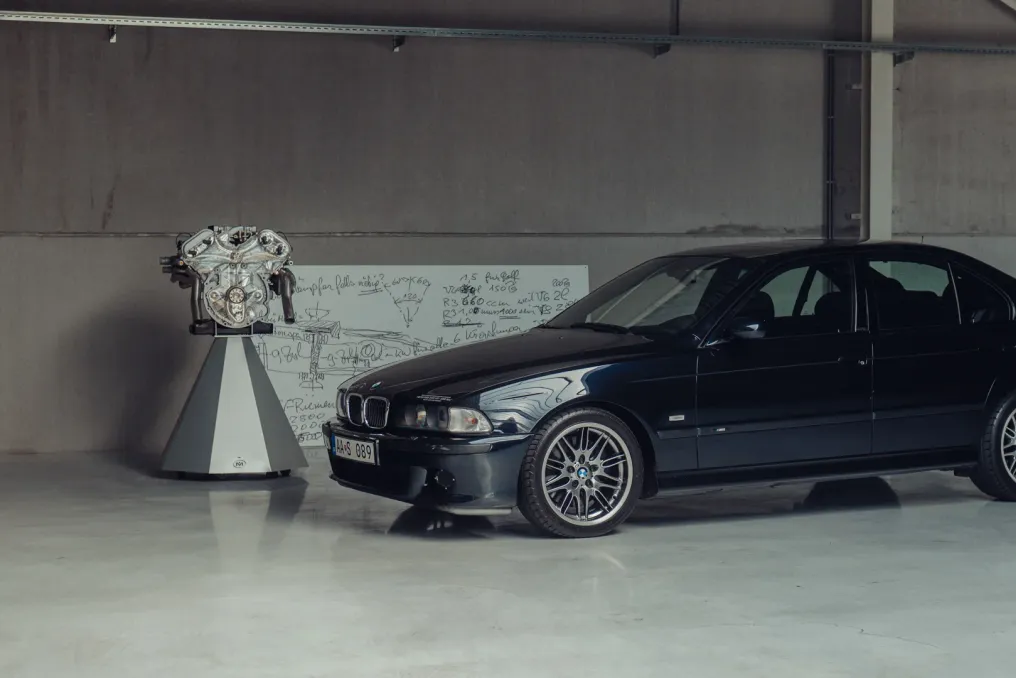
There is an inherent fascination in projects that logically should not exist, especially when they involve installing a completely foreign engine into a vehicle not designed for it. This scenario gains greater interest when executed by the manufacturers themselves. While certain ideas are inconceivable in official projects, the case of the BMW M5 sparked great curiosity due to the unexpected engine under its hood.
The BMW M5 E39 is recognized as a beautiful executive sedan transformed into a legitimate sports car, emerging in the early 21st century. Originally, it was equipped with the S62 engine, a 4.9-liter V8 producing 400 hp and 51 kgfm of torque, and offered only a six-speed manual transmission. With these specifications, the M5 E39 could reach 100 km/h in 4.8 seconds and exceed 300 km/h with the limiter removed, also standing out for its use of aluminum components in the suspension and a rear multi-link axle.
The idea of replacing the naturally aspirated V8 with a more exotic engine, such as a W10, and specifically a Volkswagen W10, led to a car whose existence was unknown until last year, when the Drivetribe website confirmed that it was an official, albeit secret, creation of Volkswagen.
The conception of this project originated with Ferdinand Piëch. At the time, the patriarch of the Volkswagen Group was known for promoting a corporate, technical, and philosophical revolution within the company, encouraging risky experimentation. Under his leadership, Volkswagen began the path toward modular platforms. Piëch drove various innovations, such as requiring the Volkswagen Phaeton to reach 300 km/h in high temperatures, ordering a turbodiesel V10 engine for the Touareg, and insisting on the renewal of the Bugatti with a sixteen-cylinder engine.
In this context of automotive megalomania, Piëch discreetly requested the development of a W10 engine. The philosophy behind Volkswagen's W engines lies in the intelligent utilization of space. It all started in the 1990s with the VR6 engine, created to fit in front-wheel-drive compact cars. The evolution led to the idea of combining two VR blocks, resulting in a W engine. The W12, for example, was shorter than a traditional V12, and this logic generated the W8 in the Passat, the W12 in the Audi A8 and Bentley Continental, and the W16 in the Bugatti Veyron.
There was a gap in the engine family: the VR5, a VR6 with one less cylinder. Following the modular logic meant that combining two VR5 blocks on a single crankshaft would produce a W10. Unlike a conventional V10, the W10 would be extremely compact and symmetrical. In 1999, Piëch ordered the creation of this W10 to be used in a high-performance sedan. An engineering team, led by Sabine Willeke, built a new aluminum engine with about five liters of displacement, without forced induction.
The challenge was that in 1999, the Volkswagen Group did not have a suitable vehicle to test the W10 engine. The project took place outside the official R&D department, under direct orders from Piëch. Although Audi was developing the RS6 and Porsche the Panamera, a car with a solid structure, good trunk space, perfect dynamics, and rear-wheel drive was needed. The choice fell upon the BMW M5 E39, which was considered the absolute standard in the category.
Volkswagen acquired a 2000 model in 'Carbon Black Metallic', with a black leather interior. After arriving at the secret VW workshop, the S62 engine was removed. Volkswagen invested almost two million euros to install and tune the experimental W10. They kept the six-speed gearbox, but all peripherals were replaced with custom parts, including a carbon fiber airbox, cooling system, and exhaust, all handcrafted.
Electronics represented a major obstacle, as integrating an engine from one manufacturer into another's chassis was not simple in the 1990s. Volkswagen had to develop its own system. Due to the priority of getting the car running, it lost all modern electronic aids, such as ABS, traction control, and stability control. Internally, the refinement was maintained, such as the original phone in the armrest, but the instrument panel was replaced by a Stack racing panel, and the speedometer was never configured.
Initial dynamometer tests indicated that the project achieved 480 hp at the rear wheels, which would equate to over 530 hp at the crankshaft, an increase of about 130 hp compared to the original engine. Popular legend said that Ferdinand Piëch used the car daily in Wolfsburg; the reality, recently revealed, is that Piëch actually drove the M5 with temporary plates, actively participating in secret public road tests.
Sabine Willeke informed that only three W10 engines were built. One was rescued by a Volkswagen mechanic in Germany, another is displayed alongside the M5, and the third is installed in the black sedan. The project was terminated by Volkswagen, which opted to keep the W8, W12, and W16 models in production. The car remained hidden for over 15 years in a collector's garage. Subsequently, it was acquired by a enthusiast from Slovakia who regularly drove it. Now, the auction house Broad Arrow is offering the M5 W10 at the Zoute Concours in Belgium on October 9th, with an estimated price between €250,000 and €350,000.