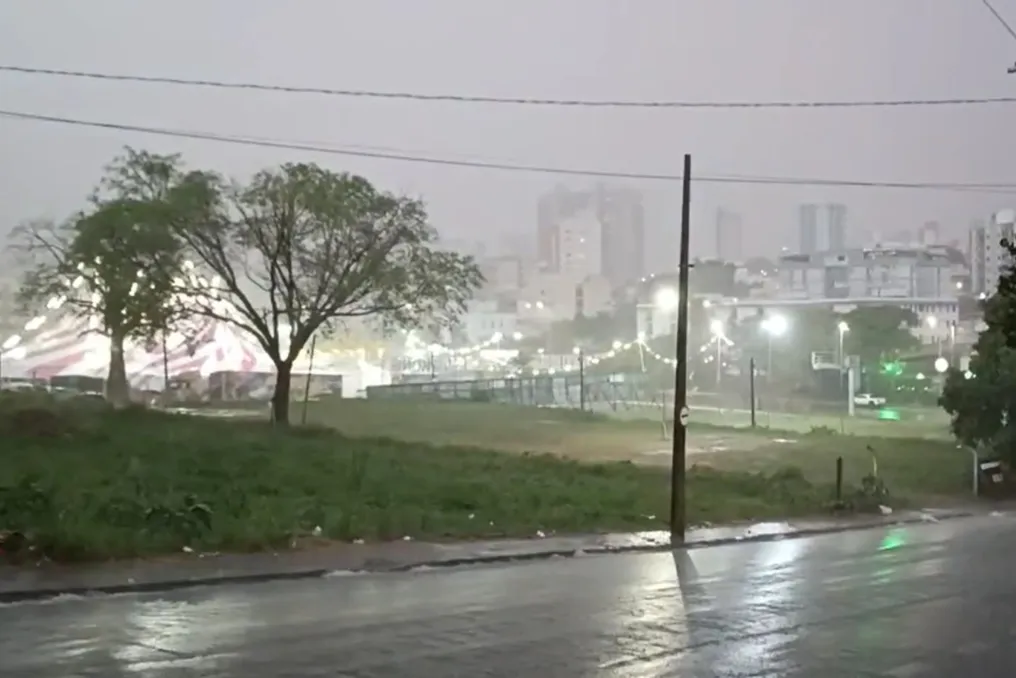
The week starting this Monday, the 5th, and extending until Sunday, the 11th, will be marked by climatic instability and constant rain in the Triângulo Mineiro and Alto Paranaíba region. According to the National Institute of Meteorology (Inmet), Uberlândia and other cities in the area are under an orange danger alert due to storms, with potential for winds reaching up to 100 km/h and hail occurring throughout the day.
This alert predicts that the storms may cause various problems, including interruptions in electrical power supply, damage to crops, falling trees, and flooding in urban areas. The institute issued guidelines for the population to avoid sheltering under trees during wind gusts and not parking cars near transmission towers.
Rainfall Projection and Atmospheric Conditions
Geographer William Borges points out that the ECMWF Ensemble model projection suggests a rainfall accumulation between 30 and 80 millimeters for the week. However, he emphasizes that the distribution of this precipitation will not be uniform; while some municipalities may record larger volumes, others will have shorter downpours and lower accumulation.
Borges explains that an extensive moisture corridor is advancing from the Center-West towards the Southeast, which favors the persistence of unstable conditions over Minas Gerais. The combination of high humidity, afternoon heating, and an unstable atmosphere creates scenarios conducive to intense rainfall, especially in the afternoon, night, and early morning.
Mild Temperatures and Feeling of Stuffiness
Inmet's weather warning for this Monday (5th) indicates that greater cloud cover and the frequency of rain will tend to restrict heating, resulting in temperatures that may be close to or even 2°C below the climatological average. However, when the sun appears, the heat may return, increasing the feeling of stuffiness due to the humidity present in the atmosphere.
The higher incidence of rain should also increase the relative humidity of the air, decreasing long periods of very dry air. Although indices may drop in the afternoons with more solar exposure, this will not have the same constancy seen in dry months.
Safety Measures During Storms
Given the risks of flooding, overflows, river breaches, lightning, and landslides, it is crucial to know how to stay informed and what actions to take to ensure safety. Below are important tips for different situations.
If a person is on the street, they must keep distance from walls and fences, as these may collapse. It is forbidden to approach poles to prevent shocks or touch barbed wire fences, metal gates, and other metal structures. At bus stops, it is recommended to sit with feet suspended, seeking covered shelter if possible. One should never seek refuge under trees, as they can attract lightning. Before the rain starts, open areas, such as parks and soccer fields, must be left due to the risk of electrical discharges. Feeling hair stand on end is a sign that lightning may strike at any moment. Attention must also be paid to leaning poles and trees, which may fall with strong winds. In cases of floods, it is vital to avoid risk areas, not cross flooded streets, stay away from electricity, and contact Civil Defense (199) or Firefighters (193) if necessary.
For those at home, it is recommended to keep windows and glass well closed and remain away from them. Contact with tap water during lightning storms should be avoided, although it is uncommon, as electrical discharges can travel through the piping. One should also not lean against concrete walls, as lightning can travel through metal wires or bars present in walls or floors. It is advisable to avoid using landline phones, opting for cell phones or cordless devices during a storm.
When driving, if the rain is very heavy, the ideal is to stop in a safe place until visibility improves. If stopping is not possible, speed must be reduced, especially with wipers running. If the road or street is flooded, one must turn back and find another route, as even a small amount of water can make the vehicle float (about 30 cm). Never attempt to cross flooded areas, even without signs of current, due to the risk of obstacles or sudden rise in water level. In slippery road conditions, one must increase the safety distance between the vehicle and those ahead, and hold the steering wheel firmly during wind gusts, especially when overtaking. If the car skids, one must remain calm, take their foot off the accelerator, and avoid braking until control is regained.
If the vehicle is hit by wires, the first action is to remain calm and call the firefighters at 193, without leaving the car until help arrives, given the high probability of electric shock. When calling the firefighters, care must be taken with the cell phone, keeping it separate from the car's metal structure and not charging. Windows must remain closed, and no part of the vehicle's metal should be touched. If it is absolutely necessary to exit, the door must be opened cautiously, and the person should not put only one foot on the ground, but both. Upon exiting, one must keep both feet together, dragging or taking small steps, without touching the vehicle, waiting in a safe place.