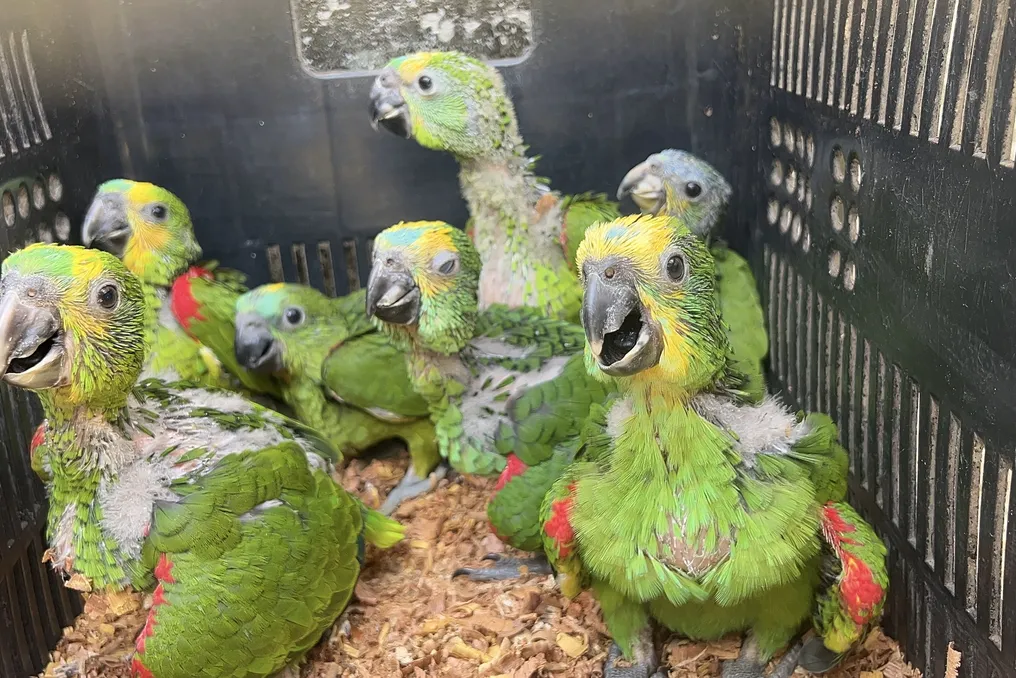
A study analyzing nearly three decades of parrot confiscations in Mexico revealed a shift in the nature of this trade: collection, previously more associated with rural areas and the need for supplementary income, now shows a stronger link to densely populated regions where demand for these animals is concentrated.
The work, published in the scientific journal Proceedings of the National Academy of Sciences (PNAS), also identified potential corridors used for transporting the birds and showed that the trade is not randomly distributed across the territory.
The methodology of this study can also be applied in other countries, such as Brazil, which between 1501 and 1520 appeared on European maps as the 'Land of Parrots' due to the abundance of these birds on the coast.
In Brazil, illegal trade in parrots and macaws threatens species already endangered, such as the Blue-and-yellow Macaw (Anodorhynchus leari), classified as 'Endangered (EN)' on the Official List of Threatened Species.
According to the Chico Mendes Institute for Biodiversity Conservation (ICMBio), this species is one of the most sought after in international trade, which historically removes eggs and chicks from nature for illegal sale in other countries.
Overall, birds are among the most affected by the trade in the country. According to the National Institute of Atlantic Forest (INMA), they account for over 60% of all animals involved in trade in Brazil. However, the problem is not limited to Brazil.
To obtain these results, researchers examined over 6,000 confiscation records conducted between 1997 and 2024. Based on this data, they correlated bird sightings with the natural habitats of the species and identified regions with the highest probability of illegal transport concentration.
According to George Ola, a researcher from the Australian National University (ANU) and one of the study's authors, this change represents a transformation in the very nature of this type of commerce. In the past, collection could serve as an additional source of income for families in rural areas near forests. However, over time, demand in urban centers has begun to play an increasingly significant role.
The researcher explains: 'The driver of this market has shifted from economic necessity for survival to the search for consumption in more densely populated cities.'
From Fields to Cities
Parrot trade is changing routes and concentrating in large cities. The study divided the records into three periods: 1997 to 2008, 2009 to 2019, and 2020 to 2024. The comparison showed that factors related to the trade changed over time.
In the first period, the number of confiscated birds was significantly linked to poverty rates in Mexican states. This result corresponds to opportunistic local collection as a means of earning income. Starting in 2009, the link to poverty weakened, while population size became more associated with confiscations.
This result demonstrates a change in the trade profile, which has become more linked to regions with the largest number of potential buyers. In Ola's view, large urban centers have begun to function as a 'magnet' for illegal trade.
Changes are also observed in the species requested. Throughout the three periods, a disproportionately high number of large, bright, and valuable birds were captured, mainly macaws of the genus Ara and parrots of the genus Amazona.
Birds Cross Hundreds of Kilometers
Another sign that the trade extends beyond local boundaries is the distance between the regions where the birds live and the places where they are confiscated. According to the study, many parrots were found hundreds of kilometers from their natural habitats, including major cities like Mexico City.
To understand how these animals could be transported across the country, researchers adapted a tool known as chain theory, usually used to study connectivity between natural areas. In this case, roads were considered possible routes for bird movement. The model combined information on parrot distribution in nature with confiscation locations and indicated corridors with the highest probability of trade concentration.
However, the study emphasizes that the map does not necessarily reflect the actual routes used by smugglers. The corridors are areas of highest probable flow according to the model, which primarily considers highways and available confiscation data.
Why Does Someone Buy an Illegal Parrot?
According to Ola, the demand for these birds is primarily linked to cultural and emotional factors, as well as a lack of awareness about the consequences of illegal trade. Parrots, budgies, and macaws are traditionally kept as pets in various Latin American countries. Their bright plumage, behavior, and ability to imitate human speech contribute to this interest.
The researcher also draws attention to consumers interested in rare or large species, for whom some animals may acquire status value. According to Ola, with the expansion of social media and online trade, illegality can become less obvious to the buyer.
Chick Theft
The consequences of the trade do not end with the removal of the animal from nature. Both the capture of adults and the removal of chicks can endanger wild populations. In the case of adults, removing breeding-age individuals directly reduces the reproductive capacity of the population. And nest raiding disrupts the influx of new individuals. Repeated removal of chicks can also harm nesting sites themselves, as many species use tree cavities for reproduction. These sites can be destroyed during capture and remain unavailable to future generations. This issue is particularly alarming for birds with relatively slow reproductive cycles, which can remain in the wild for a long time.
What Does Mexico Have to Do With Brazil?
Although the study was conducted in Mexico, the methodology can be useful for other countries facing similar problems. Brazil and Mexico possess great diversity of psittacids—a family of birds with curved beaks, extensive habitats, road networks, and large urban centers. In Ola's opinion, these characteristics can create similar conditions for the functioning of the trade.
The researcher asserts: 'The situation in Mexico shows that trade is not a random event, but a spatially predictable system that evolves in accordance with socio-economic development.' According to him, the methodology can help Brazilian authorities identify the most used trade corridors and direct supervision to these points, hindering illegal bird transport and helping combat the problem faced by both countries.