Donald Trump, the US President, blamed Ukrainian attacks on Russian oil refineries for the high cost of gasoline this Monday, stating that the conflict with Iran was no longer the determining factor.
On his social network Truth Social, Trump declared that what was raising the price of gasoline was no longer the Strait of Hormuz, given that barrel records were being exported almost daily. Instead, he pointed to the destruction of Russian refineries by Ukraine.
Furthermore, Trump also blamed what he described as the closure of refineries located in states controlled by opposing Democrats. Since the beginning of the war between the United States and Iran, the market has closely monitored the impacts of this confrontation on oil prices.
Production and transport stoppages generated fears of supply shortages, especially due to the Strait of Hormuz, one of the crucial routes for oil from the Middle East. Eight months after unsuccessful attempts at a peace agreement, oil rose again, even with the reopening of the route, exceeding US$100 per barrel on Brent, the international benchmark, on Thursday (the 1st).
Despite the recovery of Gulf exports—the maritime area of the Middle East with major oil producers—which reached 23.3 million barrels per day in the last week of September, according to Goldman Sachs estimates, the price remained high.
What happened to oil during the war?
The clash between the US and Iran intensified apprehension about the commodity's supply, given that the Middle East hosts some of the world's largest producers. The main focus was on the Strait of Hormuz, a channel connecting the Persian Gulf to the Gulf of Oman and used to ship oil from nations such as Saudi Arabia, Iran, Iraq, Kuwait, and the United Arab Emirates.
When transit in the region was compromised, there was fear of reduced oil arrival in the global market. This caused prices to rise even before a real shortage, as buyers and investors began accounting for the risk of a prolonged interruption.
The increase in oil impacts the economy by making fuels like diesel and gasoline more expensive, in addition to increasing the costs of transporting goods and people. This increase in costs can put pressure on the values of other products and contribute to a higher inflation rate.
Although the resumption of transport through the strait mitigated some of this concern, it did not cease entirely. One reason for the persistence of the rise is that the recovery of the oil market has not occurred uniformly across the entire production chain.
Crude oil returned to circulate in volumes close to previous levels, but processed derivatives, such as jet fuel, diesel, and gasoline, continue to have exports below expectations. This occurs because the conflict also affected refineries and increased logistical risks for transporting these products, meaning there may be crude oil available, but there are still difficulties in transforming it into fuels and distributing it to consumers.
Felipe Sant'Anna, an analyst at Axia Investing, emphasizes the importance of differentiating these phases: 'One thing is production, another thing is refining, another thing is mobility, exportation, whether by pipelines or even by tankers.'
Low stock keeps pressure on oil
According to the International Energy Agency (IEA), global oil stocks decreased by 507 million barrels since February. In the same period, member countries released more than 300 million barrels from their emergency reserves. With reduced stocks, companies and governments have the potential to increase their purchases to build safety reserves, which sustains pressure on prices.
Even with the reopening of the Strait of Hormuz, the market still assesses the risk of new supply problems. A new military escalation or attacks on production facilities, refineries, and vessels could reduce supply and raise costs again.
Sant'Anna comments that 'these tensions we have and this uncertainty have caused many countries to hoard oil and no longer want to 'open the tap' for the world, which causes investors to price future oil contracts higher.'
Additionally, the arrival of winter in the Northern Hemisphere can also exert pressure on raw material prices, as this implies an increase in energy consumption in the US and Europe. The analyst states: 'When winter arrives in the northern hemisphere, energy consumption, especially oil energy, right, natural gas, oil, and derivatives, will increase a lot.'
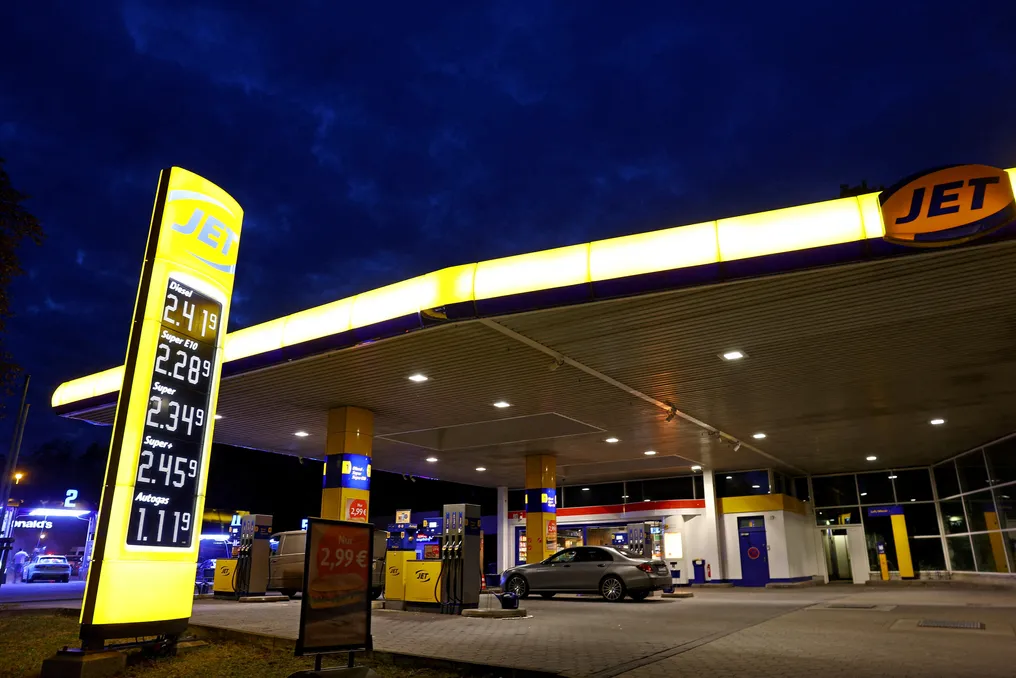
The German government implemented reductions in taxes on gasoline and diesel to mitigate the impact of rising fuel costs on consumers and businesses.
What needs to happen for oil to fall?
Maria Carolina Luchesi, an analyst at Hike Capital, points out that a more stable devaluation of prices depends on the realization of three elements: sustained recovery of exports; resumption of interrupted production; and normalization of the fuel market.
The EIA forecasts that, on average, 5.7 million barrels per day of production will remain idle in the fourth quarter, projecting that most of the Middle East's production will return to pre-conflict levels in the second quarter of 2027.
This means that the market needs greater certainty that oil will continue to reach consumers, that refineries will operate normally, and that stocks will begin to be replenished.
On Friday (the 2nd), oil traded below US$100 after news that nations might release diesel and oil reserves to boost global supply. According to Reuters, European Union countries are debating the release of 50 million barrels of diesel, while members of the International Energy Agency could make available another 50 million barrels of oil.
Meanwhile, the US and Iran remain deadlocked after months of war and failed negotiations. The main disagreements revolve around the Iranian nuclear program, American sanctions, and the reopening of the Strait of Hormuz. Iran demands the end of sanctions and guarantees to resume dialogues, while the US demands restrictions on the nuclear program and freedom of navigation in the region.