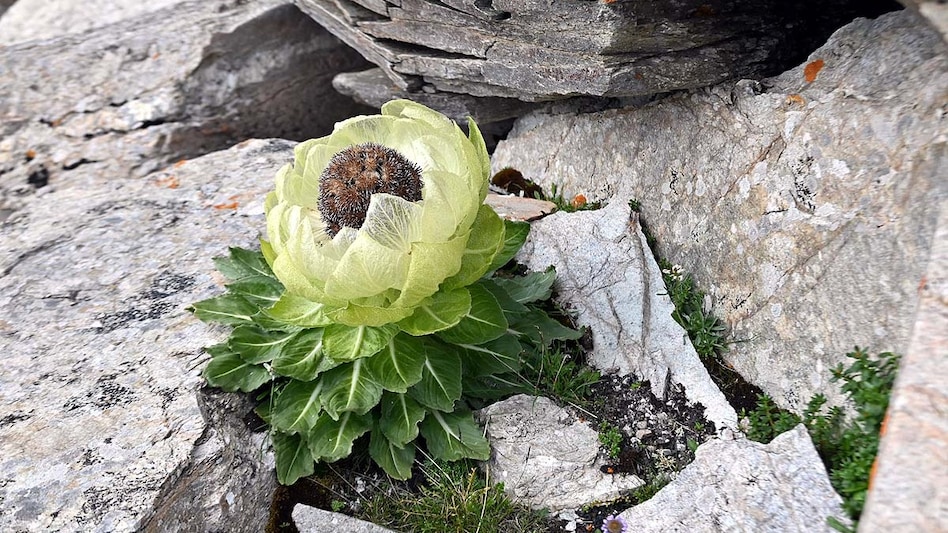
A rare flower resembling the Indian Brahma Kamal was discovered in the mountainous regions of Xinjiang province in China. This flower is called Snow Lotus, and its scientific name is Sauceria involucrata. The plant grows at an altitude of approximately 2400 to 4100 meters. Despite the harsh conditions at such an altitude—low temperatures, thin air, and high solar ultraviolet radiation—this species thrives.
The Snow Lotus is not only found in China; it is also found in some mountainous regions of Kazakhstan, Kyrgyzstan, and Mongolia. In China, it is particularly common in the northern, central, and western parts of Xinjiang. Flowering usually occurs from July to August. The large leaves surrounding the flower give it a resemblance to the Brahma Kamal when viewed from a distance.
The Snow Lotus is a plant that grows in high-altitude zones. In the Tian Shan mountain range in Xinjiang, it is found at an altitude of 2400 to 4100 meters. It can grow on mountain slopes, in valleys, meadows, and among rocks, and sometimes appears in rock crevices. At this altitude, the temperature remains quite low, the air is thinner than in the plains, and the level of solar UV radiation is higher. The Snow Lotus plant is adapted to grow in these weather conditions.
No, they are not the same plant, although they may look similar externally. The scientific name for Snow Lotus is Sauceria involucrata, while the scientific name for Brahma Kamal from India is Sauceria oviculata. Both plants belong to the same genus, Sauceria, but differ by species.
In India, the Brahma Kamal grows in the high-altitude regions of the Himalayas. According to data from the Botanical Survey of India, it grows at an altitude of about 3800–4600 meters and has been observed in the states of Jammu and Kashmir, Himachal Pradesh, Uttarakhand, Sikkim, and Arunachal Pradesh.
Wild populations of Snow Lotus are under pressure due to their collection in large quantities for use in traditional medicine. Because of this, conservation efforts are being made for it in China. However, according to KeV, it would be incorrect to call it an endangered species, as its current global status is 'Not Threatened'.
Thus, although the Tian Shan Snow Lotus may look like the Brahma Kamal, they are two different plants. It is important to note that both grow in very high mountain areas where the cold and weather difficulties significantly exceed those experienced by ordinary plants.