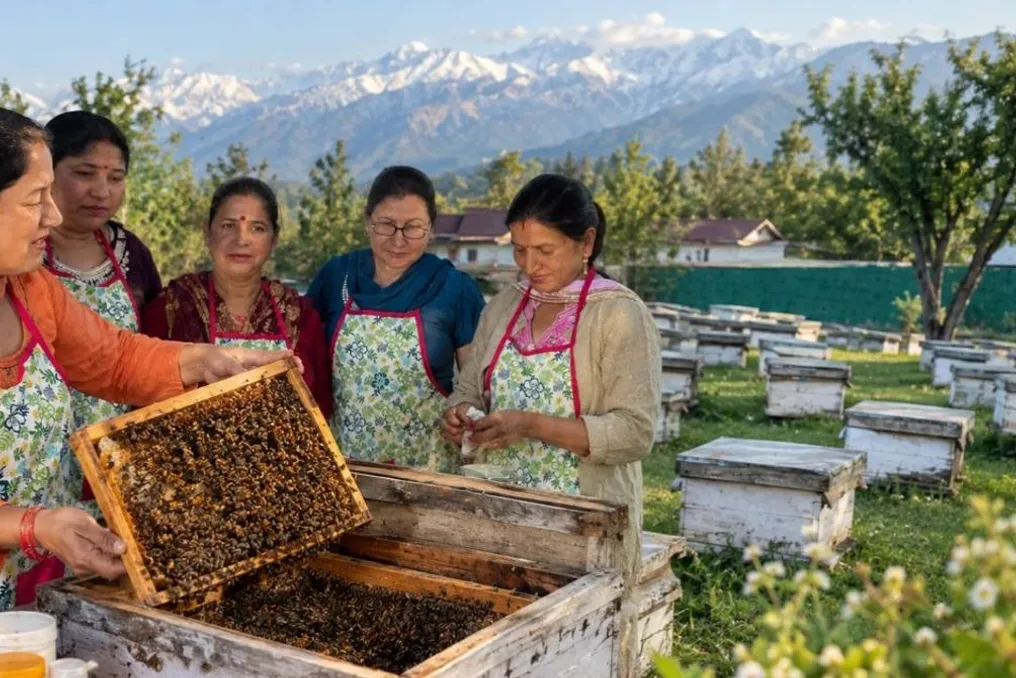
In the village of Badsar, located in the Kangra district of Himachal Pradesh state, bees are contributing to something much greater than just honey. On this green and neat land, surrounded by a picturesque backdrop of snow-capped mountains, small houses, and clean air, a group of beekeepers, farmers, and women artisans is restoring an ancient connection with nature that was once natural to this region.
The Tenacious Bee collective, founded in 2018 by a group of nature-loving friends, is working to revive traditional beekeeping methods in the state. Its mission is to demonstrate that ecological restoration and agricultural development can go hand in hand when built within the community itself.
Amidst a situation where beekeepers are being pushed out of the profession due to intensive pesticide use, climate stress, and falling honey prices, the work of Tenacious Bee relies on a simple idea: sustainable agriculture is possible without transitioning to industrial methods that have put pressure on small beekeepers and bee populations.
When beekeeping began to decline
For many generations, beekeeping has been an integral part of life in Himachal Pradesh. Practices such as maintaining 'dhaluni'—small niches built into mud and stone house walls—allowed bees to coexist with humans. Honey collection followed the seasonal rhythm dictated by local flora and environmental understanding.
However, over time, these relationships began to weaken. Low honey yields made it difficult for beekeepers to sustain their activities. As concrete structures replaced traditional dwellings, even the physical spaces that previously supported bees disappeared. This led to the gradual decline not only of bee populations but also of the knowledge systems that sustained them.
The Tenacious Bee collective started its work amidst these realities, not by introducing anything entirely new, but by returning to existing practices and adapting them to modernity. Aditya Singh, Experience and Operations Manager at Tenacious Bee Collective, explains: 'Caring for bees is vital because they support us in return. At Tenacious Bee, the team practices ethical beekeeping across the Himalayas, collecting only 20–30 percent of the honey, leaving the rest for the bees as winter stores.'
In parallel, they conduct workshops in the village where local women create products, such as lip balms and beeswax candles. These products are then packaged and sent to buyers across India.
Creating a community and women-focused model
Instead of centralizing production, Tenacious Bee focused on building a decentralized, community-managed model. Their work starts with people like small farmers, local beekeepers, and village women. Today, more than 45 beekeepers are part of their network.
Through training programs, community members learn the principles of ethical beekeeping, which prioritize the health of bees and their habitat. The focus is on local bee species that are best adapted to local conditions and play a crucial role in biodiversity conservation. Over 250 farmers have been trained in ethical, bee-friendly practices. Most of the trainees are rural women from remote areas, such as the Panghi Valley. They only collect honey from supercolonies, never touch the brood chamber, and do not harvest honey if the supercolony is not full.
Aditya adds: 'Our work focuses on helping people understand what bees mean for both humans and the wider ecosystem. If bees can survive in a place, it indicates a healthy environment, and ultimately our own food systems depend on this balance. The use of pesticides and chemicals disrupts this delicate interconnectedness, so it is crucial for people to realize how important bees are.'
Tenacious Bee Collective encourages the cultivation of local herbs and flora beneficial to bees. This strengthens food sources for bees while creating additional income streams for farmers who can use these herbs in value-added products.
Women are a central figure in this ecosystem, and those who have been trained through the collective go beyond mere beekeeping. Six women are directly employed for cold processing and packaging of honey. They also participate in producing beeswax-based products, such as candles and skin ointments, adding skills and value to the process.
Sunita, who was previously a homemaker and farmer and is now one of the beeswax experts, shares: 'I enjoy working here with other women from the village. We spend days together working and talking, and it creates a warm, supportive atmosphere in the Tenacious Bee workshop. I look forward to coming here every day. Knowing that others find inspiration in our work feels meaningful to me.'
Here, ecology and economy do not exist separately. Healthy ecosystems support livelihoods, and community involvement ensures that this work will be sustainable in the long term. At the heart of Tenacious Bee's work is a shift in the understanding of beekeeping—it is viewed not just as production, but as knowledge.
In the village of Badsar, the collective rented a small plot of land to create a space for knowledge exchange dedicated to bees, flora, and traditional practices. Bee boxes stand next to plots of cultivated herbs, demonstrating a living example of how biodiversity and agriculture can work together. The goal is not just honey production, but the restoration of a learning system. They hold workshops, inviting artists, researchers, and practitioners to engage with this space. These interactions generate new ways of understanding bees as participants in ecological balance, not just honey producers.
Speaking about the experiential side of their work, Aditya notes: 'In Apidom, which consists of wooden structures with integrated hives, guests can lie on a bed situated above active hives, experiencing a deep, calming resonance similar to Bhramari yoga. Visitors can also participate in honey tastings in the workshop, trying different varieties and learning about the diversity of honey.'
Rethinking livelihoods through beekeeping
What sets Tenacious Bee apart is its approach to livelihood security. In many sectors, sustainability is often linked to scaling up, such as increasing production and reaching larger markets. Here, the approach is different. Production remains small-scale, processes are slow, and growth is measured by ecological and social indicators, not just economic ones.
The economic impact of Tenacious Bee is evident: local beekeepers receive better support; women gain access to skill-based income; and farmers find ways to work with the land, not against it.
The Tenacious Bee model shows that small-scale production can be viable if the value of the final product is increased, rather than the volume of honey collected. The collective pays participating beekeepers premium rates, reportedly reaching three times the market price, while simultaneously generating additional income from beeswax products, experiences, and consultations.
Community involvement has played a key role in this progress. Early support from village leadership helped build trust, and resident participation is steadily growing. 'We also travel to various temporary fairs and events in cities like Delhi. These experiences have really boosted our confidence, and we feel excited and proud to be a part of them,' adds Shina, who played a vital role in conducting all the workshops and interventions in the village.
However, Shina's path to this role was shaped by a period when she was not officially working. After having children, she stepped away from work to focus on raising her family. When the children grew up, she began looking for a way to return to work and create something of her own. Tenacious Bee provided her with this opportunity. What started as a chance to learn about beeswax turned into a role where she now helps train others and plays a key role in the collective's work in the village. For Shina, returning to work allowed her to utilize her skills and contribute to something she believes in.
As ecological systems and rural livelihoods come under pressure, this model offers a sound alternative. This model not only prioritizes the health of bees, ecological restoration, and small-scale production but also provides a sustainable income for those who practice it.
More than just saving bees
The work of the Tenacious Bee Collective is often presented as conservation work, but it goes beyond that. It is about restoring connections between people and the land, between traditional knowledge and modern practice, and between local communities and the markets they interact with.
Furthermore, diversifying the economy around bees makes small-scale beekeeping more resilient than relying solely on honey. By focusing on bees, the collective addresses something bigger. Pollinators are at the center of food systems and biodiversity, and therefore, supporting them means strengthening entire ecosystems.
Simultaneously, embedding this work within the community ensures that it is not exploitative. This fosters a sense of ownership, skill development, and allows people to determine their own livelihoods. As conversations about climate change and sustainable development continue to grow, the story of the Tenacious Bee Collective reminds us that significant changes do not always begin with scale. Sometimes they begin in small villages, thanks to consistent effort and the willingness to restore what should never have been lost.