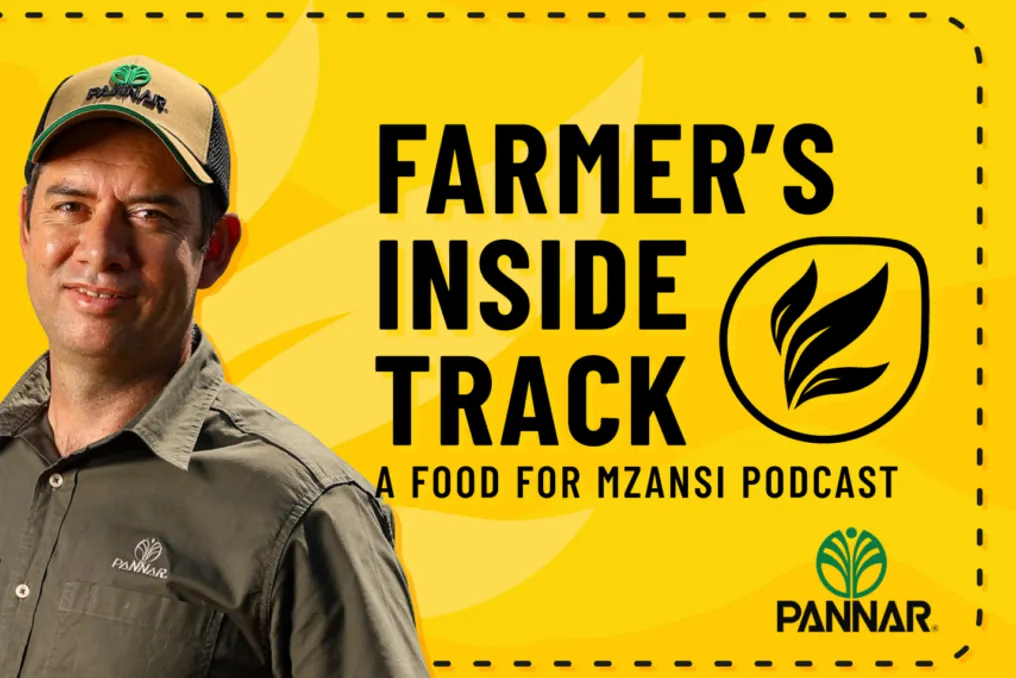
According to business manager Lucas Meyer of Pannar Seed, high yield does not guarantee high profit, especially when grain prices are under pressure. He insists that farmers should pay more attention to cost of goods sold, make more informed investment decisions, choose reliable hybrids, and start marketing in advance.
Speaking on the podcast Food For Mzansi’s Farmers Inside Track, Meyer noted that current production conditions require agricultural producers to look beyond the metric tons per hectare figures and focus on the margin generated by each hectare.
“Farmers are in a very interesting but difficult position,” Meyer stated. “On one hand, yields look strong, which is always a positive sign, but on the other hand, low grain prices and high resource costs create very real pressure on profitability.”
As he explained, this forces a shift in focus from simply achieving the maximum possible harvest to understanding what contribution each hectare makes to the final financial result.
“The main discussion is not just about the tons per hectare produced, but about the margin per hectare that the farmer can achieve at the end of the season,” Meyer emphasized. He added that in such seasons, increasing production itself may not improve the farmer's financial situation, as a large harvest does not automatically mean a better financial outcome.
When grain is sold in a weakening price environment, additional tons can be offset by a decrease in revenue per ton and an increase in production costs. Therefore, Meyer strongly urged farmers to know their break-even point and manage every hectare with profitability in mind.
The paradigm shift involves moving from the question, “How do I produce the largest harvest?” to the question, “How do I get the best return from the hectare?” This implies that decisions regarding seeds, planting density, fertilizers, crop protection, and grain marketing must be viewed through the lens of profitability.
Meyer clarified that yield remains important, but it must be profitable and should not be achieved at the expense of reducing profitability.
Under cost pressure, Meyer considers hybrid selection one of the first important decisions farmers make when managing margins. He noted that a suitable hybrid not only provides yield potential but also helps manage risks.
Instead of focusing solely on maximum yield, farmers should consider characteristics such as stability, adaptability, disease resistance, lodging resistance, and stress tolerance. He recommended selecting hybrids according to the potential and risk profile of individual fields.
On stronger soils with low risk, farmers may have more options for choosing high-yield potential hybrids. More variable or risky fields may require a greater emphasis on stability and stress resistance. Meyer added that they always try to recommend a balanced portfolio for different potentials, allowing farmers to distribute risks using a package of hybrids.
Meyer warned against unjustified cost reductions in response to declining margins. He called it not a season for saving, but rather a season for smarter investments. Cutting the wrong investments can reduce yield, while spending money without clear returns can undermine profitability.
Instead, the focus should be on understanding which investments have the greatest impact on yield and margin, including seed placement, hybrid selection, planting density, fertilizer efficiency, and crop protection. “The key is to ensure that every investment has a clear purpose and expected return, rather than just following a pure standard recipe,” he stated. Other costs, such as fuel, logistics, and finance, must also be considered when calculating the true return on production.
Given the potential oversupply, which intensifies price pressure, Meyer believes that grain marketing should become part of the profitability plan from the beginning, not postponed until the harvest is ready for sale. Farmers should first determine their break-even price and then consider a phased sales strategy, taking into account storage costs and baseline levels. Contracts and hedging can also become part of the marketing strategy if it suits the specific farm.
“Marketing cannot be left until later,” said Meyer. “It is part of the profitability plan from the very beginning.” Although some current price fluctuations may be seasonal and dependent on international production cycles, he noted that volatility itself has become part of the agricultural environment. Therefore, farmers need enterprises capable of withstanding various market cycles, combining production planning and cost discipline with a clear marketing strategy.
Meyer also stressed the role of agronomic consulting in ensuring that genetics and investments translate into commercial profit. He stated that seeds only reach their potential with proper placement and management. This requires considering the interaction between hybrid selection, soil conditions, planting density, fertilizers, and crop protection, as well as accounting for the commercial reality of the season. Ultimately, Meyer concluded that attention to detail distinguishes a good harvest from a good business result. His advice to farmers was simple: “Don't farm just for yield; farm for margin.” He advised knowing their break-even point, choosing reliable hybrids, and carefully managing investments, while linking these decisions to early marketing steps to protect profits.