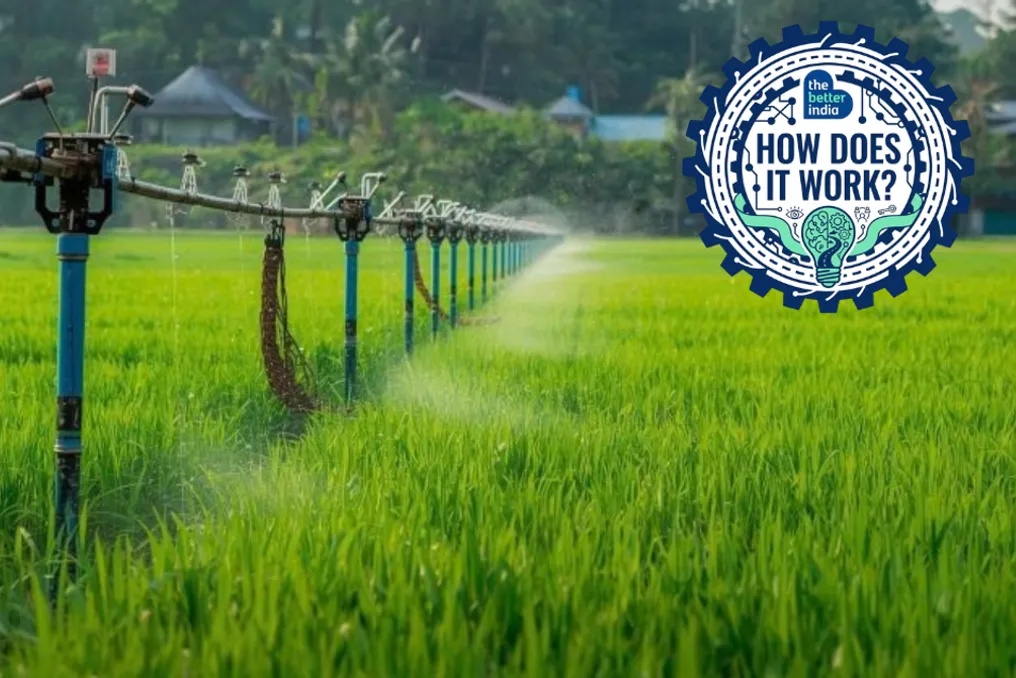
The 'How It Works?' series from The Better India explores everyday objects, revealing the complex technology, design, and sustainable thinking that ensures their effective operation. These ideas are hidden not only in futuristic machines but also in the items we use daily.
On a farm early in the morning, it might seem simple: rows of crops stretch across the field, and their roots are hidden underground. Water is supplied through pipes or drip lines directly to the plants. However, the question arises: what is the optimal amount of water?
Insufficient moisture causes stress in plants, while excess leads to water loss and soil over-saturation. For farmers managing large areas, manually checking every section and adjusting irrigation is often impractical.
This is where smart irrigation systems come in. Instead of watering for a fixed time, these systems use data about the soil, weather, and the plants themselves to decide when irrigation is needed, and in some cases—when it should stop.
What makes irrigation 'smart'?
A traditional watering timer can be programmed to turn on a sprinkler at 6 am for 30 minutes, regardless of whether it rained the day before. A smart irrigation controller functions differently: it receives information about the conditions around the plants and uses it to regulate the irrigation process.
One common method is the use of soil moisture sensors. These sensors are placed in the soil, usually in the root zone, and measure water content. Since water changes the electrical properties of the soil, sensors can assess its moisture level.
Other systems take meteorological information into account. They analyze factors such as temperature, precipitation, humidity, wind, and sunlight to estimate how much water plants lose through evaporation and transpiration, collectively known as evapotranspiration (ET).
So, how does the system know when to stop?
The system can be imagined as a simple dialogue between three components: a sensor, a controller, and a valve. First, the sensor reads the soil readings. Then, the controller compares this data with a set moisture level or 'threshold' for that specific system.
If the soil is too dry, the controller can send an electrical signal to open the valve, and water will begin flowing to the crops through drip lines or sprinklers. As watering continues, the soil moisture level changes.
In a soil moisture demand-based system, two thresholds can be set: a lower one that signals the system to start watering, and a higher one that indicates the need to stop. As soon as the sensor detects the desired moisture level has been reached, the controller closes the valve, and the watering ends. This is essentially a feedback loop: measurement → comparison → watering → re-measurement.
What if it rains?
This is where smart irrigation becomes even more useful: a rain sensor can detect precipitation and prevent the scheduled watering cycle from starting if the soil has already received enough moisture. Weather-based systems can also use precipitation data and other meteorological information to reduce or suspend irrigation.
For example, if the system anticipates a certain water loss from the soil during hot and dry weather, it can adjust the irrigation accordingly. In cooler or wetter conditions, the volume of irrigation can be reduced.
Some modern systems combine this input data through a controller or connected platform, allowing users to remotely monitor moisture, schedules, and receive alerts.
Giving plants the necessary amount of water
Smart irrigation doesn't just automate watering; its broader concept is to make irrigation adaptive. Instead of asking, 'How long should the sprinkler run today?', the system can ask: 'What do the soil and plants need right now?'
This shift helps reduce unnecessary watering while keeping moisture closer to the level required by the crops. Because the system constantly responds to changing conditions, irrigation becomes more precise rather than relying solely on fixed schedules.
The result in the field is a small but important technological change: water is delivered when needed and stopped when the soil is saturated. By combining sensors, controllers, and weather data, smart irrigation transforms a routine task into a responsive system, helping farmers use every drop more consciously.