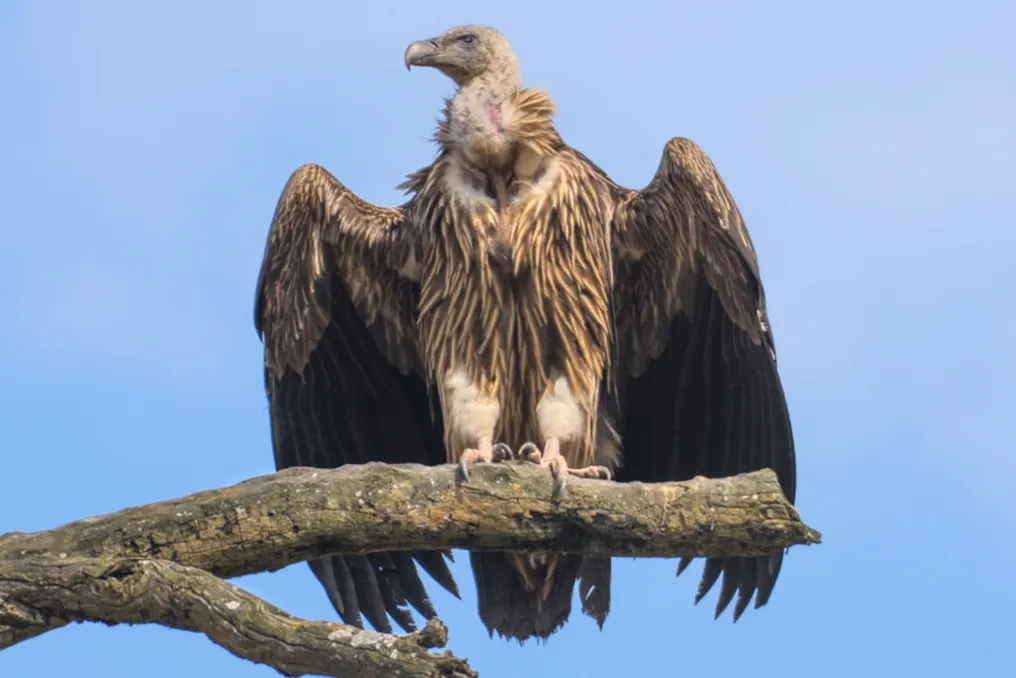
In the village of Chirgaon, located in the Raigad district of Maharashtra state, residents have consciously avoided loud music during wedding processions by banning the use of DJs and loudspeakers as early as 2002. Furthermore, restrictions have been introduced in the village on the use of firecrackers during festivals and other celebrations. The main goal of these measures was to ensure silence for vulture nests.
Thanks to these efforts, the vulture population has significantly increased. Two decades ago, only 22 individuals of two species—the white and long-billed vulture—were recorded in the village. However, according to the latest census in 2022, 347 vultures were recorded in the area.
The population recovery is not solely the result of the ban on DJs. It became possible due to the years of work by Prem Sagar Mestri, founder of the Society for the Conservation and Protection of Endangered Species (SEESCAP), as well as local bird enthusiasts and residents. They worked to protect the trees where birds nest, reduce anthropogenic impact near breeding sites, and provide food for the birds.
Authorities, including @maha_tourism MoS and @iAditiTatkare, initiated conservation measures for vultures in the Raigad district. With support from @MahaForest and SEESCAP, some projects are planned, and an area of 44 hectares in Chirgaon could be proposed as a 'vulture conservation reserve'. @AUThackeray is also mentioned.
When Mestri began studying the decline in vulture numbers in Chirgaon, he found that the problem fit into the context of a much larger collapse. The vulture population in India has sharply declined from millions of individuals registered in the 1980s. The reduction was particularly severe for the white, long-billed, and slender-billed vultures, with losses exceeding 90% in some species.
What is the relationship between DJs and vultures?
A partial answer lies in the science of noise pollution. A review published in the journal Frontiers in Ecology and Evolution in 2023 analyzed 48 peer-reviewed studies conducted between 1995 and 2021 concerning the impact of chronic anthropogenic noise on animal communities. In 38 of these studies, 79% of scientists identified at least one negative effect related to noise exposure. These effects included reduced abundance or species diversity, nesting problems, offspring survival, and hatching success.
Birds appeared in 38 of the 48 studied papers. Researchers described several mechanisms by which noise can affect wildlife. Sound can mask signals upon which animals depend, interfere with communication, distract them from other environmental information, and provoke reactions associated with a sense of danger. Repeated exposure can also cause physiological stress. An important point is that noise does not have to cause physical damage to affect an animal's survival; behavioral disruption can be sufficient.
If an adult bird has to leave the nest due to constant disturbance, the immediate consequence can be moving away from the egg or chick for a few minutes. However, frequent interruptions can reduce the frequency of nest visits and disrupt feeding, incubation, or protection of young, which negatively affects reproductive success over time. Researchers also warn that noise affects different species differently; its impact depends on the animal, the type of sound, its intensity, frequency, duration, and periodicity.
What happens when vultures hear humans?
Vultures are not fast-reproducing birds. A breeding pair usually raises one chick at a time, meaning that losing one nesting attempt can be significant for a small recovering population. In a study published in 2006 in the journal Biological Conservation, researchers Beatrice Arroyo and Martin Razin studied the impact of human activity around bearded vulture nests in the Pyrenees in France. They found that human activity affected bird behavior, mainly by reducing the time they spent near their nests. The reaction depended on the nature of the activity and its distance from the nest.
The most striking finding concerned very noisy activities. These activities were the most likely causes for vultures to leave their nests, and this effect was observed even when the activity occurred more than 1.5 km away. In comparison, pedestrians, cars, or airplanes usually affected behavior when within approximately 500–700 meters of the nest. The study also established a link between the frequency of human activity and reproductive failure: the probability of failure increased as the frequency of human activity increased, with particularly strong evidence relating to very noisy activities. Although this study does not concern Indian vultures and does not establish a specific noise limit for them, it demonstrates why disturbance during reproduction can be a problem for nature conservation.
Thus, Chirgaon lowered the volume
Mestri and SEESCAP, together with the then Sarpanch Kishore Gulghule and local residents, decided to protect the birds as a community decision. These restrictions were later supplemented by measures to reduce other types of disturbances, including firecrackers, intrusion of outsiders into sensitive nesting areas, and photography during the breeding season. The 43-hectare Chirgaon-Bagewadi Devrai area, where the birds nest, was also kept relatively free from unnecessary human activity. The goal was not to create a reserve completely isolated from people, but to minimize the types of disturbances that could render the breeding site unsuitable.