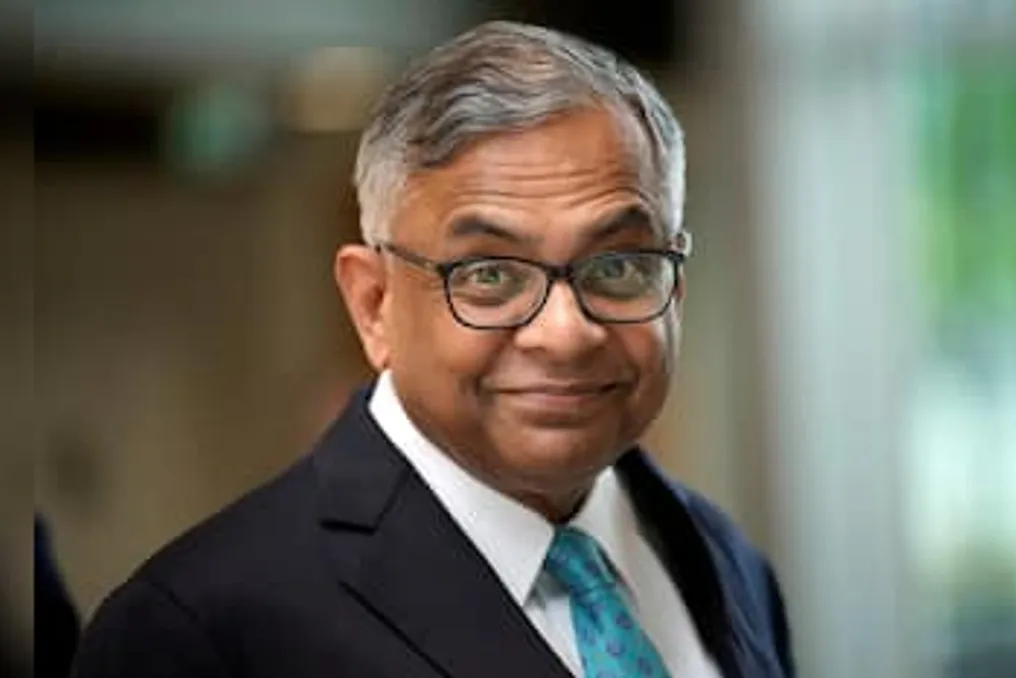
N Chandrasekaran speaks of India's strong economy, emphasizing energy security and jobs
Read more
Business Standard
business-standard.com

N Chandrasekaran speaks of India's strong economy, emphasizing energy security and jobs

N Chandrasekaran, who recently secured his third five-year term as chairman of the board of directors of Tata Sons amid intense boardroom battles, stated that the Indian economy is showing very positive results.

According to the Chairman of Tata Sons, the Indian economy is resilient and strong despite global uncertainty. He noted that energy security, jobs in advanced manufacturing, and investment in human capital are critically important for sustaining long-term growth.

He also emphasized that the Viksit Bharat 2047 concept has permeated all sectors of the country. Achieving this goal, in his view, will require inclusive and sustainable development based on world-class infrastructure, institutions, and intellectual property.

Chandrasekaran added that over the past years, the Indian economy has consistently exceeded expectations, demonstrating the highest growth amidst a complex global environment. This growth is driven by strong domestic demand, service exports, and a favorable policy environment created by the government.

He pointed to confident growth in sectors such as auto sales, lending, energy, and cement. Among the indicators confirming India's stability and strength, he cited the current account deficit, which has remained consistently below one percent of GDP, service exports around 11 percent of GDP, strong foreign exchange reserves, and a low level of bad bank loans.

To ensure long-term growth, Chandrasekaran stressed the need to prioritize energy security, jobs in high-precision and advanced manufacturing, and investments in human capital.

Citing the example of Toyota, he mentioned that the Japanese automotive giant never viewed quality merely as an end result but simultaneously focused on innovation and productivity. He stated that for Toyota, quality became a key driver of innovation, productivity, and competitiveness.

He also mentioned that countries like Germany have managed to transform by focusing on national competitive advantage through the lens of quality. Chandrasekaran believes that a similar transformation is necessary in India, whether in product design, standard setting, precision, or building the entire ecosystem of suppliers and small and medium-sized enterprises.

Furthermore, he strongly urged Indian manufacturers to adopt sustainable production processes alongside quality and other factors, asserting that this must 'be embedded in our entire manufacturing ambition.' He expressed hope that this process will foster strong leadership not only among large corporations but also within the SME ecosystem, and that experts will emerge to become multipliers of strength, assisting the country and becoming a global voice in shaping the future of global manufacturing.
Similar stories

S&P Global raises India's economic growth forecast to 7% for 2026-27
Read more
www.aajtak.in

S&P Global raises India's economic growth forecast to 7% for 2026-27

The confidence of major global agencies in the pace of India's economic growth continues to rise. The rating agency Standard & Poor's Global (S&P Global) has raised its forecast for India's growth, despite the complex global situation, high oil prices, and geopolitical tensions.

The agency increased the forecast for India's real GDP for the fiscal year 2026-27 from 6.6% to 7%. This increase came after economic indicators in the June quarter were better than expected. According to S&P, strong industrial activity, domestic consumption, goods exports, and government investments helped the economy, with consumption growth in India proving particularly resilient.

Investment activity in India also remains the strongest among leading economies in the Asia-Pacific region, allowing India to be considered one of the main growth drivers in the region.

Nevertheless, S&P warns of some future challenges. The agency forecasts a slight slowdown in growth rates in the second half of the current fiscal year. The additional momentum given to the economy through GST rationalization and income tax reduction is gradually weakening. Furthermore, weather will play an important role; up to September 9, the total rainfall in the country was about 15% below normal, which could significantly affect agriculture and rural consumer demand.

S&P forecasts that average consumer inflation in India in the current fiscal year will be around 5.1%. Consequently, attention will be paid to inflation and food prices. The agency expects the Reserve Bank of India (RBI) may raise its policy rate by 25 basis points during the current fiscal year. Thus, despite strong growth, there is pressure from the need to tighten policy due to rising inflation.

The most serious external challenges for India are the cost of crude oil and the dynamics of the rupee. If oil prices remain high amid Middle East conflicts, this could affect import bills, inflation, and the Indian rupee exchange rate. India imports over 80% of its required fuel. According to S&P, by mid-September, the Indian rupee had weakened by more than 5% against the US dollar. Despite this external pressure, the resilience of domestic consumption and investment remains, making the domestic economy India's main strength.

The rating agency adjusted the forecast for India's real GDP for 2026 by 0.4 percentage points, while the forecast for 2027 remained unchanged. According to S&P estimates, the next three fiscal years may look like this: 2025 – 7.8%; 2026 – 7.0%; 2027 – 7.2%; 2028 – 7.0%; 2029 – 6.8%.

India surpasses China and Japan in GDP growth rates according to S&P forecasts. China is projected to grow at 5.0% in 2025, 4.3% in 2026, 4.3% in 2027, 4.4% in 2028, and 4.2% in 2029. Forecasts for Japan are 1.2% in 2025, 0.8% in 2026, 0.9% in 2027, 0.9% in 2028, and 0.7% in 2029. South Korea is projected to show figures of 1.1%, 3.5%, 2.7%, 2.4%, and 1.9%. Although Taiwan's forecast for 2026 is 10.9%, higher than India's, this is attributed to strong activity in technology and artificial intelligence.

S&P is not the only one positive about India's growth. On September 18, Moody's Ratings also raised India's GDP forecast for the fiscal year 2026-27 from 6% to 7%. The agency attributed this to strong private consumption, investment, public infrastructure spending, and the strengthening of the services sector. Thus, there has recently been an improvement in growth forecasts for India from global rating agencies.

India's strong growth means that the foundation of demand and investment in the domestic economy currently remains solid. However, another side of the coin is important for investors: the inflation forecast of 5.1%, a possible 25 basis point rate hike, expensive oil prices, pressure on the rupee, and the risk of growth slowdown in the second half of the year cannot be ignored. In the coming months, key indicators for India's growth rate will be agricultural production, food inflation, crude oil prices, and the next RBI decision.

Popular