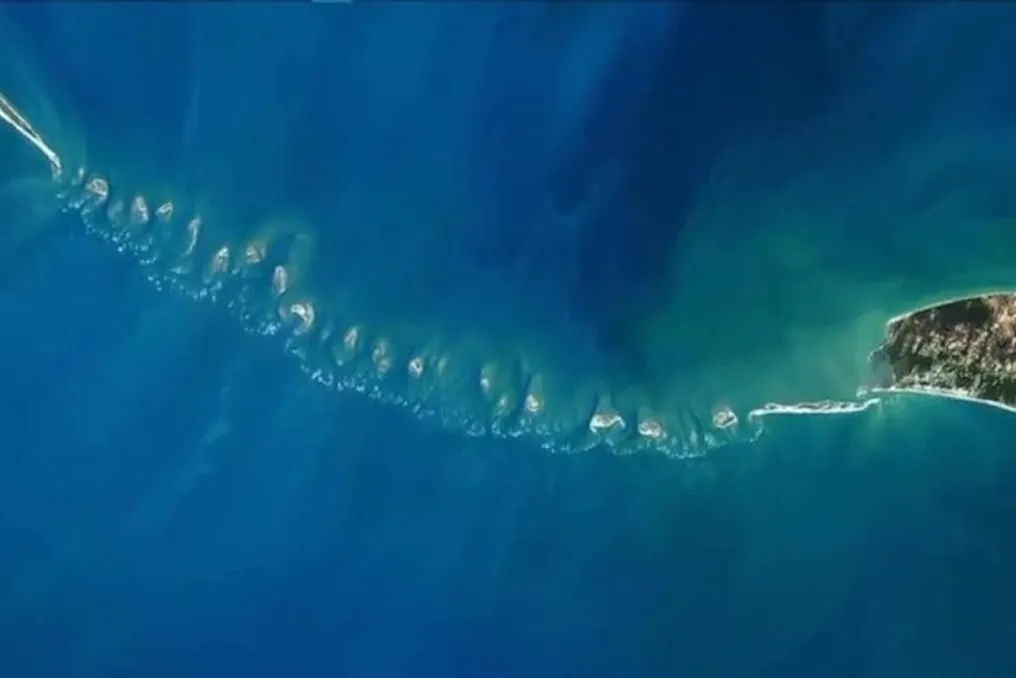
A long chain of rocks and stones lies in the sea between Rameshwaram in India and Mannar Island in Sri Lanka. Millennia-old religious traditions refer to this place as Ramsetu, while modern geography identifies it as Adam's Bridge.
There is a belief that during Lord Rama's journey with an army of monkeys to bring Mother Sita back from Lanka, they built this sea route. However, science views this object differently: is it a man-made bridge or a unique structure formed by natural marine processes?
NASA images also became central to the debate, sparking widespread discussion globally and nationally in 2007. An assertion circulated online claiming that NASA proved Ramsetu was built by humans. Nevertheless, it is necessary to clarify what NASA actually stated.
Mythological History of Ramsetu's Construction
According to Valmiki's Ramayana, when Lord Rama headed towards Lanka to rescue Mother Sita from Ravana's captivity, his army reached the seashore. Since crossing the vast ocean was critically necessary, the construction of a bridge began. According to legend, there was a skilled commander in the monkey army named Nal, who is considered the son of Vishwakarma and a master builder. Under Nal's leadership, the army began erecting the bridge using large stones, rocks, and trees brought into the sea to create a passage. The Ramayana also describes the miraculous speed of this construction; according to some details, it was completed in just five days, transforming the history of Ramsetu from simple construction into a narrative connected with faith and miracle.
The Legend of Floating Stones
One of the most well-known beliefs associated with Ramsetu is that Lord Rama's army inscribed the name 'Ram' on the stones before throwing them into the sea. It is said that these stones did not sink but remained floating. However, it is important to understand that the story of stones inscribed with the name 'Ram' belongs to religious and folk traditions and cannot be presented as modern scientific proof. Furthermore, there are discrepancies in the accounts of Ramsetu across various versions of the Ramayana and subsequent folk tales, making it appropriate to consider religious beliefs and original source descriptions in different contexts.
The Story of the Squirrel in Ramsetu
Another popular legend associated with Ramsetu involves a small squirrel. As the monkey army constructed the bridge from huge stones and rocks, a small squirrel also participated in the work. It ran on the sand near the sea, then approached the bridge and shook off sand with its body. The monkeys considered its efforts insignificant and amusing, but Lord Rama understood its intention. According to folk beliefs, Lord Rama gently stroked the squirrel's back, causing three stripes to appear on it, which are still associated with the squirrel's appearance. This story conveys a beautiful message that the value of a contribution is determined not by its size, but by its sincerity.
What Is This Structure in the Sea?
Now let us examine the area where religion and science are in direct contradiction. Between Rameshwaram in India and Mannar in Sri Lanka, a chain of shallow structures made of sand and limestone is visible. In the international scientific and geographical context, this is called Adam's Bridge. In NASA images, this structure is described as a chain of limestone shoals approximately 48 kilometers long. NASA materials indicate a disputed geological origin for this structure, meaning the structure itself exists and is clearly visible in satellite imagery.
However, the main question remains open: who built it? A major misconception arose regarding the claim that NASA proved Ramsetu was created by humans. Around 2007, satellite images of Ramsetu rapidly spread online. Along with these images, it was asserted that NASA itself confirmed that this structure between India and Sri Lanka is a man-made bridge. But no single satellite image can prove that any structure was created by humans.
A satellite image can show the landscape, but based on one image, one cannot determine the age of the structure, who built it, or whether it is entirely natural or shows signs of human intervention. Therefore, the statement 'NASA proved that Ramsetu is man-made' is incorrect. NASA's own publications also register this structure as Adam's Bridge and note the controversy surrounding its geological origin.